







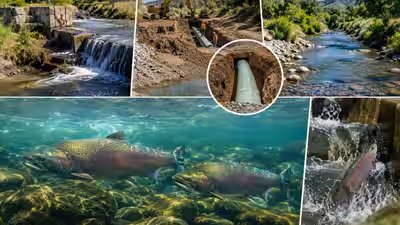
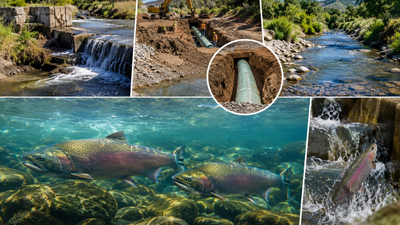
A barrier that had blocked migratory fish for decades disappeared in California in 2025, and salmon soon followed the newly opened route. Crews relocated a Pacific Gas & Electric (PG&E) natural-gas pipeline and buried the new section about 20 feet below Alameda Creek near Sunol, then removed the concrete structure that had created an 8-foot drop in the creek. The work reopened more than 20 miles of upstream habitat, and that same week, biologists spotted two Chinook salmon beyond the former barrier, marking the first documented access to this part of the watershed since the 1950s, according to NOAA Fisheries, which reported on the decades-long restoration effort.
The barrier that blocked the creek
The pipeline itself was not simply sitting across the creek. It was protected by a concrete erosion-control mat that protruded into the stream channel. That structure created a steep drop that made passage difficult or impossible for migratory fish during most stream flows. The solution was to move the pipeline approximately 100 feet downstream and lower it beneath the creek bed. According to NOAA Fisheries, crews dug a trench about 20 feet deep, installed the new pipeline, removed the old section and its concrete covering, and then reshaped roughly 1,800 feet of the stream channel. The new channel was graded to provide a gradual, more natural passage rather than the previous 8-foot drop.California Trout, which partnered with PG&E on the project, says the pipeline was ultimately lowered approximately 18 feet beneath the creek bed. The difference in the reported depth reflects the descriptions used by the project partners, while the central change remained the same: the pipeline was moved underground deeply enough that the concrete barrier was no longer necessary. NOAA Fisheries provided $4.3 million through its Office of Habitat Conservation for the project. PG&E, Oliver de Silva and a Bay Area foundation contributed additional funding.
A 28-year restoration effort
The pipeline project was not an isolated construction job. It was the latest step in a restoration campaign that began in the late 1990s. In 1997, environmentalist Jeff Miller began investigating whether steelhead could be restored to Alameda Creek. He subsequently founded the Alameda Creek Alliance and helped establish the Alameda Creek Fisheries Restoration Workgroup in 1999.At the time, a series of structures had fragmented the creek for migratory fish, including road culverts, water-control dams and other barriers. The last known steelhead sighting in the upper portion of the creek had been in 1967, according to NOAA Fisheries. Yet resident rainbow trout continued to survive in the upper watershed. Scientists later found that some of these fish retained genetic characteristics associated with migratory steelhead, providing another reason to pursue restoration.Over the following decades, agencies, conservation groups and community organisations worked on fish ladders, culvert replacements, dam modifications and other projects. NOAA says partners ultimately opened passage at 18 barriers along Alameda Creek. By 2023, the pipeline-related structure near Sunol was the final major obstacle on the creek’s mainstem.
More than 20 miles of habitat reopened
Removing the barrier matters because the upper Alameda Creek watershed contains habitat suitable for spawning and juvenile fish. According to NOAA Fisheries, the restored route gives steelhead access to spawning and juvenile-rearing habitat more than 20 miles upstream, including areas within the Sunol Regional Wilderness. The project also restored natural stream processes in the section where the barrier once stood.California’s Department of Fish and Wildlife similarly states that the project was designed to restore access to more than 20 miles of high-quality habitat for migratory fish, including Central California Coast steelhead, Chinook salmon and lamprey species. The restoration also included plans for native vegetation and long-term monitoring.
Salmon arrived almost immediately
The most remarkable development came in November 2025, when construction had just been completed. Biologists documented two Chinook salmon upstream of the former barrier. NOAA Fisheries identified them as a male and female, while California Trout reported that they were between 12 and 24 inches long. Based on the best available records, the sighting represented the first time salmon had voluntarily accessed this part of the watershed since the 1950s. Claire Buchanan, Central California regional director for California Trout, described the sighting as a sign that the fish were already reclaiming habitat that had been inaccessible for decades. Her comments were reported in California Trout’s project announcement following the completion of the work. The return of Chinook does not mean a self-sustaining salmon population has already been established. Scientists and restoration partners are continuing to monitor fish movement and habitat use.
Steelhead remain the bigger restoration goal
Although the Chinook sighting attracted attention, the broader restoration effort is closely tied to threatened Central California Coast steelhead. In February 2026, an Alameda County Water District employee photographed a male and female steelhead moving upstream through a fish ladder in the lower watershed. NOAA Fisheries said they were the first documented adult steelhead independently moving upstream past barriers in that lower section in decades.Scientists are also tracking juvenile rainbow trout moving downstream. Some have been fitted with tags that allow researchers to determine whether they are heading toward the ocean, a journey that could eventually lead to their return as adult steelhead. Restoration partners are monitoring fish, identifying additional priorities and planning projects involving the lower creek, its connection to San Francisco Bay and potential habitat improvements.For Alameda Creek, the buried pipeline therefore represents more than an infrastructure change. It marked the removal of the final major barrier in a nearly three-decade effort to reconnect a fragmented watershed. And within days of that barrier disappearing, salmon provided a striking indication of what the newly opened route could mean for the creek’s future.