








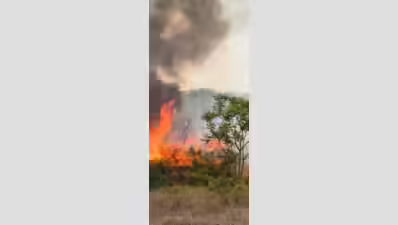
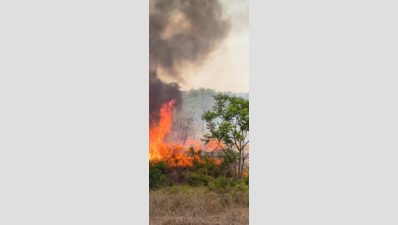
When the Nilgiris forests caught fire two weeks ago, Tamil Nadu’s forest department fought back with everything it had — drones, more than 400 field staff and an Indian Air Force Mi-17 V5 helicopter equipped with a Bambi bucket. But the actual firefighting, say officials, began in 2023 with the removal of ‘exotics’ that threatened to destroy forests.“We set in place efforts to remove exotics such as wattle, pine and eucalyptus trees that were introduced decades ago as part of plantations,” says Supriya Sahu, additional chief secretary, environment, climate change and forests. “These exotics have dried out in several parts of the forest and are highly combustible. What works instead to stop the spread of fires are shola patches, which retain moisture and act as natural barriers.” In the ongoing fire, 800 hectares of forest were destroyed. “The more resilient Shola patches remained unaffected,” says S Ramasubramaniam, chief project director, TN Biodiversity Conservation and Greening Project, who monitors forest fires.“Eliminating the exotic trees will alter the fire risk as there will be less biomass available for fuel, which is what we are doing,” says Sahu.The forest department has also planned a way forward with the establishment of a network of forest fire control centres, collaborations with nodal agencies and the development of forest fire management information systems. A state control and command centre in Chennai now provides real-time alerts using satellite imagery, supported by district-level control rooms to ensure faster, coordinated action. “Response time has improved and so has the time taken to douse fires,” says Sahu. In the past, when a forest fire occurred deep within the woods, forest officials would spring to action only after being alerted by locals. “They would see smoke and alert us. It would sometimes be hours before we knew there was a fire,” says an official. “We have observation towers in protected areas such as tiger reserves, but not all reserve forests have them. Thanks to satellite imagery technology, the district-level control room can be instantly notified by the Chennai centre.”Deep trenches are also being dug across forest ranges to prevent fires from jumping from patch to patch. “Earlier, we only had fire lines, but now fire trenches are being dug in areas where there is an accumulation of biomass at least two feet above the ground and one foot below the ground. Remote forest areas require these as they are more effective than fire lines. We are creating them in several patches,” says Sahu.The department also has 34 specialised firefighting vehicles, though use is limited by terrain. Drones are being used to map fire spread and guide teams into otherwise inaccessible areas. TN recorded 2,023 fire reports in 2024-2025 and 3,212 in 2025-2026. Despite not being among the states with the highest fire incidents, Tamil Nadu has seen a rise due to rising temperatures and erratic rainfall, with 108 LFF incidents reported by March 2025 and 120 by April.‘There is no such thing as a natural forest fire’“There is no such thing as a natural forest fire, except in rare cases like lightning,” says Srinivas R Reddy, head of the forest force. “Fires are typically triggered by accidental causes such as discarded cigarette butts or burning of farm debris, and in rare cases, electrical faults.” In the Nilgiris case, authorities suspect deliberate ignition, as fires broke out simultaneously in multiple interior locations. An inquiry is underway.“The sheer scale of the fire, occurring in so many different locations in the areas in Parson’s and Glenmorgan ranges, is alarming, especially since some of these locations have not experienced a fire in more than a decade,” says Reddy. “Although these areas are far removed from residential locations, we are currently conducting an inquiry to determine the cause of the fire.”