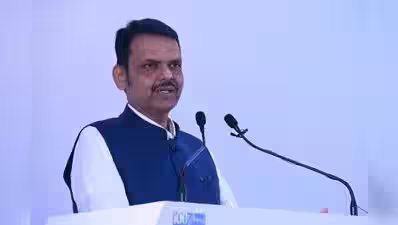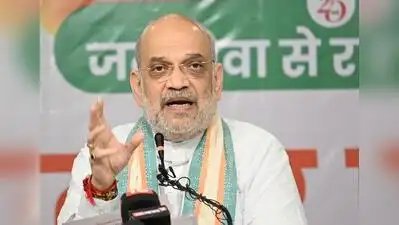









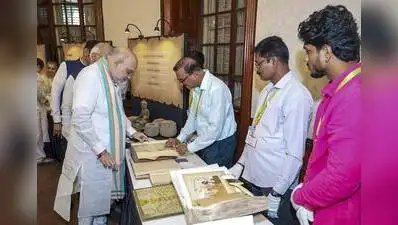
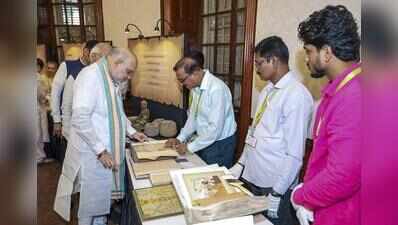
Mumbai: Decolonisation does not mean the erasure of history, Union home minister Amit Shah said on Sunday, asserting the need to free history from colonial-era fetters and rebutting allegations made against the PM Modi-led govt that it was trying to wipe out the past.Criticising the British Empire for instrumentalising Indology “in order to maintain and consolidate its power and to destroy the confidence” of the Indian people, Shah said the original purpose of Indology was neither enlightenment nor welfare. Distinguishing between German and British Indologists by specifically referring to the British colonisers, Shah said they used Indology to understand Indian systems so that they could rule over Indians for a long time. “Today, we are freeing knowledge from that grip to present the truth to the world,” he said.Shah’s comments came at a function at the Asiatic Society of Mumbai and could be seen as an unapologetic response to charges of “takeover of institutions” hurled at BJP and other ideological affiliates of the Sangh Parivar, especially so as the remarks came on an occasion at which he was invited to see the Society’s rare collections by its newly-installed committee said to be ideologically inclined towards BJP, with former party MP Vinay Sahasrabuddhe as president and two other former MPs as key office-bearers.“The process of decolonisation is a must. It means presenting history to people again with a complete, authentic, and Indian perspective,” Shah said, setting out the aims, as he sees them, of the Society’s new establishment.Shah made a distinction between an external power that “studies a civilisation” and “one that seeks to define a civilisation”. A study, if sincere, could even bring about a change in the thinking of such a power, he said. But India’s colonisers, he argued, had carried out their study for their own aims. “Indian knowledge wasn’t being written in India’s voice but in the colonial power’s language,” Shah said.On how the entire approach to Indology—which “emerged as a study of archaeology, history, epigraphy, literature, linguistics, grammar, Darshan Shastra, Dharma Shastra, among other subjects”—was abused, he said, “When a people’s self-confidence is shattered, they do not offer resistance against this state of slavery for a long time. India’s treasure of knowledge had deliberately been defined to ensure such an outcome.”India’s knowledge tradition, which has at its core the well-being of the universe, had survived despite repeated attempts to destroy it, Shah said. Citing Nalanda’s example, he said, “One can burn the library of Nalanda, but the knowledge that resides in people’s minds as Smruti (memory) and Shruti (oral traditions of texts), no one can destroy.”“Today, the country has become independent. More than 80 years have passed. Now, the govt has also changed, so has the Asiatic Society’s committee. Now this treasure trove of knowledge, for long lying unused, will be used for welfare of the universe, country, and world. Such a path will certainly be paved,” he said, urging the Society to “preserve Indian knowledge systems, history, traditions, languages, manuscripts and archives” and take these across the country and the world.“The British tied up the idea of knowledge with power. Our task is to detach knowledge and power, so that power itself flows from knowledge and is structured around it,” Shah said.At a time when BJP is being accused of historical revisionism through an ideological lens, Shah said, “True knowledge is never held hostage by an ideology. Knowledge itself is an ideology. If you bind it in any way, you change the very meaning of knowledge. Knowledge should be free and uninhibited, and its declaration should also be free and uninhibited.”He urged that the collected works of P V Kane, author of the monumental five-volume study of The History of Dharmashastra, be brought out by the Society. He outlined a three-point strategy for the Society: to seek and invite scholars wanting to take a deep dive into its collections; to digitise its entire collection and share it with societies and libraries across India; and to build a unified platform for all such institutions under its aegis.Shah was accompanied by CM Devendra Fadnavis, deputy CM Eknath Shinde and state education minister Chandrakant Patil.