










CHANDIGARH: A day after the Centre notified the appointment of Justice Ashwani Kumar Mishra as Chief Justice of Punjab and Haryana high court, the Punjab cabinet, headed by chief minister Bhagwant Mann, on Sunday passed a resolution against it, arguing that the Centre “hurriedly notified the appointment without waiting for state’s response.”Calling it an “assault on Punjab’s rights by central govt”, Mann posted on X: “Appointing the new Chief Justice of Punjab and Haryana high court without obtaining the consent of state govt is a direct violation of the prescribed procedures (Memorandum of Procedure) and constitutional norms.”State govt will not tolerate such “direct interference in judicial appointments”, Punjab CM said, adding: “We demand that this appointment be immediately put on hold and that, in accordance with the constitutional process, the views of the state be accorded due respect. Inquilab Zindabad.”
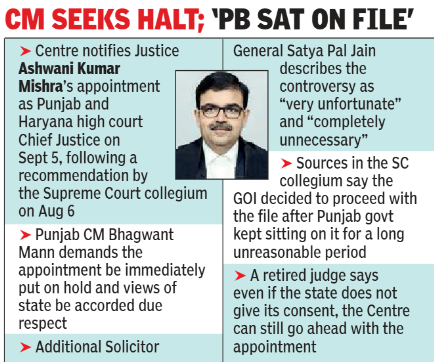
CM Mann also wrote letters to President Droupadi Murmu and Prime Minister Narendra Modi on the issue.Mishra, who is the acting Chief Justice, is the only one of the eight CJs to have been elevated from within the same high court. Among his important verdicts in recent times was the Aug 3 order from a division bench comprising him and Justice Rohit Kapoor to Punjab govt to pay pending DA to employees within 15 days. AAP-led Punjab govt has since moved Supreme Court against the order.“Convention has been that the Centre consults state govt concerned on the appointment of the Chief Justice of HC. This was followed in this case and Punjab govt was duly requested by GOI to give their opinion/input. They kept sitting on the file for a long unreasonable period. Hence, GOI rightly decided to proceed with the file,” sources in the collegium said when approached by TOI.Additional Solicitor General Satya Pal Jain on Sunday described the controversy as “very unfortunate” and “completely unnecessary”, asserting that all procedures were followed.At least two retired high court judges and as many former advocate generals TOI spoke with said that the HC Chief Justice’s appointment was the domain of the SC collegium and the Centre, and that the state had little say in it even if it objects to the appointment.
No clear time limit: Pb; unnecessary interference by state, says ex-judge
Additional Solicitor General Satya Pal Jain on Sunday described the controversy as “very unfortunate” and “completely unnecessary”. “There is a fixed procedure for appointment of judges, known as the Memorandum of Procedure (MoP), and the entire process was followed before Justice Mishra’s appointment,” he said, adding that the views of all state govts concerned were sought after the Supreme Court Collegium recommended the names of eight Chief Justices. Except for Punjab, all others submitted their views within a week, and the appointments were completed on time, Jain said.“Punjab and Haryana govts were informed about the proposal and their views were sought on Aug 10, 2026. The Governors of both Punjab and Haryana approved the proposal, and Haryana govt also submitted its views in favour of the proposal on Aug 12 and 13. Punjab govt had sufficient time to submit its opinion but it hasn’t,” Jain said in a press statement.A former AG said the matter is sent to govt “only for consultation” and it was “not binding on the Centre to take a decision based on what the state says.” The other ex-AG said the President was the constitutional authority for this, and wondered if govt was mistaking ‘concurrence’ for ‘consultation’.A retired judge said, “As per the Constitution, the state has no right in this matter. Centre can ask the state for convenience, but even if the state does not give its consent, the Centre can still go ahead with the appointment. The Memorandum of Procedure says that if state govt does not give consent in a time-bound manner, consent is deemed to be given.”The AAP-led govt thinks otherwise. A statement by the CM’s office stated, “This appointment has been made without obtaining the consent of state govt thereby bypassing all Constitutional norms and set procedures.”As per the CMO, the cabinet took note of para 6 of the MoP that says after receipt of the recommendation of Chief Justice of India, the Union minister of law would obtain state govt’s views, and only then submit the proposal to the Prime Minister, who will then advise the President on the selection.The cabinet pointed out that “no clear time limit” was prescribed for the state and governor to send their recommendation, the CMO said.The CMO note said it was on Aug 12 that state govt received the letter from Union law minister Arjun Ram Meghwal on the collegium’s recommendation, and for Punjab’s consent as per para 6 of MoP. As per the CMO, the cabinet pointed out, “However, in complete disregard to the Memorandum of Procedures and Constitutional norms, Union govt has hurriedly notified the appointment of the Chief Justice of Punjab and Haryana high court without waiting for state govt’s response.”It mentioned a reply of Meghwal in Lok Sabha that appointment of judges “requires consultation and approval from various constitutional authorities, both at the state and central level”.Justice Jora Singh (retd) said, “If Punjab govt keeps on sitting on file for two years, will that mean that Chief Justice will not be appointed?” He added, “Tomorrow, he will take oath. What will they do? This is unnecessary interference. If state govt does not agree with the decision on the appointment of (Justice Mishra as) Chief Justice, it has the right to appeal. They cannot just say that appointment should not be made. This is not wise on the part of state govt. It should do its work and let the judiciary do its own, as per the Constitution.” Terming the stance taken by the state govt as “akin to creating tussle”, he added, “If there is no coordination between the executive and the judiciary, it would lead to a constitutional crisis.”