









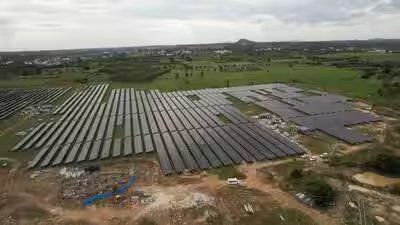
Devanahalli: What was once seen as a sign of Bengaluru’s water distress is now emerging as an unlikely answer to Karnataka’s power crunch. With land around Bengaluru becoming prohibitively expensive for setting up new power projects, Bescom has turned its attention to dry lakebeds.Caught in a pincer between Bengaluru’s soaring demand for uninterrupted power and the constant pressure to ensure seven hours of quality electricity supply to irrigation pump sets (IP sets), Bescom has, over the past two years, transformed around 310 acres of portions of lakebeds in Bengaluru Rural that remain dry even when the lakes are filled to their normal storage levels into sprawling solar fields. Together, these installations generate 95MW of power, turning otherwise unproductive stretches of lakebeds into valuable sources of clean energy.The move could also help the state save several crores of rupees in land-acquisition costs. Setting up new generation facilities close to Bengaluru requires huge investments, as land prices in and around the city range from Rs 5 crore to Rs 7 crore an acre. Acquiring hundreds of acres for solar projects would therefore entail a massive financial burden on the state exchequer. Instead, Bescom has demonstrated the novel model of using land that is already available but remains largely unutilised.The utility has developed the solar parks under the Centre-assisted Pradhan Mantri Kisan Urja Suraksha evam Utthaan Mahabhiyan (PM-Kusum-C) scheme. They collectively supply quality power throughout the day to nearby farmers who would otherwise have relied on the main grid, exerting pressure on the already strained state grid.“The experiment offers a three-fold advantage — it allows us to generate more solar power without incurring the prohibitive cost of land acquisition, ensures farmers get quality power during the daytime and thereby protects them from risks such as wildlife attacks and snake bites while irrigating their fields at night, and reduces the pressure on the conventional grid,” said N Shiva Shankara, Bescom managing director.Centre may replicate Karnataka model: GeorgeEnergy minister KJ George said the model has been appreciated by the Centre. “We collaborated with the minor irrigation department, which owns these lakes. There has been no damage to the lakebeds as the panels are mounted on removable frames. The projects also cause zero pollution, as certified by the Karnataka Tank Conservation and Development Authority. All cables connecting the solar panels have been insulated to ensure utmost safety. Since this was done for the first time in India, a central team from the ministry of new and renewable energy (MNRE) recently visited these lakes and decided to replicate the model in other parts of the country,” George said.TOI visited Uganavadi lake near Kundana in Bengaluru Rural district, located 10km from Kempegowda International Airport (KIA), where the project has been executed by Hyderabad-based Megha Engineering and Infrastructure Limited (MEIL).“The lakebed has been leased to the company for 25 years at an annual cost of Rs 25,000, with the amount subject to a 5% revision every year. The lease amount will be paid to the minor irrigation department by the project executor. Throughout the project period, the company will sell power to Bescom’s feeder at a KERC-approved tariff of Rs 2.75-3 per unit. Compared with the energy exchange price of Rs 6-7 per unit, this will be significantly cheaper, while ensuring a stable supply for the next 25 years,” Shiva Shankara explained.Alongside Uganavadi-Kundana lake, Bescom has created similar solar parks in a total of 10 lakes, covering more than 300 acres and generating about 95MW of solar power every day for the next 25 years.