





MUMBAI: “Mala jevayla jayche aahe” (I need to eat), “mala lagvi la jayche aahe” (I need to use the restroom), “mala ghari jaychay” (I need to go home).These are among the first Marathi sentences that some auto and cab drivers are memorising these days.Alongside them are more practical phrases: “mala gas bharaychay” (I need to refill CNG) and “mala riksha durust karaychi aahe” (I need to repair the auto).For drivers who did not grow up speaking Marathi, these are not classroom exercises. They are phrases being picked up between trips, at RTO classes, from fellow drivers and sometimes from handwritten notes kept inside their vehicles.“Chhutte nahi hain” is written alongside “Sutte nahit”.“Rasta bataiye” becomes “Rasta sanga”.“Kahan utaroge” becomes “Kuthe utarnar”.“Traffic hai” becomes “Traffic aahe”.It is not a language textbook.It is a driver trying to turn a regulatory requirement into something usable between one passenger and the next.
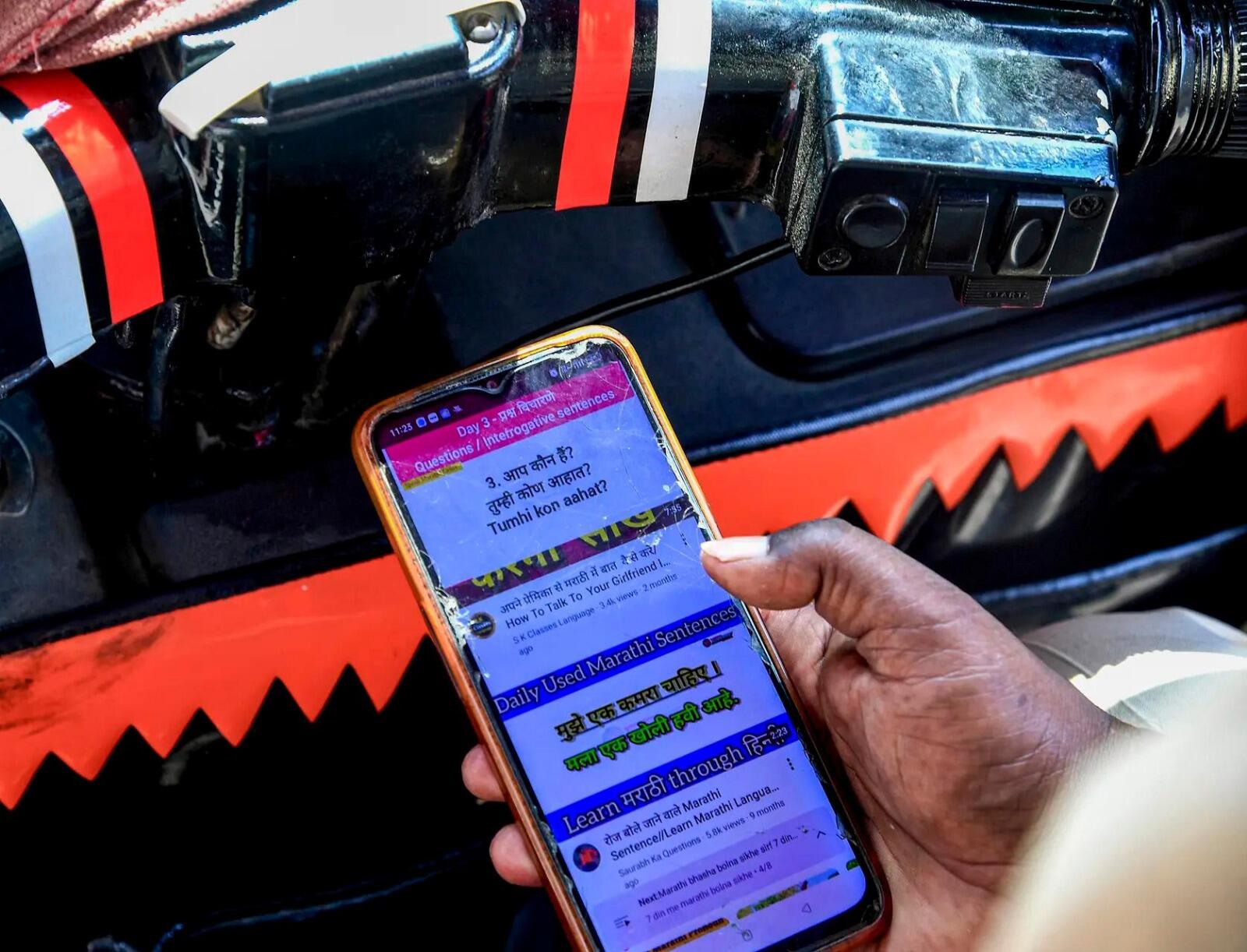
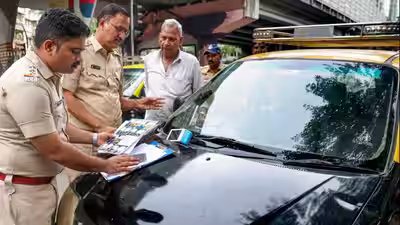
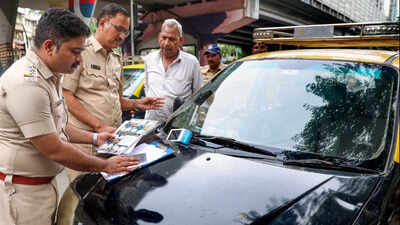
Auto driver watches YouTube to learn Marathi amid mandatory test rule (Photo credit: PTI)
The reason is simple: Marathi has now become part of the job.For Bablu, an auto-rickshaw driver from Uttar Pradesh who has spent two decades in Maharashtra, Marathi is not an entirely unfamiliar language. He knows enough to hold conversations with passengers and get through his daily work.“We don’t have a problem with learning Marathi. We have been living in Mumbai for so many years and understand some of it too. But suddenly testing us and talking about cancelling our badges is unfair. We drive from morning till night and have to run our homes. Now that the government has given us a year, that’s fine, we will learn it by then. They just shouldn’t harass us in the name of checking,” Bablu said.What initially appeared to be a requirement to know enough of the local language for routine passenger interactions soon became a source of anxiety for thousands of drivers when RTOs began checking their proficiency.For drivers, the question was no longer just how to say a few sentences in Marathi. It was what could happen if they could not.A show-cause notice could follow a failed check, with suspension and eventually cancellation of the driving authorisation or badge possible for continued non-compliance.That is where the language requirement began to collide with livelihoods.
A few sentences, and a lot at stake
The government’s position has been that drivers do not need to become fluent in Marathi.They need a working or practical knowledge, enough to communicate with passengers during everyday journeys.The training programme reflected that approach. Drivers were taught a limited set of conversational sentences intended for routine interactions rather than a broad examination of Marathi.For many drivers, however, even that basic requirement presented a challenge.Some of those affected are in their 50s and 60s and have little formal education. Others have spent years driving in Maharashtra without needing to speak the language regularly.One driver who participated in the protests put the difficulty bluntly:“We are 55-60-year-olds. We have never been to a school. How can we speak Marathi? Had we been educated, we would have been sitting in an office.”For others, the concern was financial.An auto driver from Mumbai’s eastern suburbs, who had bought his vehicle on loan, feared that losing his badge would leave him without an income while his EMIs continued. Another driver worried that roadside checks could leave individual enforcement officials deciding whether his Marathi was good enough.And that exposed the central tension in the rule.The government saw a basic communication requirement. Drivers saw a condition attached to the document that allowed them to earn.When the government announced the Marathi mandate in April, transport minister Pratap Sarnaik said a “working knowledge” of Marathi had long been part of the licensing framework for auto-rickshaw and taxi drivers.
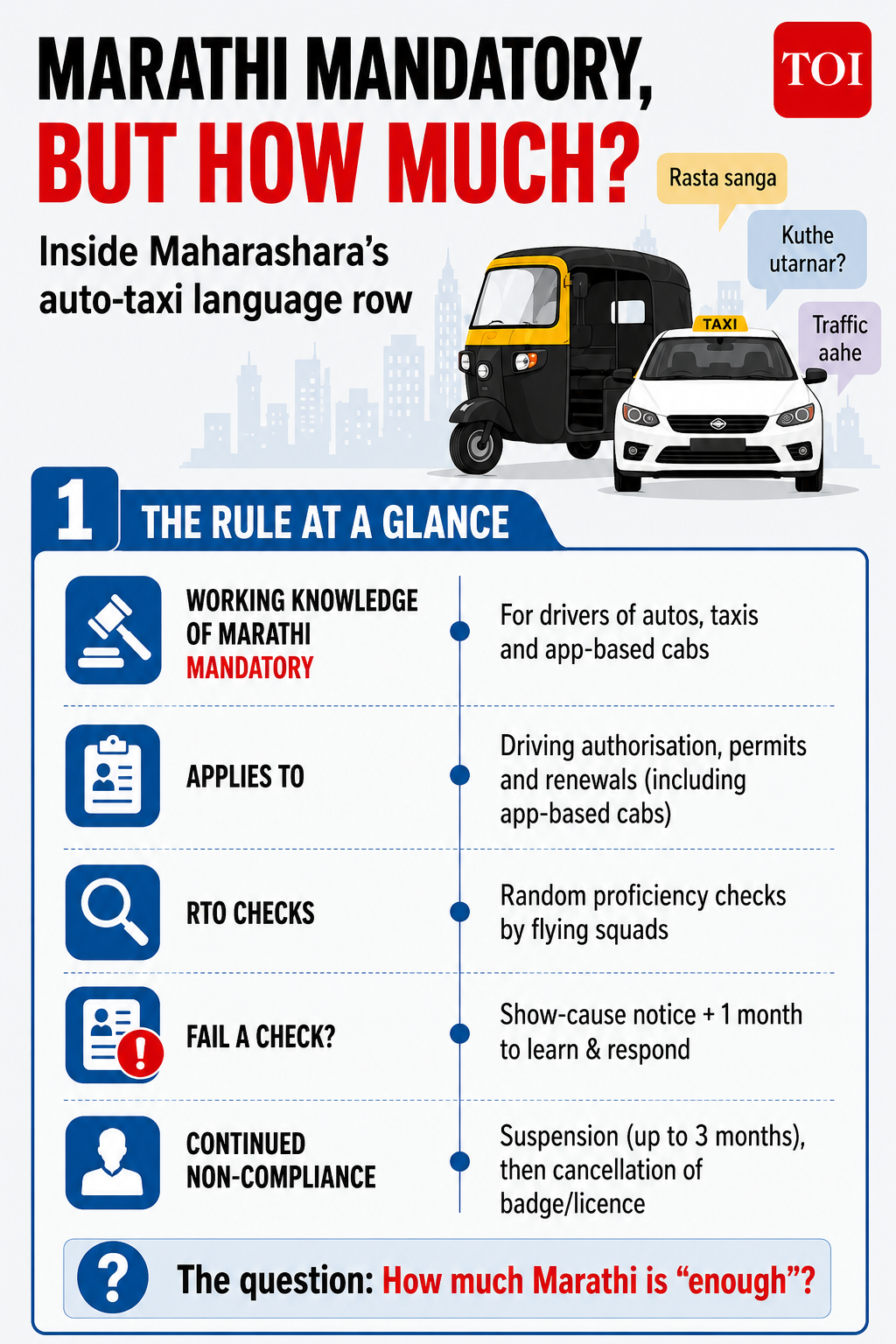
What Maharashtra’s new Marathi requirement means for commercial drivers
What changed was the decision to enforce it more strictly.Shraddha Kausadikar, a resident of Kalyan, said, “We live in Mumbai, a city of dreams that refuses to sleep even at night. People come here for all sorts of reasons, tourism, livelihood, opportunities, etc. No one will force anyone to speak only one language, but if you’re doing business or earning in a state and don’t even know the basic phrases of that language, then it is a problem. Learn at least enough to communicate; it will be beneficial for everyone. The government is trying to do just that, and I feel it is a very necessary decision.”The state initially set August 15 as the deadline, while arranging Marathi classes to help non-Marathi-speaking drivers comply.Driver unions objected to what they saw as an expansion of the existing requirement.Mumbai Rickshawmen’s Union leader Thampy Kurien said “working knowledge” should mean the basic Marathi required to do the job, rather than fluency or a formal reading-and-writing test.DA Salian of the Mumbai Taxi Association also questioned the prospect of cancelling badges of drivers who had been working for years.The government, meanwhile, argued that complaints had come from passengers in the Mumbai Metropolitan Region, Chhatrapati Sambhajinagar and Nagpur about drivers being unable or unwilling to communicate in Marathi.
When Marathi moved from the classroom to the roadside
The Maharashtra Motor Vehicles (Amendment) Rules, 2026 gave the requirement a clearer legal framework.Working knowledge of Marathi was incorporated into provisions governing driving authorisation, permits and renewals, including for app-based cabs.Then came the enforcement mechanism.RTO flying squads were authorised to conduct random checks. A driver found lacking practical knowledge could receive a show-cause notice and be given a month to learn the language and respond.Continued non-compliance could result in suspension for up to three months and, eventually, cancellation of the badge or licence.By August, the government said the training drive had reached more than 1.65 lakh drivers.Certificates were issued through RTOs, and the state held a felicitation programme in Thane on August 17 for drivers who had completed the course.But the transition from training to testing revealed a gap between the policy on paper and what some drivers experienced on the road.On the first day of checks, 1,268 commercial passenger vehicle drivers were served show-cause notices. Another 1,499 were noticed the following day, and the number eventually crossed 4,000.App-based cab drivers were also brought into the checks, including a workforce with a large number of migrants from Uttar Pradesh, Bihar and Jharkhand.Some drivers said they had not even been able to complete the training because there were not enough centres.One driver said the classes had taught around 16 conversational Marathi sentences, but the road test did not ask what they had learnt.
And then there was the ‘no’ problem
There was an ironic twist to the language classes.At an RTO-run class in Kurla, one driver was found to have carefully noted down Marathi phrases he could use while interacting with passengers.Except many of the phrases were ways of refusing rides.“Mala jevayla jayche aahe.”“Mala ghari jaychay.”“Mala gas bharaychay.”“Mala riksha durust karaychi aahe.”The phrases were practical. But they also highlighted another longstanding problem in Mumbai’s auto-rickshaw ecosystem: ride refusals.
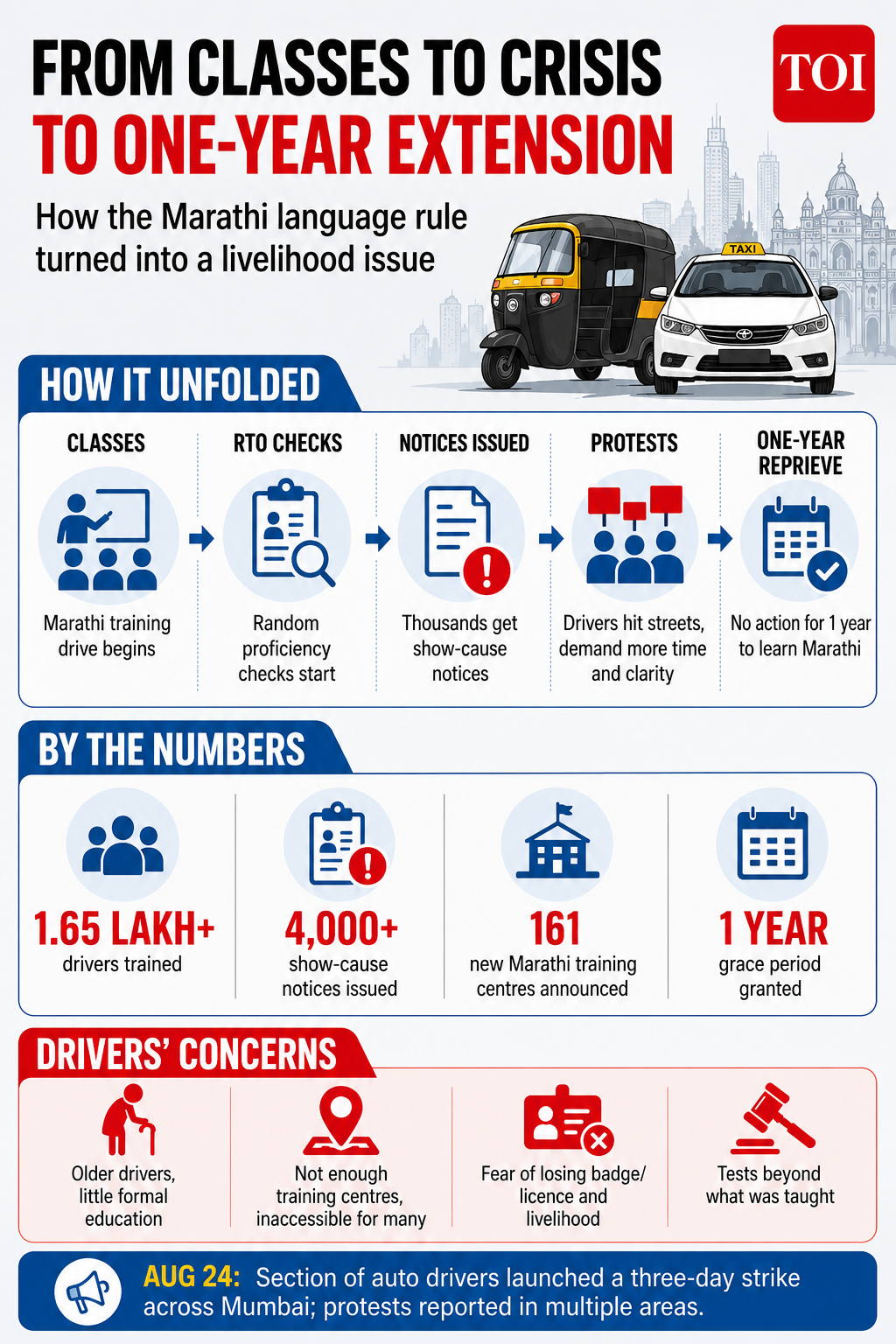
The road from RTO checks to protests and a one-year reprieve
TOI previously reported that ride refusals accounted for around 60% of passenger complaints in the suburbs.So while drivers were learning how to explain in Marathi why they could not take a passenger, commuters were still asking a more basic question: would the new language rule actually make service better?The answer was not immediately clear.By August 24, the dispute had moved from RTO offices to Mumbai’s streets.A section of autorickshaw drivers began a three-day strike, blocking roads in Kandivali during the morning rush. Protests were also reported in Malad, Santacruz, Dahisar and Andheri.Some protesters allegedly stopped other auto and taxi drivers, including app-based cab drivers, from carrying passengers. An autorickshaw driver was allegedly assaulted during one such confrontation in Kandivali West, leading to an FIR.For protesting drivers, the issue was increasingly about time and livelihood, rather than whether Marathi should be spoken.One driver asked how people earning their daily income could afford penalties of Rs 15,000-20,000.Another argued that drivers with 25-30 years of experience should not suddenly have to prove their ability to work through a language test.“Why suspend licences over language?” another asked, arguing that enforcement should instead focus on overcharging, meter tampering and ride refusals.A senior Borivali RTO official said misinformation had circulated that drivers would immediately be fined Rs 5,000 to Rs 20,000 for not knowing Marathi.
‘They don’t need to become experts’
Amid the protests, chief minister Devendra Fadnavis sought to clarify what the government actually expected.“There is no reason for our Hindi-speaking brothers who work as taxi or auto drivers here to become experts in Marathi. They only need to know enough Marathi to carry out their work,” he said.But reassurance alone did not resolve the practical problem.Drivers wanted more training centres and more time.The state responded by announcing 161 Marathi training centres across Mumbai, Thane, Navi Mumbai, Vasai-Virar, Nalasopara and Bhiwandi, along with an RTO helpline for complaints about harassment and irregularities during checks.Mumbai BJP labour cell leader Abhijit Rane backed non-Marathi drivers and alleged that some RTO officials were testing drivers beyond the prescribed syllabus.Political observers also saw the dispute through the prism of Maharashtra’s long-running Marathi identity politics.The Shiv Sena has sought to occupy the “Marathi manoos” space traditionally associated with Shiv Sena (UBT) and MNS, while the BJP has its own support base among migrant communities, including sections of the auto and taxi workforce.
Then came the one-year reprieve
The turning point came when Fadnavis met representatives of driver unions led by Haji Arfat Shaikh.The delegation argued that drivers came from different age groups and that many had left formal education decades ago. Learning a new language within the existing timeframe, they said, was unrealistic.The government agreed.Drivers would now get one year to acquire working knowledge of Marathi, and no action would be taken against them during this period for not possessing the required proficiency.
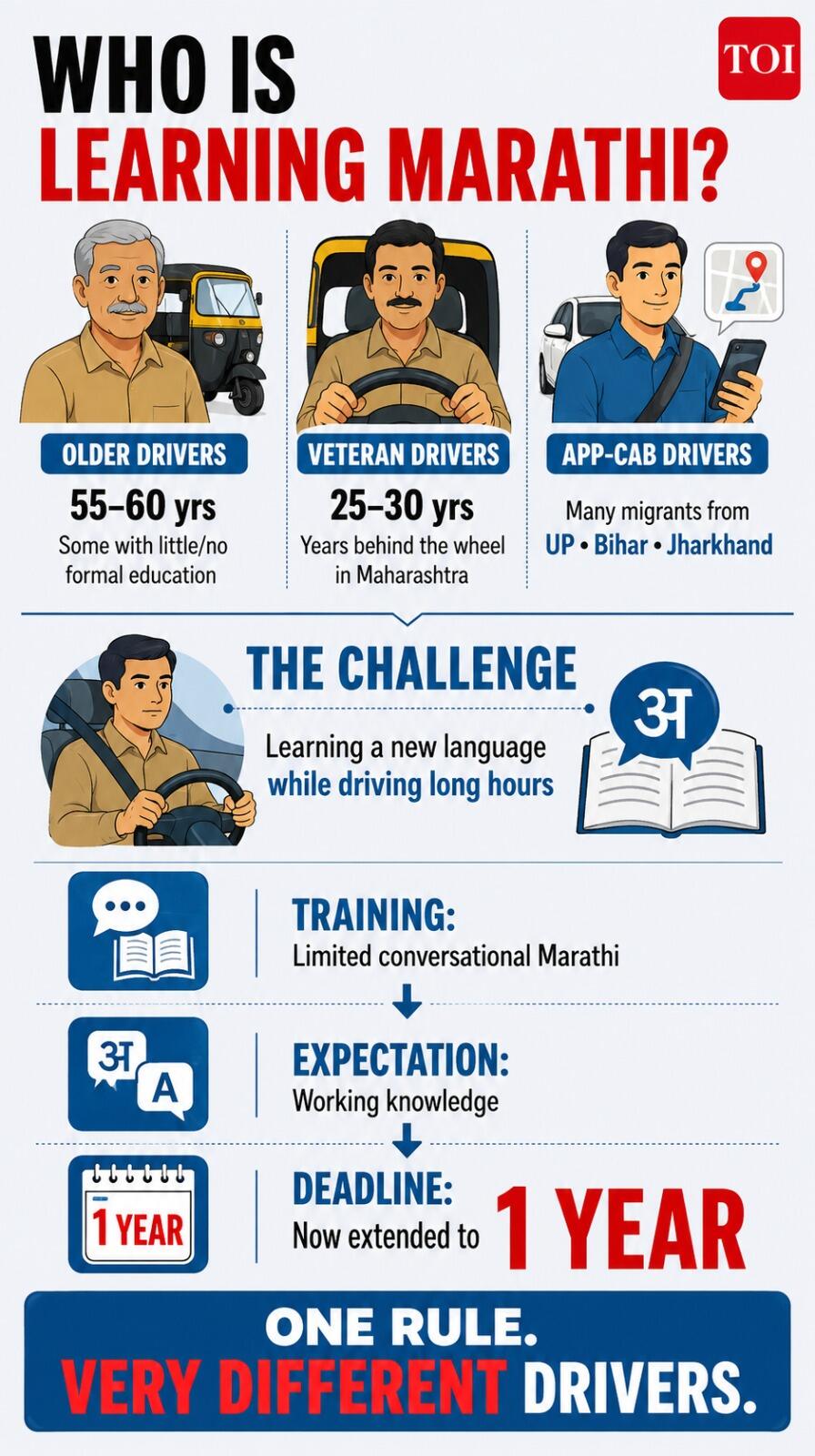
From veteran drivers to app-cab workers, who is learning Marathi?
The move also changed the legal position.Four cab drivers had approached the Bombay high court challenging the language requirement, arguing that the August 12 notification violated their fundamental rights under Articles 14, 19 and 21.They also questioned whether the Motor Vehicles Act empowered the state to prescribe a language qualification for a driving licence or badge.The petition said the rule could affect nearly 9.65 lakh drivers across Maharashtra.After the state informed the court about the one-year extension, the Bombay high court disposed of the petition.The requirement itself hadn’t gone away, only the deadline had moved.
So, what is ‘enough’ Marathi?
The government has consistently maintained that drivers do not need fluency. They need enough Marathi to handle routine interactions, greeting passengers, understanding destinations, discussing fares and communicating basic information.Drivers, meanwhile, have largely objected not to learning the language but to how quickly the requirement was introduced and how it was enforced.For an educated young driver, memorising a handful of sentences may be a manageable task.For a 55-year-old who left school decades ago, drives long hours and depends entirely on the vehicle for income, it can be very different.The government has now given one year before taking any action.However, the larger question is how the state enforces a language requirement on people who came to Maharashtra with the intention of earning a livelihood, and for whom Marathi may be a language as foreign as the state itself once was.And how, with this enforcement, will the government ensure that its push to promote Marathi in Maharashtra does not become a burden that threatens the livelihood it was never meant to touch.