











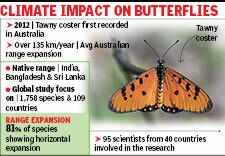
Kolkata: A familiar butterfly species across Bengal and much of the Indian subcontinent — the tawny coster — has emerged as a striking example of how butterfly ranges are changing in a warming world. It’s one among the 1,758 butterfly species from 109 countries whose examples were highlighted in a global study to show how butterflies worldwide are on the move after being hit by climate change.
Butterfly
First recorded in Australia in 2012, the species has since spread across the country at an average rate of about 135 km a year.Known as ‘Harinchhora’ in Bengali, the tawny coster (Acraea terpsicore) is native to India, Bangladesh and Sri Lanka. Its rapid Australian expansion is among the examples highlighted in the study examining how butterfly distributions are responding to climate and environmental change.The study, published in science journal Nature Ecology & Evolution, shows that roughly 80% (over 1,400) of recorded species have expanded their living ranges due to climate change. Besides climate, agriculture and urbanisation-driven deforestation, as well as the drainage of wetlands, were identified as major drivers of this migration. It involved 95 scientists from 40 countries.The research also has a Kolkata connection. Vijay Barve, a biodiversity informatics expert and research adviser to Kolkata-based Nature Mates-Nature Club, is one of the scientists involved in the study. Nature Mates, which is playing a key role in the Indian context by keeping long-term butterfly data, identifies Barve as its research adviser.The study, led by researchers at Monash University, including lead author Shawan Chowdhury, head of the Global Change Ecology Lab from the varsity’s School of Biological Sciences, found that 81% of species showing horizontal range expansion had extended their geographical ranges, while 27% studied experienced range contraction and 22% shifted in elevation.“The tawny coster’s movement is particularly notable as researchers describe its Australian expansion as one of the fastest documented geographical range expansions,” said butterfly expert Arjan Basu Roy of Nature Mates-Nature Club.Scientists caution that an expanding range does not automatically mean a species is thriving; the ecological consequences of such movements can vary considerably.The global picture also includes sharp contractions. The small blue (Cupido minimus) has lost about 40% of its UK habitat over the past 150 years. In Mexico, between 1988 and 2011, the painted lady (Vanessa cardui) shifted towards higher elevations at about 83 metres a year, while Danaus gilippus moved downhill at around 32 metres a year.“These movements underline the need for better monitoring, particularly in tropical regions where butterfly diversity is high but long-term data is limited,” added Basu Roy.