








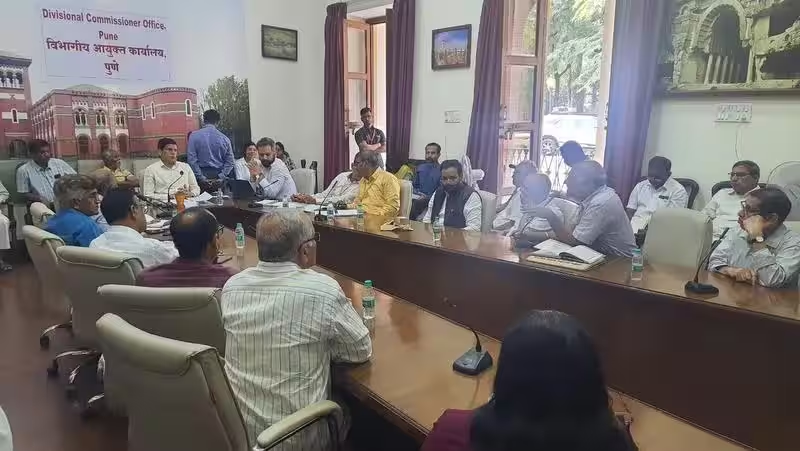
“You can’t manage what you can’t measure.”This was the basis behind a petition filed by city resident Pushkar Kulkarni in the National Green Tribunal (NGT) in 2025, against the backdrop of the increasingly apparent water crisis in Pune and Pimpri Chinchwad. His demand was propelled by the absence of concrete data on water availability, from which authorities could derive the extent of the problem at hand. Kulkarni’s petition demanded that the collector “conduct an immediate and comprehensive survey of all borewells, dug wells, and all water sources in Pune district, undertake assessment of groundwater contamination and identify the sources”. Why does the city not already have this data? Key residential areas like Wagholi, parts of Kharadi and Vimannagar, Prabhat Road and Bavdhan continue to struggle with a water crisis in the middle of the monsoon. Most societies in these areas rely on tankers amid missing or inefficient infrastructure. Other bustling neighbourhoods like Sangvi, parts of Deccan, Peth areas and pockets of Kothrud never seem to have enough supply, be it via civic body networks or by using groundwater. The crux of the problem also lies in the flow of information. Court-mandated meetings between city residents and civic authorities have failed to yield results. Many societies have had to follow up repeatedly with officials to get their issues resolved — but at least they managed to put their needs forth. Others are still relying on tankers, with officials completely unaware of their troubles. “We are flying blind,” said Kulkarni. “In meetings of housing societies and civic body representatives, the mismatch in demand and supply of water comes across clearly. Earlier, authorities wilfully did not calculate exact demand when peripheral areas were merged into Pune Municipal Corporation (PMC) limits. We are paying the price of this now,” he added. “The development plan (DP) followed for urban planning is old. No fresh assessment, study or survey has been done since the mergers to understand what infrastructure exists and what resources are available. Expansion is just going on unchecked. Does Pune have the means to match the volume of constructions currently under way? If there is scarcity now, how will civic bodies match demand from the growing population that will come to these new constructions?” the petitioner asked. ‘Water meetings’ mandate In Aug 2022, 11 housing society associations, organisations and NGOs came together to file a public interest litigation (PIL) in Bombay high court. They requested that civic bodies be directed to supply 135 litres per day per citizen to honour their responsibility. This group included the Balewadi Welfare Federation (BWF), Bavdhan Citizens Forum, Wagholi Housing Societies Association (WHSA), Aundh Vikas Mandal (AVM), Dear Society Welfare Association, Pune District Cooperative Housing Societies and Apartments Federation, Association of Nagar Road Citizens Forum (ANRCF), Akhil Bharatiya Grahak Panchayat (ABGP), Pimpri Chinchwad Cooperative Housing Societies Federation Ltd (PCCHSF), Baner Pashan Link Road Welfare (BPLRW) Trust and Hinjewadi Employees and Residents Trust (HEART). In an ensuing order in April 2023, HC directed the divisional commissioner to form a committee with PMC, Pimpri Chinchwad Municipal Corporations (PCMC) and Pune Metropolitan Region Development Authority (PMRDA) representatives. It would hear citizens’ grievances on water scarcity, with meetings advised to be held at least twice a month. This was not the first such direction from HC. A similar petition was filed in 2017, and HC at the time appointed a committee, also under the Pune divisional commissioner, for planning authorities to receive and resolve municipal water supply issues in a time-bound manner. However, this committee met only four times in 2017-2018, forcing the second PIL to be filed. Vijay Sagar, national executive member of ABGP, one of the petitioners, told TOI, “The city’s water issues won’t be resolved in the near future. We are already falling behind and constructions don’t seem to halt. The only way to begin bridging the demand-supply gap is to stop construction. The redevelopment spate is alarming and will continue to affect water supply for all. Multiple factors are disturbing water absorption and holding capacity. Civic bodies need to understand that just building is not development. More importantly, if authorities aren’t aware of issues plaguing residents, how do they even begin to resolve them?” Potential for solutions… The HC-mandated 2023 committee was meant to facilitate discussions and generate data on water supply, in a bid to find solutions for areas facing scarcity. At the meetings, authorities would also present their plan of action to maintain transparency. Water supply department heads and engineers present were advised to listen to society and association representatives, and an engineer would be assigned for further resolution and follow-up to speed things up. “For example, a 600-flat society in Bavdhan had no water supply from PMC for almost nine years. Today, their issue is on the way to being resolved after pending pipeline work. Unless societies come forward and attend meetings, we cannot hope for issues to be solved. More societies must come forward, so that civic bodies can be taken to task if they don’t follow through on their responsibility,” Sagar added. Balewadi is another example of how meetings could be helpful for localities. Representatives of BWF attended meetings and, on a short-term basis, the on-ground situation improved for residents. “The impact of meetings has been different across areas. We presented authorities with suggestions to be implemented in the short-, medium- and long-term after considering Balewadi’s current need and supply and future projections. There have been some changes on-ground. However, these are short-term measures. They tend to dwindle on and off,” said Yash Choudhary, joint secretary of BWF. “According to a study BWF privately conducted, Balewadi residents need 3.5MLD of water more now. Approximately 25,000 new flats will be delivered in the next one-and-a-half years and the demand arising from this has not been considered at the moment. Non-revenue water losses (leakages, etc.) for PMC should be around 20%, but are easily 35-40%. This is a lot. We are probably going to face a similar scarcity in the 2027 summer like this year. The situation must change,” added Choudhary. … Derailed by inconsistency Meetings have not been fruitful for all attendees. Sunil Koloti, a member of the Mohammadwadi-Undri Residents Welfare Development Foundation (MURWDF), said the meeting for Undri, Mohammadwadi, NIBM Annexe and Pisoli areas was nothing more than an eyewash. “We have been demanding a DP for Undri since Oct 2017 — that’s nine years now. Every time we raise it, we’re told it’s ‘under process’, but nothing happens on ground. We went for the meeting back then expecting some concrete outcome for Undri and Pisoli, but in vain. PMC is prompt in collecting property and water taxes. By our estimates, property tax from this area since Oct 2017 should be over Rs650 crore (collected and pending). Where has this money gone? Not a single rupee reflects in roads, drainage, or water infrastructure. Officials should stop holding meetings for optics and instead visit to assess the ground reality, and commit to a date for the DP,” Koloti said. It must be noted that following the Aug 2023 HC order, residents had to follow up with the divisional commissioner repeatedly. It was only in Dec that year, six months down the line, that the first water meeting was held. Advocate Satya Muley, who had approached HC on behalf of the petitioners, pointed out multiple issues with the water committee’s functioning. “The committee is supposed to meet once in two months, but this frequency is not maintained. Often, we have to issue a notice to have a meeting. The scheduling is erratic and meetings also get postponed at the last minute. Important decisions taken during meetings — such as filing of FIRs against builders who do not comply with water affidavits — are not implemented. Citizens now plan to continue attending meetings but alongside, file a contempt petition in HC against the committee, as results are not on par with expectations,” Muley said. “For instance, a Bavdhan society with several hundred flats approached the committee over water issues, but even after regular follow-up, PMC only provided one tanker — sometimes not even that. The society was forced to move HC. After court intervention, PMC started giving them eight tankers. That is also not enough, so they are now looking to move Supreme Court,” he added. Kulkarni pointed out, “At least PMC has attended meetings and conducted activities on ground to meet orders. It took a legal notice to get PCMC on board and PMRDA has not bothered at all. Solutions were not found for all grievances submitted, but at least there is some data of demands.” He explained, “A builder is legally bound to provide potable water to a project’s residents till the time the planning authority doesn’t provide the same through pipelines. PMC has now also published a list of all construction projects given approvals based on water affidavits or undertakings from builders, as directed by HC. Both PCMC and PMRDA responded after legal notices and have since started uploading relevant data.” Official Speak The kind of complaints we get, versus the ones received by PMC or PMRDA, are intrinsically different in nature. We were able to get issues of over 30-35 societies resolved, and many others are currently under way. For example, a society that had never complained before came forward during these meetings and we realised that they were getting less water because their pipe size was small, which can be fixed. The meetings have definitely helped get a better understanding of the issues on ground — Ajay Suryawanshi | Joint city engineer, PCMC The committee meetings have been extremely helpful to understand the nitty-gritties of the issues plaguing small pockets and different areas of the city. Pressure from these meetings was one of the reasons why we were able to fast-track the overhead water tankers in the Mohammadwadi area. We do have an idea of the demand for water based on population estimates and calculations, but the meetings help understand what the exact problem is and where — Nandkishor Jagtap | Chief engineer, water supply department, PMC Keeping the on-ground situation in mind. We have been giving building permissions only if we get water affidavits from developers. There has to be some source of water for residents, so either the builder provides it or gets a permission letter saying that the relevant civic body or gram panchayat has agreed to provide the supply — Shrikant Prabhune | Assistant director, town planning, PMRDA Expert Speak PMC and PCMC are giving rampant permissions for new projects without provision for water supply. PMRDA remains a mute spectator as if it is not responsible for anything, even going to the extent of saying water supply is not its domain, while ignoring the building permissions it is giving across Hinjewadi and Maan. Furthermore, thousands of old bungalows are undergoing redevelopment. Instead of 10 people in a bungalow, a few hundred residents will be accommodated in the same space. All this is increasing the strain on water sources. Metro has increased FSI, allowing for bigger buildings and much larger water demand. Groundwater extraction permissions are also given rampantly. Citizens and housing societies must come forth so that we can help file FIRs against builders — Satya Muley | Advocate, representing residents’ bodies in court for water PIL