











Hyderabad: Despite recruiting more than 10,000 nursing officers over the past two-and-a-half years, Telangana continues to face a major shortage of nurses, with its nursing workforce remaining 47% below the World Health Organisation (WHO) benchmark, according to data tabled in the Rajya Sabha by Union health minister JP Nadda.The data shows Telangana has 60,919 registered nurses and registered midwives (RN&RM). Against the state’s estimated 2026 population of nearly 3.9 crore, this works out to just 1.58 nurses per 1,000 people, far below the WHO recommendation of three nurses per 1,000 population and the national average of 2.45.
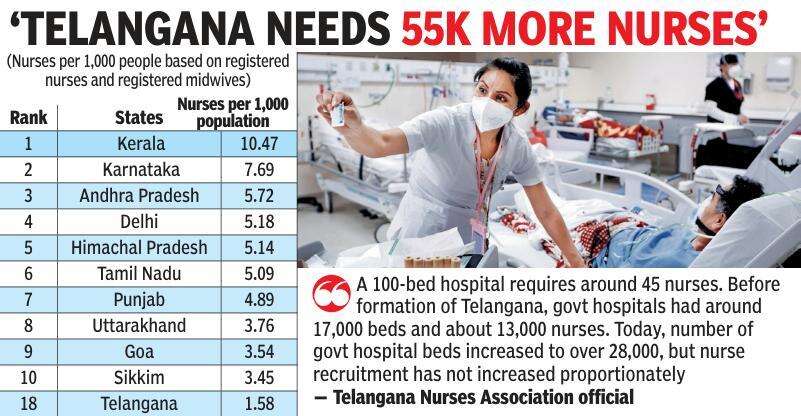
Among the larger states, Telangana performs better than Gujarat, Chhattisgarh, Haryana, Uttar Pradesh, Bihar and Jharkhand. However, it lags behind Maharashtra, Rajasthan, Madhya Pradesh and every other southern state. Kerala has the highest nurse-population ratio at 10.47, followed by Karnataka (7.69), Andhra Pradesh (5.72), Delhi (5.18) and Tamil Nadu (5.09). Health experts said the state’s recruitment drive has helped fill vacancies in govt hospitals, but it has not kept pace with the rapid expansion of healthcare facilities, including new government medical colleges, district hospitals and super-specialty services.Officials from the Telangana Nurses Association (TNA) said the shortage is especially visible in govt hospitals. “As per norms, a 100-bed hospital requires around 45 nurses. Before the formation of Telangana, govt hospitals had around 17,000 beds and about 13,000 nurses. Today, the number of govt hospital beds has increased to over 28,000, but nurse recruitment has not increased proportionately. The state still needs another 6,000 to 7,000 nurses in govt hospitals alone,” a TNA source said.Experts warned that a shortage of nurses directly affects patient care. “Nurses spend the most time with patients. When there are too few nurses, patient safety is affected, workloads increase and the quality of care suffers,” said Dr Kiran Madhala, Secretary General of the Telangana Teaching Government Doctors’ Association (TTGDA). He suggested that future recruitment must match the state’s growing healthcare infrastructure.“Every new medical college, ICU, dialysis unit and speciality ward needs trained nursing staff. The focus should now be on creating enough nursing capacity for the future, not just filling existing vacancies,” he added. Based on the WHO benchmark, Telangana would require around 1.16 lakh registered nurses and midwives for its current population, indicating a shortfall of nearly 55,000 personnel. Experts said sustained recruitment, expansion of nursing colleges, stronger faculty, and improved nurse retention will be essential for the state to bridge the gap.GFX: Nurses per 1,000 Population (RN & RM only)(Based on Registered Nurses & Registered Midwives and projected 2026 population)Rank States Nurses per 1,000 population1Kerala10.472Karnataka7.693Andhra Pradesh5.724Delhi5.185Himachal Pradesh5.146Tamil Nadu5.097Punjab4.898Uttarakhand3.769Goa3.5410Sikkim3.4511Mizoram3.4112Arunachal Pradesh3.2213Nagaland2.9414Maharashtra2.7615Rajasthan2.1916Madhya Pradesh2.0917Gujarat1.8618Telangana1.5819Chhattisgarh1.4720Haryana1.4621Tripura1.3722Meghalaya1.3523Odisha1.0924West Bengal1.0825Assam0.9726Uttar Pradesh0.9227Jammu & Kashmir*0.8828Bihar0.1529Jharkhand0.26