








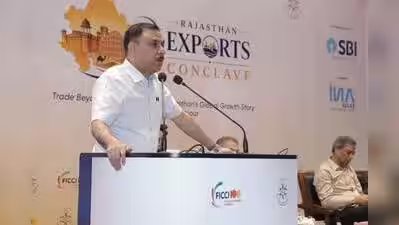
Jaipur: Rajasthan’s exports to Oman surged 156% to Rs 137.29 crore in June 2026, the first month after the India-Oman Free Trade Agreement (FTA) came into force, providing an early indication of the potential for the state’s exporters to tap the Gulf market. Exports to Oman had stood at Rs 53.67 crore in June 2025.Exports to the UAE have also been tracking strong growth, rising 281% from Rs 3,202 crore in 2021-22 to more than Rs 12,198 crore in 2025-26 after the India-UAE Comprehensive Economic Partnership Agreement (CEPA) came into force in May 2022. The momentum continued in June, with exports rising from Rs 1,290 crore in June 2025 to Rs 1,391 crore in June 2026, a year-on-year growth of about 8%.Speaking at a FICCI event on exports Tuesday, ACS (industries) Shikhar Agarwal said Rajasthan needed to examine which free trade agreements were delivering results for its industries and how exporters could make better use of the market access created by such agreements.“Some FTAs are working for us, while some are not. We need to understand why,” Agarwal said, stressing that exporters also needed to factor in non-tariff barriers, including certification, environmental requirements, quality standards and customs procedures.The UAE has emerged as an important market for Rajasthan’s traditional export sectors like gems and jewellery, textiles, handicrafts and natural stone, with Jaipur, Alwar, Bhilwara, Jodhpur, Udaipur and Kota making major contributions.Agarwal said the larger challenge was to move beyond exporting commodities and create greater value within the state. The state currently contributes around 6.3% to India’s economy, which he said should be raised to 6.5-7% through faster industrial growth, productivity and value addition.Dileep Baid, a leading exporter in the state, said that material losses during the production process, average defect rate and labour productivity are areas where the industry needs to be efficient. “Compared to India, Vietnam’s labour productivity is 60-80% higher and in China it is 3.5 times,” added Baid.