









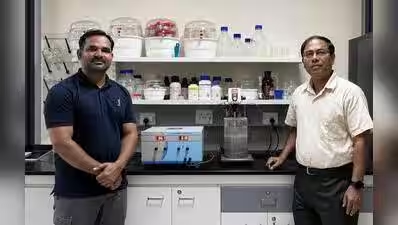
Guwahati: People in districts with arsenic and fluoride-contaminated groundwater can now access safer drinking water through a low-cost IIT-Guwahati technology.Researchers have developed a rotating-anode electrocoagulation (RA-EC) reactor that can remove up to 98.2% of arsenate and 91.8% fluoride from contaminated groundwater within minutes.The technology could be significant for Assam, where the Annual Groundwater Quality Report 2024 reported groundwater arsenic contamination in seven districts.“The researchers from IIT-Guwahati developed a rotating-anode electrocoagulation (RA-EC) reactor that achieved up to 98.2% arsenate and 91.8% fluoride removal within minutes. The initial demonstration was performed at an estimated operating cost of Rs 18–Rs 58 per 1,000 litres of treated water, depending on contaminant concentration,” a media release read.The findings were published in the peer-reviewed Chemical Engineering Journal. The paper was co-authored by IIT Guwahati’s Prof Mihir K Purkait and research scholar Mukesh Bharti.The technology can be used for community drinking-water purification, decentralised rural treatment systems, treatment of contaminated groundwater, industrial wastewater remediation and integration with adsorption and membrane filtration.Prof Purkait of IIT-Guwahati’s department of chemical engineering said, “Groundwater serves as the primary source of drinking water for millions of people across India. In several regions, however, it contains both arsenic and fluoride, two contaminants that pose significant long-term health risks.”He said treating both contaminants together was challenging because they behave differently during conventional purification and compete for removal sites. The new reactor was developed to address this challenge.Bharti said the technology was tested using real groundwater samples from Assam and under conditions involving naturally occurring calcium, magnesium, bicarbonate, sulphate and phosphate ions.