








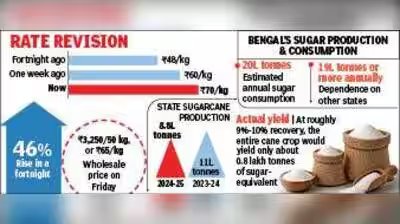
Kolkata: Sugar has turned dramatically dear just as Bengal is about to enter its peak festival season, with retail prices in Kolkata shooting up from around Rs 48 a kg a fortnight ago to Rs 70 now — a rise of nearly 46% within two weeks. While a section of the industry has blamed low yield, diversion for ethanol, and supply-line glitches, the Centre has denied diversion as a reason for the crisis.The price acceleration has been particularly sharp over the past week. Sugar that was selling for around Rs 60 a kg seven days ago is now being quoted at Rs 68-Rs 70 across neighbourhood markets. Jaggery has also become costlier, raising concerns over another round of price increase in sweets ahead of Durga Puja, Lakshmi Puja, Kali Puja and Diwali.Wholesale sugar was selling at Rs 3,250 for a 50-kg bag, on Friday, leaving retailers little cushion after transport, handling and other costs. “We are buying at Rs 65/kg and being forced to sell at Rs 68-Rs 70,” said Amit Somani, a retailer at Janbazar.“Having to pay Rs 70 for something that cost under Rs 50 a fortnight ago has hit my household budget,” said Adhir Goswami, a Parnasree resident.Anup Kumar Das of Satish Chandra Das and Sons said, “Prices of sweets depend on how much sugar the shop consumes daily, the rise in production cost, and whether sweet prices may have to be increased.”.Confederation of West Bengal Trade Associations president Sushil Poddar said the Centre on Thursday permitted one million tonnes of raw sugar to be imported duty-free until Oct 31, India’s first sugar imports in nearly a decade. But added that this will not be enough to immediately cool the market, arguing that the quantity represents only a fraction of national consumption.India’s sugar output this season is estimated at about 27.9 million tonnes against consumption of roughly 28.5 million tonnes while stocks at the start of the new season on Oct 1 could fall to about 3.5 million tonnes, the lowest in more than three decades. Additionally, India diverted 34 lakh tonnes of sugar towards ethanol in 2024-25..For Bengal, the vulnerability is sharper because the state produces little of the refined sugar it consumes and depends overwhelmingly on supplies from major producing states like Maharashtra and Uttar Pradesh.