








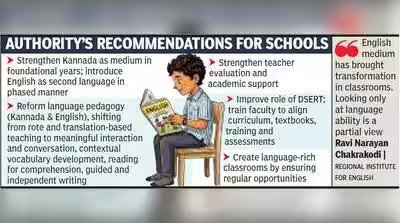
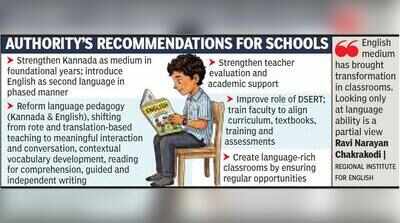
Bengaluru: A study by Kannada Development Authority (KDA) has found that students of classes 6 and 7 in govt bilingual schools in Karnataka have limited vocabulary, difficulty in forming sentences, and weak comprehension — a stark commentary on the huge gaps in learning in schools which offer English and mother tongue as mediums of instruction.Karnataka pioneered the concept of bilingual schools to boost confidence among students nearly eight years ago. Deena Bandhu Trust of Chamarajanagar conducted the study for KDA to understand English-language proficiency among class 6 and 7 students in ‘recently converted English-medium schools’. The trust spoke to 201 students in 20 schools. The surveyed students have been learning in two mediums since class 1.Not surprised by the underwhelming outcome of the study, KDA chairman Purushotham Bilimale said a similar situation exists in other states too. However, experts refused to accept the assessment at face value, contending the sample size was too small and there was no comparable study of proficiency of learning in another language to contrast the overall results.Some 12.7 lakh students are studying in 24,987 bilingual-medium schools in Karnataka.The assessment evaluated students’ competency in English on core skills: listening, speaking, reading and writing. Various tasks like oral interaction, recitation, picture description, listening comprehension, reading passages, vocabulary tasks, grammar-in-context exercises, and writing activities were given as part of the exercise.The study said students were not able to speak freely or express ideas with confidence in complete sentences. In many cases, students showed partial exposure to the language.“Students have encountered English in some form, but not enough to use it independently or confidently. They may recognise familiar words or phrases, follow simple instructions or classroom routines in English, recall memorised answers, poems. But they struggle to form their own sentences,” the study found.Some educationists flagged the report as insufficient. “The findings need to be treated with caution until we have greater clarity about the academic expertise behind the study, particularly the researchers involved, their expertise in English-medium and bilingual education, and the research methodology adopted,” said Ravi Narayan Chakrakodi, professor and head of the Regional Institute for English. “They should have compared English-medium students with their counterparts in Kannada medium. Does the report imply Kannada medium would have produced better results? Without a comparison group, it is difficult to determine whether the observed difficulties are attributable to English medium or other variables such as teacher proficiency, pedagogy, exposure, socioeconomic factors, resources or other systemic factors,” he said.An official from the department of school education and literacy said, “Only in 2025-26 did the bilingual focus begin with the approval of about 6,000 schools in 15 districts. For the first time, teachers’ capacity building is taken up with 60,000 teachers being trained before Dec. Customised textbooks are in place. The schools surveyed were part of the initial cohort in 2019. They were not treated separately even during the teacher transfer process.”