





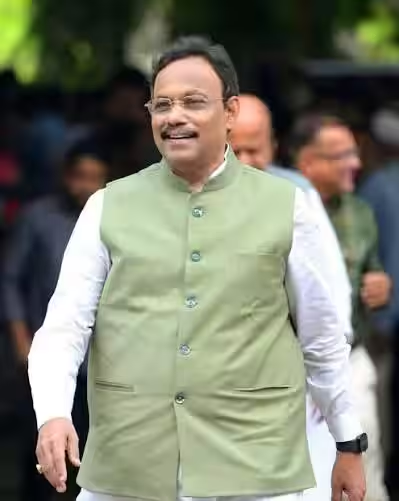
Lucknow: The appointment of BJP national general secretary Vinod Tawde as BJP’s UP incharge and former Gujarat MLA Jagdish Patel as co-incharge has brought the spotlight back on party’s outreach to politically influential Kurmi community, a crucial OBC bloc, ahead of the 2027 Assembly elections.Both Tawde and Patel belong to the Kurmi community, making their elevation more than a routine organisational reshuffle. The move is being viewed as part of BJP’s broader strategy to strengthen its hold over a caste group whose support is considered pivotal in shaping electoral outcomes across large parts of Uttar Pradesh.The appointments follow a series of signals indicating party’s sustained focus on the community. Earlier, BJP had handed over the reins of its UP unit to Union minister and seven-time Maharajganj MP Pankaj Chaudhary, another prominent Kurmi face. More recently, the party retained former MP Rekha Verma as a national vice-president during its central organisational revamp.BJP’s alliance with Kurmi-dominated Apna Dal (S) has also remained central to its OBC strategy. Party chief Anupriya Patel, one of the most prominent Kurmi leaders in the state, continues to be a member of Modi Cabinet.The community’s influence is reflected in Yogi govt as well. Four cabinet ministers — Swatantra Dev Singh, Rakesh Sachan, Sanjay Gangwar and Ashish Patel — hail from the Kurmi community, underscoring its importance in BJP’s social coalition.The numbers further highlight the community’s political heft. Uttar Pradesh currently has 40 Kurmi MLAs, with BJP accounting for the largest share of 27 legislators. Samajwadi Party has 12 Kurmi MLAs and Congress one.Kurmis are among the state’s most influential OBC communities. Estimates based on the 2001 Social Justice Committee report place them at roughly 7.5% of Uttar Pradesh’s OBC population, making them one of the largest OBC groups after Yadavs. More importantly, their presence is spread across central, eastern and Awadh regions of the state, giving them the ability to sway outcomes in a significant number of constituencies.Political observers say BJP is treading cautiously to consolidate Kurmi support after signs that sections of the community drifted away during the 2024 Lok Sabha elections, when the party’s tally in Uttar Pradesh dropped from 62 seats in 2019 to 33.That election also underlined the growing competition for Kurmi votes. Uttar Pradesh elected 11 Kurmi MPs, of whom seven belonged to SP: Lalji Verma (Ambedkar Nagar), Naresh Uttam Patel (Fatehpur), Ram Prasad Chaudhary (Basti), Utkarsh Verma (Kheri), Shiv Pal Singh Patel (Pratapgarh), Krishna Devi Shivshankar Patel (Banda) and Ram Shiromani Verma (Shrawasti).BJP, by comparison, returned three Kurmi MPs: Pankaj Chaudhary (Maharajganj), Chhatrapal Singh Gangwar (Bareilly) and Praveen Patel (Phulpur). Anupriya Patel was the lone Kurmi MP elected from among the BJP-led NDA allies.With Samajwadi Party aggressively courting non-Yadav OBCs and Congress backing the caste census narrative, BJP’s latest organisational choices suggest that retaining and expanding support among Kurmis will remain a central pillar of its electoral strategy in Uttar Pradesh.