









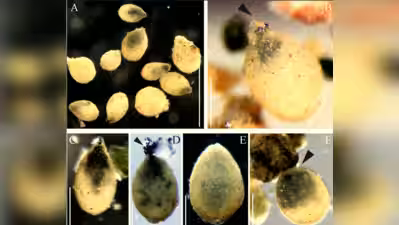
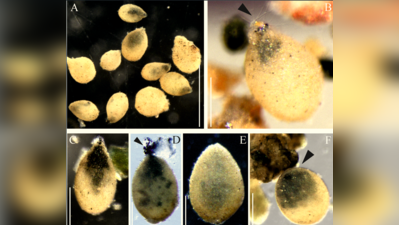
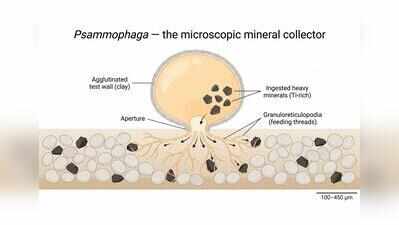
Pune: Scientists from Pune’s Agharkar Research Institute (ARI) have discovered two new species of microscopic marine organisms that selectively pick up and swallow specific mineral grains from the seafloor, a finding that could improve understanding of India’s coastal ecosystems and marine biodiversity.The organisms — Psammophaga holzmannae and Psammophaga sinhai — were found at Rajapuri Creek in Raigad district along Maharashtra’s Konkan coast. The study by the ARI scientists was recently published in the European Journal of Protistology.Tushar Kaushik, lead researcher from ARI, “Psammophaga is a type of foraminifera, a group of microscopic organisms commonly found in oceans. The name comes from Greek words meaning ‘sand eater’. Unlike many foraminifera that have hard, multi- chambered shells, these organisms have just one chamber and a soft wall made mainly of very fine clay particles. “The newly identified organisms are extremely small. P. holzmannae measures between 103 and 246 micrometres, while P. sinhai is larger, measuring between 279 and 448 micrometres. For comparison, 1,000 micrometres make up just one millimetre.Researchers found that the two species also differ in shape and also the way they store mineral grains. “P. holzmannae is oval to almost round and has an orange or yellowish interior. The mineral grains it swallows are mainly kept near an opening called the aperture. P. sinhai is longer and may look like a droplet. Its mineral grains are spread throughout the body,” added Kaushik.The most interesting discovery was what the organisms choose to eat. Using powerful microscopes and chemical analysis, the researchers found that both species selectively take in heavy minerals containing titanium and iron. These include ilmenite and magnetite.Vaishnavi Dixit, who is also part of the study said, “This is important because these minerals occur only in small amounts in the surrounding sediment. The researchers found that quartz and silicate minerals were much more common in the sediment, while titanium oxide was present only in trace amounts. Yet, the tiny organisms contained a much higher concentration of titanium bearing minerals.”So how do they do it? “Psammophaga uses thin, temporary hair-like extensions called granuloreticulopodia. These extend from the aperture and help the organism interact with the surrounding sediment. Scientists believe these extensions may help the organism detect differences between mineral grains, although the exact mechanism is still not known,” added Dixit.The two species were collected from different parts of Rajapuri Creek. P. holzmannae was found near Rohini village, while P. sinhai was collected near Sawali village. The species have been named after scientists Maria Holzmann and Devesh Kumar Sinha in recognition of their contribution to foraminiferal research.For the Pune researchers, the discovery also shows how much of India’s marine biodiversity remains unexplored. Thirumalai Murugan, one of the researchers said, “The study examined only a small part of the country’s vast coastline, and the researchers said further studies could reveal many more such organisms. The finding could help scientists understand how microscopic organisms interact with minerals and sediments on the seafloor and what role they play in coastal ecosystems.”