








Deep in the forests of Mozambique, finding a wild bee nest can begin with a sound. Yao honey hunters use a distinctive call to attract greater honeyguides, small birds capable of leading people towards bee colonies hidden inside trees. The relationship has been passed down for generations, but new research suggests the birds are not simply responding to any human noise. They appear to recognise the particular signals used by the people they live alongside. In experiments in Mozambique and Tanzania, honeyguides were much more likely to respond to the local call than to a signal used by honey hunters elsewhere. The finding points to an unusual form of communication between humans and a wild species, shaped by traditions on both sides. It also adds a new detail to a relationship in which birds locate hidden bee nests, while people open them and leave behind the beeswax the honeyguides feed on.
How African honeyguides help honey hunters find hidden bee nests
The greater honeyguide (Indicator indicator) has an unusual role in African honey hunting. From above the forest, the bird can locate bee colonies that are difficult for people to spot. When a honey hunter gives the right signal, the bird approaches and begins moving through the landscape, making conspicuous calls as it goes. The person follows until the bird reaches a tree containing a nest. At that point, the bird settles nearby and becomes quiet, effectively leaving the final search to the hunter.The arrangement works because each side can provide something the other cannot easily obtain alone. Hunters have the tools and knowledge needed to open a tree and reach the honeycomb, while the bird has an ability to locate bee nests. After the honey is taken, honeyguides can feed on the beeswax that remains. According to US National Public Radio, honey is also an important part of the Hadza diet, with earlier calculations indicating that it accounts for roughly 10% of their annual calories with the help of honeyguides.
Why African honey hunters use special calls to attract honeyguides
The researchers were interested in a detail that could easily have been overlooked. Honey hunters do not all call honeyguides in the same way. In Tanzania, Hadza hunters use a particular whistle. In Mozambique, Yao hunters use a trilling call followed by a low grunt, described as sounding roughly like “brrr-humph”. These are not simply different versions of the same sound; they are signals embedded in the traditions of separate communities.Claire Spottiswoode and Brian Wood wanted to know whether the birds themselves recognised this difference. The study published in Science, titled ‘Culturally determined interspecies communication between humans and honeyguides’, compared honeyguides’ responses in Tanzania and Mozambique by playing recordings of the different human signals. The researchers also used ordinary recordings of people saying their names as a control, allowing them to distinguish a response to the specific honey-hunting signal from a general reaction to hearing a person nearby.
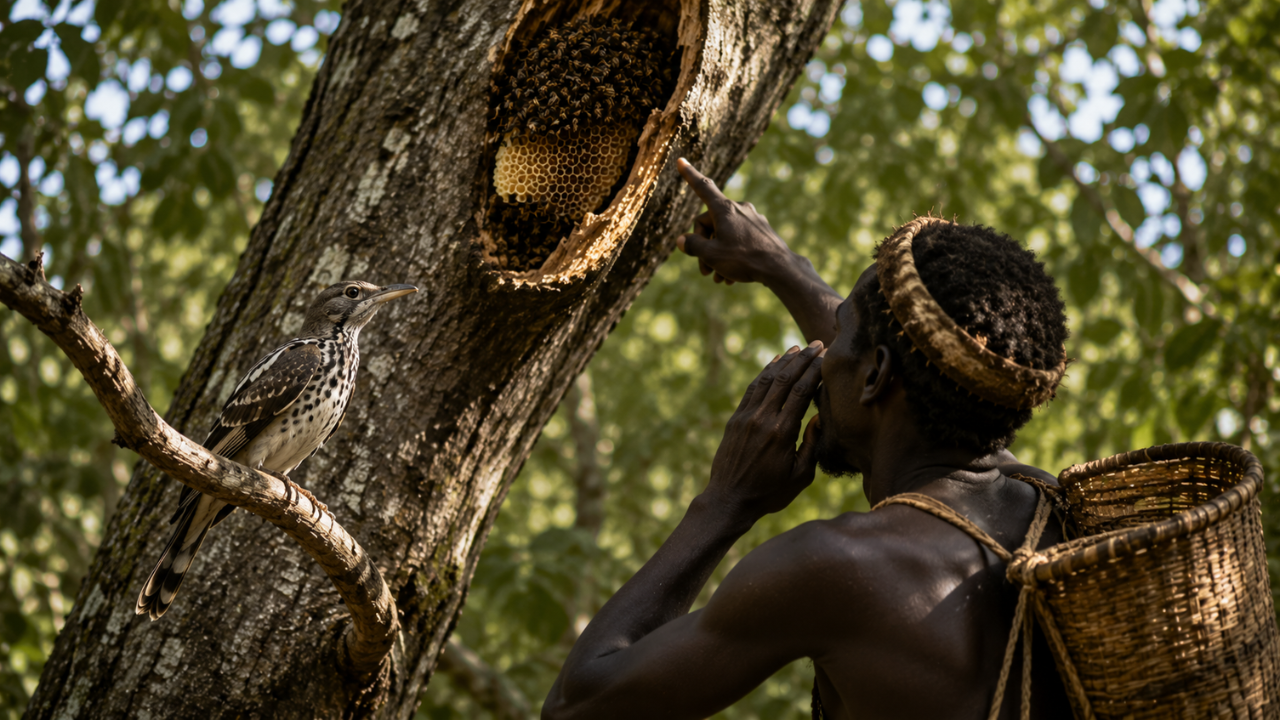
Image AI generated
Honeyguides respond more strongly to local calls from African honey hunters
The results were strikingly different between the two locations. In Tanzania, honeyguides appeared in response to Hadza whistles 82% of the time. When the birds heard the trilling calls traditionally used by Yao honey hunters in Mozambique, they appeared only 24% of the time. In Mozambique, the pattern was reversed: the birds responded to the local trills 73% of the time, compared with 26% for the Tanzanian whistles.According to the researchers, differences in how the sounds travelled through the environment could not explain the pattern. The birds were responding preferentially to the signals associated with the people they normally encountered. The Science paper therefore argues that the findings are consistent with honeyguides learning local human signals. NPR reported Brian Wood describing the result as strong evidence for a learning process, although exactly how the birds acquire this knowledge remains unresolved.
Why scientists are unsure how honeyguides learn human calls
There is an important complication. Honeyguides are not known for the kind of vocal learning associated with parrots or many songbirds. The birds also do not grow up being raised by their biological parents. Honeyguides lay their eggs in the nests of other bird species, which then raise the young. That makes the route by which a young honeyguide could acquire knowledge of a particular human signal far less obvious.One possibility raised in the reporting is that younger honeyguides learn socially by watching older birds interact with people. When a hunter opens a tree, several honeyguides may gather to feed on the exposed beeswax. As many as half a dozen or more birds can sometimes be present. If younger birds observe older ones responding to local honey-hunting calls, they may gradually acquire the same association.