









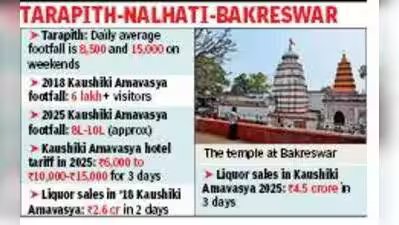
Kolkata: The hotel fire at Tarapith can impact a mutiple-crore religion-tourist circuit weeks before Kaushiki Amavasya, when the pilgrim economy, centred around Tarapith and extending to Nalhati, Bakreswar and Kankalitala, is expected to enter its peak season.The state, which has already ordered a safety audit, plans to complete the safety checks of hotels, guest houses and lodges in the area by Aug-end. Asked if the safety audit would be over before Kaushiki Amavasya, junior fire minister Koushik Chowdhury said, “We will do it on time without compromising on people’s safety.”“The religion-tourism circuit makes the Tarapith fire more than an isolated hotel accident,” said Tarit Saha, a hotelier at Rampurhat. With lakhs of pilgrims moving through the district during major religious occasions, accommodation safety, electrical systems, fire exits, occupancy limits, emergency access and evacuation arrangements become part of pilgrimage management itself.Tarapith is the anchor of a larger pilgrimage landscape. Tourists frequently combine a visit to the Tara temple with Nalateswari at Nalhati, Bakreswar and Kankalitala, besides other religious destinations in Birbhum. The district’s official tourism portal itself promotes circuits, linking several of these sites, and describes Nalateswari as an important regious destination and Tarapith as a major centre of spiritual practice. “The concern assumes greater significance with Kaushiki Amavasya due in a few weeks. Around Kaushiki Amavasya, Tarapith witnesses its biggest annual congregation. The Bhadrapada Amavasya tithi this year falls on Sept 10 and 11,” said Arijit Ghosh, who specialises in religious tour operations in Bengal. An earlier temple committee estimate puts Tarapith’s average daily footfall at about 8,500 and 15,000 on weekends. During Kaushiki Amavasya in 2018, more than six lakh visitors descended on the town over a weekend and its roughly 500 hotels were reported to be full. “The numbers have since risen, especially during festivals. Ahead of Kaushiki Amavasya in 2025, the temple committees expected four lakh-five lakh pilgrims, while some local estimates put the possible congregation at 8 lakh-10 lakh. Railway figures cited by the temple committee showed around 3.5 lakh-four lakh passengers travelled by train for the festival in each of the preceding two years,” said a former tourism department official.The impact of the fire and the audit of hotels went far beyond the temple’s own finances as pilgrimage sustained hotels, lodges, restaurants, sweet shops, puja-material sellers, flower vendors, priests, transport operators and thousands of other small businesses, said Gouranga Ganguly, a Tarapith sevayat.Tarapith alone was reported to have around 400 hotels in 2025. During Kaushiki Amavasya, non-AC rooms went for Rs 6,000 for three days and AC rooms for Rs 10,000-Rs 15,000, with reports of tariffs at some properties rising to two or three times the usual rates.One indicator of the extraordinary surge in consumption comes from excise sales. During the 2018 Kaushiki Amavasya weekend, liquor sales crossed Rs 2.6 crore in two days, about eight times the usual figure at the time. In 2025, reports put liquor sales at around Rs 4.5 crore in three days, said hotelier Saha. These figures are not a measure of the total tourism economy, but illustrate how sharply commercial activity rises during the pilgrimage.Bakreswar, Kankalitala and Nalhati added another layer to this pilgrim movement. Bakreswar combines the Bakranath Shiva temple, a Shakti tradition, and hot springs. The district tourism authority says a fair was held there every Shivaratri. Nalhati’s Nalateswari temple is another important pilgrimage destination, while academic tourism studies have identified Tarapith, Kankalitala and Bakreswar as part of Birbhum’s wider mass religion-tourism landscape.Kaushiki Amavasya will be the first major stress test after the tragedy.