





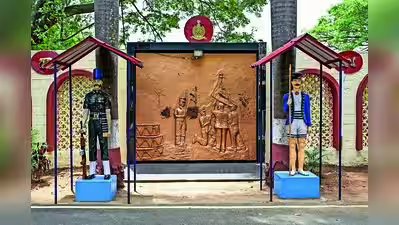
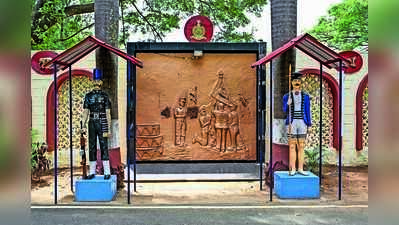
By R Prashanth VidyasagarThe Army’s oldest engineers have a museum in Bengaluru. And it’s quite a story. A road most of us have travelled, a sign that beams through rain and shine, and, of course, the men rowing on Ulsoor Lake. The MEG Circle opposite the lake — or Army Circle, as many locals know it — is a familiar Bengaluru landmark. But there is much more to the institution behind it. And this Independence Day, Bangalore Times takes you through a slice of History that is bound to make you proud.Raised in 1780 as the Corps of Madras Pioneers, the Madras Sappers are the oldest engineer group in the Indian Army and have been headquartered in Bengaluru since 1865. They are also an integral part of the city’s history. From building and maintaining key landmarks to installing the Lion Capital of Ashoka atop Vidhana Soudha, their imprint is everywhere. Mayo Hall, Attara Kacheri, St Mark’s Cathedral, St John’s Church and the old BRV Theatre all came up with their involvement. In 1911, they were called upon to double Bengaluru’s water-pumping capacity and mains, helping bring water to more parts of the growing city. Now, there is an opportunity to get to know the Sappers beyond the familiar gates and uniforms. The Madras Sappers Museum and Archives has opened to the public.Once inside the well-maintained campus, the noise and bustle of the city seem to disappear. Give yourself at least a couple of hours to walk through this slice of history and understand what it means to be a sapper. As Col Udaykumar Sankeshwar graciously took us around, he summed up the experience beautifully: a museum is a fabric of emotions, with every artefact carrying a story that is part of history. Walking through it is a chance to travel along that timeline and understand the past. There are mines, weapons, flags, uniforms and campaign maps, along with an entire section dedicated to sport — which finally explains those boats on Ulsoor Lake. The regiment has fielded formidable hockey, football and rowing teams for decades, with the lake serving as a training ground for its crews.A garter that fell off at a danceOn the old cap badge sits a dark blue buckled garter bearing the words Honi Soit Qui Mal Y Pense — roughly, “shame on him who thinks evil of it”. It is the emblem of the Order of the Garter, England’s oldest order of chivalry, founded by Edward III around 1348 and traditionally reserved for the sovereign and a select group of knights. The story behind it is the fun part. At a court ball, a lady dancing before the king reportedly lost her garter. It slipped off in front of everyone and the court sniggered. Edward III walked over, picked it up, tied it around his own leg and uttered the now-famous words. He later built an entire order of chivalry around the moment.In 1876, the same garter was granted to the “Queen’s Own” Madras Sappers for use on their uniform. The badge wall beside it compresses the rest of that history into just a few inches: a royal cypher added in 1885, a crown in 1925, and, after Independence, the Chakra, Purana Qila fort, a lotus wreath replacing the laurel and Ashoka’s lions.The city’s biggest exportNot the dosa. In 1912, Maj R L McClintock conducted a series of trials on this campus to solve an old battlefield problem: how to get infantry through barbed wire without sending men crawling towards it with cutters. His answer was a pipe packed with explosives that could be pushed under the wire from a safe distance, with additional sections screwed on for greater reach. Two years later, it became indispensable in the trenches. During D-Day, American engineers used similar Bangalore torpedoes to breach the Normandy wire — the scene many will remember from Saving Private Ryan. A century later, the invention has made its way into video games including Call of Duty, Battlefield and Company of Heroes. Apex Legends even named a character Bangalore after it. And the Sappers still have a cocktail named after it.Royal postA letter dated December 24, 1855, written in a fine, looping hand. Prince Gholam Mohamed, son of Tipu Sultan, invites Maj J Raleigh of the Alipore Militia to a function and, quite casually, requests a full guard of honour with colours. The letter remained in an English family’s papers for 132 years before a descendant returned it to the regiment in 1987.Nearby is a photograph from another chapter of that history. In 1948, the Maharaja of Mysore, Sri Jayachamaraja Wadiyar, became the Group’s Honorary Colonel.A bell from a Ming templeBronze, black and gold, the bell hangs in its own frame. It came from the Temple of Agriculture in Peking, built in 1420, where Ming and Qing emperors would exchange their robes for peasant clothes once a year and ceremonially plough a furrow. During the Boxer Rebellion of 1899-1900, American General Chaffee and his officers presented the bell to Lt Loch, who commanded the Madras Sappers’ telegraph section there.The train that ran through the messAround 1903, the Sappers laid a narrow-gauge railway across the campus, connecting the Officers’ Mess, Assaye Lines and Meanee Lines. The little coal-fired Decauville locomotive that worked the line now sits preserved on the grounds. The service continued until 1968.An engine that needed another engineThere is a 25 BHP Caterpillar diesel engine from Peoria, Illinois, installed in 1951 and in service until 1989. The catch? It couldn’t start itself. A smaller petrol-powered “donkey engine” had to turn it over first. Recruits learnt their trade on it for nearly four decades. A few cases away is a Japanese wrist compass captured during the Second World War. Eighty years on, its needle still swings north.A silver trowelSmall, easy to miss, and our favourite object here. The silver trowel was presented by the Hindu ranks of the regiment to their Commandant, Col J F S Steadman. It was used to lay the foundation stone of the Kaliamman Temple in Meanee Lines on September 16, 1942. Considered auspicious, it still makes an appearance for the first turn of earth whenever the Sappers build something new.What they singOn the way out, a plate carries the Group Song in Tamil: Madras Sappers endru cholli nimirndu nilluvom. “We will say we are Madras Sappers and stand tall.” The men here have been the Army’s thambis for more than two centuries.PLAN YOUR VISITMadras Sappers Museum and ArchivesOpen: Wednesdays and Saturdays, 9 am to 3 pmEntry: Rs 50 for adults | Rs 20 for childrenBooking: Prior approval required through email or WhatsApp. No walk-ins.Dress: There is no official dress code, but visitors are advised to dress respectfully, wearing full-length trousers and closed footwear.