



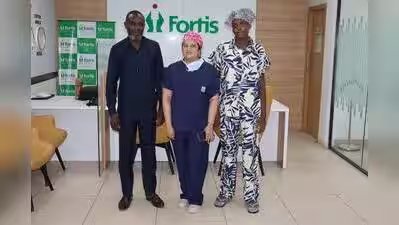
Gurgaon: A 5.4kg tumour, which had turned into an infected wound after it went untreated for months, was removed from the breast of a 44-year-old woman from Democratic Republic of Congo at a Manesar hospital.Doctors at Fortis Hospital said the woman first saw the growth in Dec 2025 but did not seek treatment for it at the time. In the next few months, the tumour grew rapidly and when she reached the hospital on June 18, it covered her entire right breast and was oozing a foul-smelling discharge.The case became even more complicated after doctors found they could not perform an immediate surgery to remove the mass because she was suffering from severe anaemia, malnutrition and sepsis. So, the medical team first worked to stabilise her condition and control the infection.A PET-CT scan provided good news — despite the enormous size of the tumour, the cancer had not spread to distant organs or lymph nodes.Once the woman’s condition was stable, a team, led by breast oncoplastic surgeon and senior consultant of surgical oncology Dr Mansi Chowhan, performed the complex surgery to remove the tumour.The operation, however, was only part of the challenge. A large portion of the breast skin had been affected by the disease. After removal of the tumour, the patient therefore required specialised wound care and a skin graft to cover the surgical area. Doctors said the graft healed well and that the woman is now recovering.Her treatment is still ongoing. She will undergo chemotherapy followed by radiotherapy, after which a breast reconstruction is planned.Dr Chowhan said the case highlighted the importance of not ignoring changes in breast anatomy and seeking timely medical evaluation if one spots any changes. “It shows how delayed treatment can transform a potentially treatable breast cancer into a complex medical emergency, with the patient eventually requiring management not only of the cancer but also of infection, severe anaemia, malnutrition and extensive tissue damage,” she said.