









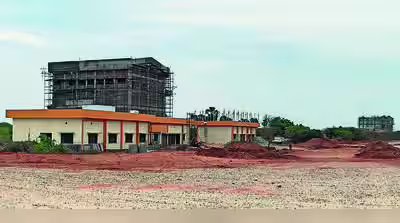
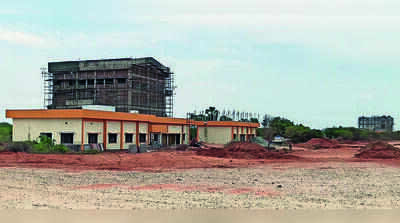
The Indian space industry is at a crucial juncture. Skyroot’s orbital mission last month made India the third country in the world to have private launch capabilities. With a host of promising startups beginning commercial operations and eyeing a global space market estimated at $400 billion to $600 billion, Tamil Nadu finds itself at the centre of the action. With growing demand for satellites and space-based data for various applications, the market is expected to hit a trillion dollars in a decade. Isro’s upcoming launch complex at Kulasekarapattinam will play a central role in private launches in India, alongside the agency’s small satellite launch vehicles (SSLVs). The site is specifically designed for smaller vehicles launching into polar or sun-synchronous orbits for earth observation, intelligence, reconnaissance missions and strategic applications. It provides a quicker turnaround time and the flexibility needed to meet increasing commercial demand.Small vehicles, cost differential“We expect a 30-40% increase in fuel and payload advantage,” said Srinath Ravichandran, co-founder and chief executive of Agnikul Cosmos, the startup building reusable rockets. “This is also particularly valuable for earth observation satellites, which typically need polar or sun-synchronous orbits. It also benefits communication and defence that depend on precise, repeatable ground tracks, making the site strategically useful beyond any single satellite category,” he noted. The location is ideal for the startup’s reusable launch operations and booster recovery. “Coastal proximity gives us direct access to downrange ocean needed for booster recovery. Sea access simplifies tracking, retrieval and logistics for returning stages,” he added. Agnikul is building an integrated 300-acre end-to-end facility for manufacturing and testing vehicle systems.Isro’s primary launch pad at Sriharikota carries a payload penalty due to geography, posing challenges for commercial rocket launch competitiveness. To ensure that spent booster stages do not impact landmasses like Sri Lanka, polar launches require a ‘dogleg’ manoeuvre, which significantly reduces the payload capability. Kulasekarapattinam eliminates this with a direct southward trajectory, allowing SSLVs to deliver a payload of about 300 kg.The spaceport is designed to cater to polar orbits and small satellite payloads under 500 kg for Earth observation (EO), smaller communications, navigation, and Internet of Things (IoT) missions, said Rajeev Jyoti, director of the technical directorate at IN-SPACe. It will support more than 24 launches per year, and when combined with Sriharikota’s launch pads, India’s integrated capacity is projected to reach 40 to 50 launches annually. It is expected to be commissioned by March 2027.Anchoring demandHe stated that three primary players are slated to utilise the port are Agnikul Cosmos, Skyroot Aerospace, and Hindustan Aeronautics Ltd (HAL). HAL won the technology transfer contract for Isro’s SSLV and is on track to conduct its first launch by September 2027.Vishesh Rajaram, founding partner at Speciale Invest, an early investor in Agnikul, said Kulasekarapattinam’s true value lies in its high launch frequency. This perfectly positions Indian startups to capture a lucrative global market of ‘rideshare refugees’ or satellite operators who demand their own dedicated orbit and timeline rather than waiting for a shared slot on a larger rocket. EO constellations requiring precise, repeatable polar insertions and broadband players requiring cadence can prefer Indian players. He believes the government’s primary role is to serve as a committed anchor customer generating demand, rather than acting as a subsidising cost and govt has already signaled demand with its space-based surveillance (SBS) program.The Indian govt plans to transition Kulasekarapattinam into a privately operated spaceport that can facilitate rockets launching on demand, said A.K. Bhatt (retd), director general of the Indian Space Association (ISpA). Raising similar point, he said , “An expression of interest has been released by IN-SPACe to hand over the management of the entire spaceport to a private company or consortium. This shows treating the spaceport much like a commercial airport where private infrastructure players handle operations to maximize launch frequency,” he said.“With higher domestic demand and launch startups entering commercial operations and more players such as Astrobase, the country will have high-cadence and lower the cost. IN-SPACe’s financial incentives between 30% and 50% for launch services will further bridge the gap,” Bhatt added. “Having an integrated facility that combines launch vehicle assembly, subsystem testing, and payload integration right near the spaceport drastically cuts down on costs, reduces component transit and testing timelines and ensures safer propellant handling,” said Liwaans Amuthan, founder and CEO of Cosmicport, a deep-tech aerospace startup. A native of Tuticorin who returned after a career in the US to build methalox engines and reusable small launch vehicles in the district, he believes the real commercial benefits of this geographic advantage can only be fully tapped if the state provides these integrated facilities.Mayilsamy Annadurai, former Isro director and mission director of Chandrayaan-2, said the spaceport and the allied space industrial and propellant park can play a key role in India gaining a larger share of global satellite launches. “Currently, components for launch vehicles and satellites are manufactured in different parts of the country and sent for assembly ahead of the launch. Making components under one roof near the spaceport has its advantages. Access to the Tuticorin port will help international players handle satellite payloads efficiently, as not every component or satellite will be made domestically.”Green shootsThe Tamil Nadu govt is capitalising and announced a space industrial and propellant park. The FY27 budget announced that the Tuticorin and Tirunelveli districts will be designated as a space industrial investment zone. Apart from Agnikul, launch companies such as Skyroot Aerospace and EtherealX are setting up facilities in the region, according to state industries department sources. Skyroot has committed an investment of about `200 crore. EtherealX (Ethereal Exploration Guild) has committed an investment of about `519 crore for a new facility in Tirunelveli district, the above-mentioned sources said on condition of anonymity.IN-SPACe and the TN government are building a common technical facility near the complex with a `100 crore outlay. Jyoti said the facility will support smaller companies with vibration, thermovac, and ground testing. “It will reduce capex burdens for private manufacturers. This, along with a payload testing facility in Ahmedabad, is intended to support startup and MSME prototyping and encourage clustering around manufacturing hubs,” he said.French satellite internet service provider Eutelsat OneWeb has already established a ground station at Vaipar to support its low-earth-orbit satellite constellation. On the propellant side, Premier Explosives and Solar Industries have committed investments of about `900 crore and `500 crore, respectively, to support solid and liquid propellant manufacturing. Several early-stage startups, including SpaceTug, OrbitAid, and CosmicPort, have also shown interest in the ecosystem developing around Tuticorin. Opportunities in downstream industries, including building critical software and applications, are highly lucrative yet often overlooked, said Rohin Kumar Maheshwaran and Mrudhula Vijayakumar, co-founders of ArtemysX, a space and defence software startup building software and AI systems for ground stations.