








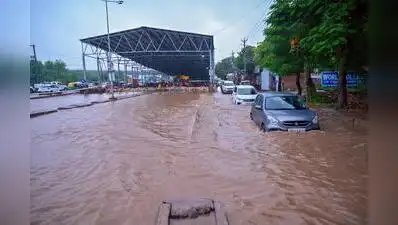
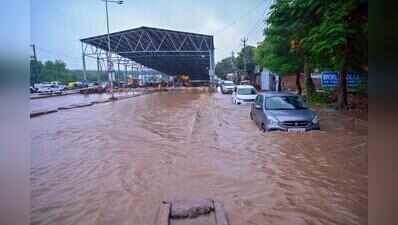
Gurgaon: A contrasting picture has emerged across the city’s underpasses this monsoon — some were inundated and had to be shut temporarily, while others continued handling traffic despite the same spell of intense rain.The difference is starkest on Golf Course Road, where underpasses that faced waterlogging in past years have since seen drainage and engineering interventions, and stayed relatively clear through the recent downpour.At least three underpasses — Medanta Road, Bajghera and IFFCO Chowk — were disrupted in the recent spell. NHAI shut the Medanta and IFFCO Chowk underpasses after they flooded, while traffic at Bajghera was stopped for three hours as flood barriers and sandbags went up to keep water out.The city has a network of 24 underpasses across national highways, expressways and arterial roads, maintained by different agencies including NHAI, PWD, GMDA and DLF. On Delhi-Gurgaon Expressway, these include Rajiv Chowk, Hero Honda Chowk, Medanta Road, Signature Towers, Ambience Mall and IFFCO Chowk. Subhash Chowk and Vatika Chowk lie on Sohna Highway. Dwarka Expressway corridor has underpasses at Bajghera, sectors 109/110 and 88B, Kherki Majra, and the Trumpet interchange. Golf Course Road alone has seven — at Sikanderpur, Shankar Chowk, DLF-1, Genpact and Cyber City, besides two DLF Cyber City U-turn underpasses. Additional underpasses exist at Atul Kataria Chowk, Mahavir Chowk, Dhanwapur and Millennium City Centre.The recent incidents suggest flooding isn’t linked to rainfall intensity alone, but to a combination of factors — drainage arrangements, surrounding topography, the volume and direction of surface runoff entering the structure, sump capacity, and the capacity and functioning of pumping systems and the receiving stormwater network.NHAI attributed the waterlogging at Medanta Road to backflow of surface-drain water into the underpass through the faulty sump-pump system, rather than seepage. The authority said the problem would be addressed by installing a non-return valve in the sump pumps to prevent it from recurring.Bajghera presents a different challenge. NHAI said stormwater from the ROB side, along Bajghera road, flows towards the underpass because of the natural ground slope, with surrounding developed areas at a higher elevation adding to the runoff. The situation is compounded by the lack of a proper inlet into GMDA drain. “With the drain already running at full capacity, it was unable to take additional runoff from the road, resulting in water accumulating outside the underpass,” an NHAI official said.The underpass has faced waterlogging during heavy rain for the past two years, since Dwarka Expressway opened. NHAI deployed flood barriers and sang bags. Traffic was restricted for three hours as water levels failed to recede even after the rain stopped. While such measures protect the structure during heavy rainfall, they remain a temporary response rather than a permanent fix.The pumping infrastructure also points to why individual underpass capacity needs scrutiny — Bajghera has eight sump pumps (six of 2.5hp, one of 10hp and one of 35hp) connected to the master drain, yet the repeated flooding underscores the need to address the underlying drainage and engineering issues causing runoff to accumulate outside the structure.At IFFCO Chowk, NHAI had to stop traffic for nearly two hours after water entered the underpass carriageway through the vehicular entry.The heavy rain also disrupted traffic at the Mahavir Chowk underpass near Sector 12 on Friday, where accumulated water forced the traffic police to temporarily block the entry. PWD teams deployed pumps to drain the underpass, while officials said runoff from the adjoining Police Lines residential area was flowing onto the road and coming into the underpass through the passing vehicle.GMDA officials say the relatively better situation on parts of Golf Course Road this monsoon is partly the result of measures to intercept runoff before it reaches the urban road network. According to the authority, rainwater coming down from the Aravali side gains considerable speed because of the steep gradient. GMDA has created water channels and diversions, directed runoff towards depressed areas, and revived creeks 1, 2, 3 and 4 to increase their holding capacity — including a water channel along the AIT roundabout to channelise stormwater into creek 4, and an additional drain laid in Sector 54.The authority has also surveyed natural water-flow paths and, wherever feasible, diverted runoff towards ponds and depressed areas. “These act as buffers, reducing the amount of water entering the urban drainage system at one time. Check dams and holding areas have also been created at multiple locations to retain water before it reaches the built-up areas,” a senior GMDA official said, adding that drills of sump and pumping systems at underpasses were carried out before the monsoon to check efficiency and drainage time.The official acknowledged, however, that problems at individual underpasses can differ. At Bajghera, for instance, GMDA has held a joint inspection with concerned agencies following the heavy rainfall and suggested a tabletop arrangement to divert runoff. It has also written to PWD to create a surface drain connected to the master drain, so water can be diverted before reaching the underpass. The authority said it is also examining location-specific measures, including enhanced pumping capacity and additional pumping arrangements where required.Experts point to a larger structural issue — much of the city’s drainage infrastructure was planned before it reached the current scale of development, and rapid, fragmented urbanisation, particularly in older and unauthorised colonies, has significantly increased the stormwater and sewage load on existing networks.“The situation is not something the administration is unaware of, but the approach has largely focused on constructing more concrete drains. That, by itself, is not a scientifically sound solution. In many places, drains are boxed or covered, after which sewage and solid waste also find their way into the stormwater network. Municipal waste dumped on roads eventually gets washed into these drains, further reducing their carrying capacity. As a result, even the limited drainage infrastructure available is often unable to perform its intended function,” said Fawzia Tarrannum, director at Earthwise Nexa, an environmental engineering and climate technology firm.In several densely built-up areas, particularly Old Gurgaon, roads and houses were constructed without adequate stormwater infrastructure, leaving little space to create new drains today without extensively digging up existing roads and built-up areas. That means installing larger pumps at every flooding point won’t always solve the problem — if the receiving drain itself is full, pumping more water into it provides little relief, Tarrannum said.“There are relatively simple nature-based measures that can make a significant difference. For instance, by lowering the edges of green spaces and creating proper gradients, rainwater from roads can be diverted into these areas, allowing it to infiltrate into the ground rather than immediately entering the drainage network,” she said, adding that the city’s substantial green spaces — including parts of the Aravalis, parks and other open areas — can be used to retain and absorb stormwater.“There are examples within the city that demonstrate that this approach can work. Golf Course Road is one such example. Following severe flooding around the corridor, a study was undertaken and recommendations were made to use the existing green-blue infrastructure more effectively instead of relying entirely on conventional concrete drainage. Several interventions were subsequently undertaken, including the development of creeks, diversion channels from roads and water-harvesting measures around areas such as Sikanderpur forest. The same approach can be replicated elsewhere, but it requires a detailed study of each catchment. There is no single drainage solution that can be applied uniformly across the city. If we continue to treat every flooding problem simply by constructing another concrete drain, we will keep expanding the drainage network without addressing the underlying issue,” Tarrannum said.