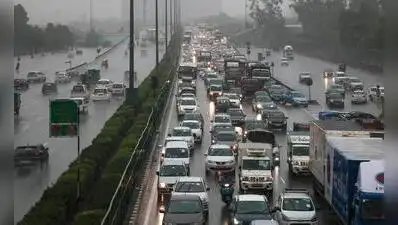









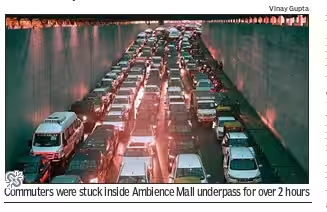
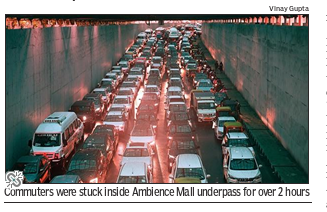
Gurgaon: Tuesday’s gridlock on Delhi-Gurgaon Expressway worsened because not one but two key underpasses got affected — Ambience Mall underpass and Bajghera underpass on Dwarka Expressway.The situation was so grim that city traffic police had to resort to stopping the entry of vehicles into Ambience underpass for around two hours late in the evening as it was totally jammed.Commuters got stuck inside this underpass for over two hours and the patchy network and decreasing fuel increased their anxiety.According to NHAI, traffic congestion was caused by the combined impact of heavy rainfall, peak office-hour traffic and the movement of kanwariyas.While traffic police spokesperson and ACP (Highways) Satyapal Yadav could not be contacted, a traffic police officer said heavy waterlogging at several locations across the city severely disrupted traffic.“The Ambience underpass remained heavily congested for nearly three to four hours, leaving several commuters stranded inside and causing a major tailback on Delhi-Gurgaon Expressway. To clear vehicles already stuck inside, traffic from the Udyog Vihar side was stopped for around two hours. Commuters were diverted towards Delhi and advised to take a U-turn under the Rajokri flyover,” the official said.At Bajghera underpass on Dwarka Expressway, the gushing rainwater forced NHAI to place sandbags and flood barriers. This underpass was closed for nearly three hours.“We were forced to close this underpass as the water level had not receded even three hours after the rain stopped. We installed flood barriers to prevent ingress of water into the underpass and the affected carriageway was closed as a precautionary safety measure,” said an NHAI official.The temporary closure of Ambience Mall underpass forced hundreds of commuters to take long detours.“I got reminded of those days when this Ambience Mall underpass did not exist and we were forced to pay toll at the Delhi-Gurgaon border, enter Delhi and take a U-turn under the Rajokri flyover before heading back to Gurgaon. Last night was a repeat of that. I left my office in Udyog Vihar but found the underpass closed by NHAI vehicles. Since I was already on the Rajokri flyover, I had to take the Dwarka Expressway U-turn and then got stuck in congestion near Ambience Mall,” said Nayan Aggarwal, a resident of Sushant Lok.Another commuter, Vijeta Sinha, a Sector 54 resident, said she had to take a detour driving through the already choked lanes of Udyog Vihar to reach Shankar Chowk on her way to her home in Sector 56. “It took me around an hour to reach Cyber Hub from Udyog Vihar Phase 3, a journey that usually takes about 15 minutes,” she said.Civic agencies on Wednesday announced a joint action plan to tackle the recurring waterlogging at Bajghera underpass. “GMDA, along with NHAI and PWD, will take necessary steps such as construction of tabletop structure at Bajghera underpass and install additional pumping machines wherever necessary to ensure there is no repeat of such incidents,” said a GMDA official.According to NHAI, rainwater from the railway overbridge side and the GMDA road continued to flow towards Bajghera underpass because of the natural ground slope. Officials said the problem was compounded as the surrounding developed areas are at a higher elevation than the GMDA road, leading to continuous runoff towards the underpass.NHAI pointed out the situation worsened due to the absence of a proper inlet into the GMDA drain. Since the drain was already flowing at full capacity, it could not receive additional stormwater, resulting in backflow onto the road and preventing the accumulated water from draining out.Under the action plan, NHAI will regulate stormwater flow towards the underpass during heavy rainfall. It will also inspect the existing sump wells and pumping infrastructure and carry out repairs or upgrades wherever necessary.PWD will construct surface drains to intercept rainwater flowing towards the underpass and connect them to GMDA’s Leg-1 master drain, allowing faster discharge of stormwater into the city’s drainage network and reducing water accumulation.