







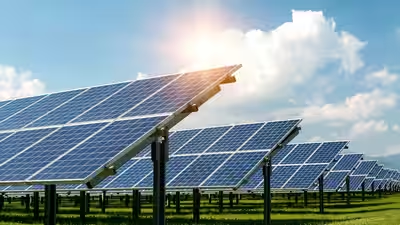

MUMBAI/NEW DELHI: India appears to have crossed an important milestone in its clean energy transition, with solar power helping meet record summer electricity demand without a proportionate increase in coal-fired generation, according to a new analysis that points to a gradual but significant shift in the country’s electricity mix.The April-June quarter of FY2026-27 saw India record its highest-ever quarterly electricity generation of 524 billion units (BU), up 9% from a year earlier, even as national peak demand climbed to an all-time high of 271 GW on May 21. Yet, despite the unprecedented demand, coal’s dominance in meeting incremental electricity needs continued to ease as renewable energy—led overwhelmingly by solar—accounted for a growing share of additional power generation. For Maharashtra, the findings carry particular significance. The state recorded the country’s highest peak electricity demand at 30 GW, ahead of Uttar Pradesh (27 GW) and Gujarat (25 GW), reflecting the energy needs of India’s largest industrial economy and one of its fastest-growing urban regions. With rising temperatures, expanding manufacturing, commercial activity and increasing air-conditioner use, electricity demand in Maharashtra continues to outpace most other states. The report by the Centre for Research on Energy and Clean Air (CREA) found that solar electricity generation surged 37% year-on-year to 57 BU, making it by far the fastest-growing source of power. Solar supplied 10.9% of India’s total electricity generation during the quarter—the first time it has crossed the 10% mark in an April-June period—and contributed 36% of the year-on-year increase in electricity generation, compared with just 11% two years ago. Over the past three years, solar generation has more than doubled from 28 BU to 57 BU, while daily solar output touched a record 696 million units on May 11.For consumers and businesses, the trend signals that renewable energy is increasingly helping meet rising daytime demand, reducing pressure on conventional power plants during periods of peak consumption. On 61 of the 91 days during the quarter, the country’s daily peak demand occurred while solar plants were generating electricity, underscoring solar’s growing role in supporting India’s daytime power needs. Coal, however, remains the backbone of India’s electricity system. Coal and lignite together generated around 369 BU, or roughly 70% of the country’s electricity. But their contribution to the increase in electricity generation slipped to 68%, down from 71% in Q1 FY2024-25, suggesting that an increasing share of new demand is now being met by renewable energy rather than additional coal generation. Combined non-fossil sources generated a record 149 BU during the quarter.Another notable development was the operational debut of large-scale battery energy storage in supporting the national grid. On days when peak electricity demand occurred after sunset, battery energy storage systems (BESS) supplied up to 4.1 GW, meeting about 1.1% to 1.8% of national nighttime peak demand. India’s storage pipeline is also expanding rapidly, with tenders issued for around 272 GWh of storage projects, while about 7.5 GWh of battery capacity is already operational and another 3 GWh is expected to come online by the end of this year.India’s installed power generation capacity stood at 549 GW by the end of June, with non-fossil fuel sources accounting for 54% of installed capacity, overtaking fossil-fuel-based capacity for the first time. Renewable energy additions continued to dominate investments, with about 13 GW added during the quarter compared with 2.26 GW of new thermal capacity. Even so, around 42.7 GW of coal-fired capacity remains under construction, though nearly 89% of it is still at an early stage of development. The report, however, points to a major bottleneck that could slow India’s clean energy transition. Despite record renewable generation, substantial quantities of green electricity could not be used because of transmission and operational constraints. During the quarter, around 473 million units (MU) of solar power and 112 MU of wind power were directly curtailed, while even larger volumes were backed down under grid-balancing mechanisms. The findings indicate that unless transmission networks, battery storage and grid flexibility expand much faster, India risks wasting increasing amounts of low-cost renewable electricity even as demand continues to rise.“India is demonstrating that renewable energy is reliable and can be deployed at scale. The next challenge is ensuring the grid can fully utilise renewable electricity,” said Manoj Kumar, India Analyst at CREA. He said expanding transmission infrastructure, accelerating battery storage and improving the operational flexibility of existing coal plants would be crucial, while future decisions on new coal capacity should be evaluated alongside investments that improve the utilisation of existing assets.The quarter’s numbers suggest India’s power sector is entering a new phase. The debate is no longer only about adding renewable capacity but about ensuring that clean electricity generated across the country reaches homes, industries and businesses efficiently. Whether India’s transmission network and storage infrastructure can keep pace may now determine the speed of the country’s energy transition.