









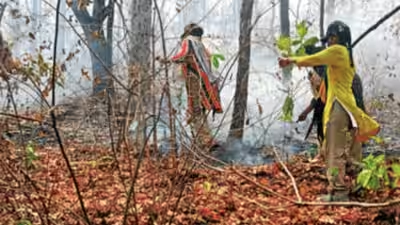
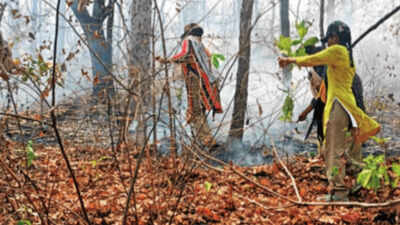
Deep inside the dense forests of Mulugu in Telangana, where mobile signals fade, poachers are on the prowl and Maoist warnings still echo, a forest range officer once posed as a pangolin buyer.The woman behind the undercover operation, Md Apsarunnisa, posted as a range officer at Eturnagaram Wildlife Sanctuary, cracked an organised pangolin smuggling network in Telangana.Her trap led to the seizure of pangolin scales and the rescue of several animals from remote forest settlements, resulting in four arrests.“Villagers from Bhupatpur were supplying pangolins to the gang. Some of the animals were dead, a few alive. After the arrests, we worked to reform these villages. Many have stopped poaching now,” Apsarunnisa says.But this was not her only fight. From catching timber smugglers to generating Rs 4.5 crore revenue through seized wood auctions, she and her all-women patrols have shown that forest protection is no longer just a man’s job.These women trek 10km daily, tracking tigers and keeping vigil on encroachments, all in areas where security forces move cautiously.Shattering the ‘green ceiling’, these women warriors protect forests from poachers, timber smugglers, and illegal sand miners, safeguarding vast stretches from encroachment, while facing life-threatening conditions.
Confronting Sand Smugglers
Meet Madhavi Sheetal, forest range officer from Mulugu division, who recounts a night when her women’s team stormed a sandsmuggling zone in the Tadvai range in the forest.“It was pitch dark,” she says. “We found five tractors in operation. Around 20 men were involved. We had no communication links, but we managed to seize all the tractors and drive them to the forest office.”The team had only flashlights to defend themselves, but their resolve did the trick.Such incidents are not exceptions. Women officers across Telangana are increasingly at the vanguard of forest protection.
A Quiet Transformation
Telangana leads the country in gender parity in its forest department. Women constitute 43% of forest beat officers (FBOs), the frontline staff.They make up 31% of the department’s workforce. Even at the top, women occupy 32% of Indian Forest Service posts, led by principal chief conservator of forests Suvarna Chandrappagari , the second woman to head the force.But the numbers thin out in the middle ranks. Women make up only 21% of range officers and 6.5% of section officer/deputy range officers, highlighting a continuing gap.Mulugu, Telangana’s most forested district with 74% green cover (2.9 lakh hectares out of 3.9 lakh total), mirrors this shift.“Women officers played a major role in regenerating 332 hectares lost in an unusual weather event last year, which caused very strong winds. They were also tracking tigers in Lingala; one of them is now monitoring Mulugu’s first resident tiger,” says DFO Rahul Kishan Jadhav.Women officers are equally effective in firefighting and legal work, he adds. “They handle chargesheets, non-bailable warrants, and court documentation. What they need is non-lethal weapons like stun guns, tasers, and vehicles for mobility.”
‘It Was A Male Domain’
Suvarna Chandrappagari, head of Telangana forest department, says forestry has long been a maledominated field.“Only recently have state departments started recruiting women in large numbers. Many states still lack proper recruitment norms, and gender mainstreaming is not yet part of HR strategy,” she adds.Her initial doubts about the inclusion of women disappeared after multiple field visits.“Wherever I go, I see women performing well on the field. They have learnt how to deal with difficult conditions.”
Guardians Without Weapons
Apsarunnisa and her peers often patrol without any weapons.In 2015, scooters were allotted to women staff, but because no new vehicles were provided, the officers are having to operate decade-old two-wheelers, not optimal, say several of them. The 2019 batch got none.“In Maoism-affected areas like Mulugu, police get special allowances, but forest staff don’t,” says a Tadvai officer.Despite risks, FBO Mood Renuka continues her daily vigil. Posted at Pasra checkpost, she stops trucks carrying forest produce and sand. “I stop and check lorries without fear and find illegal sand smugglers,” she says.Renuka also patrols on foot in Mutluguda South Beat, watching for bison pugmarks and wild birds. Her work has earned her an award for outstanding service.
Daily Battles
Encroachment by tribals and nontribals is among the toughest challenges. “They occupy deep forest areas with thick cover and water bodies, about 10 to 20 hectares each, and grow crops,” says forest protection officer M Renuka.“When we go for retrieval, we face verbal and physical attacks. But we continue.”Pasra range officer Madhavi Sheetal J says her range covers 20,000 hectares with nine Gutti Koya (a tribal community) habitations. “A forest has no gates or walls.At night, timber smugglers and poachers enter easily. Patrolling never stops,” she says.Eturnagaram FDO Ramesh says the sanctuary is both a bison protection and giant squirrel sanctuary, dotted with 36 human habitations.“We are educating Koya and Kuthikoya tribes to stop encroachments,” he says, adding that some interceptor vehicles used by women staff were strengthening surveillance.
Endurance & Grit
E Krishnaveni, deputy range officer at Tadvai, recalls the 2024 “heavy winds event” that flattened 25,000 trees across 233 hectares.“We climbed trees to enumerate them. Around 7,000 to 8,000 were extracted under supervision. We cleared debris and created 22km of fire lines,” she says.Forest work, she adds, demands “physical strength and mental endurance”. Beat officers walk 5-8km a day through dense terrain.FRO Madhavi says, “Firefighting is our biggest challenge. Because of dry leaves and slopes, fires spread fast. Early mornings, we go to beat the flames. Some officers suffer burns.”FBO M Aparna, who returned from maternity leave, joined a fire-control operation on her first day back.“Sometimes, we walk 10km on the road and trek two more through the hills to reach the fire,” she says.
Breaking Barriers
At Dulapally’s Forest Academy in Hyderabad, director S J Asha says women now make up a third of new recruits.“Even in unreserved posts, women get selected on merit. We train them in survival, water sourcing, snake handling, landmine awareness, camping, and weapon skills with NISA (National Industrial Security Academy, CISF) and the police academy.”Principal chief conservator of forests Suvarna Chandrappagari says gender mainstreaming has come a long way.“Forestry was once male-dominated. Now, a significant number of women are doing well in the field,” she tells TOI . But there’s more to be done, especially about safety.As a senior officer notes, “Foresters here are told by Maoists not to wear uniform in certain areas. That’s the reality.”Even then, the quiet custodians of Telangana’s forests march ahead, walking miles every day to keep the wild alive.