








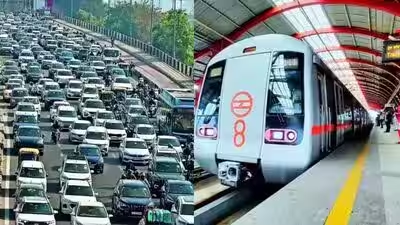
NEW DELHI: Every weekday at 5am, Manish (31) leaves his home in Bahadurgarh for a twohour commute to Vikas Bhawan. His journey involves a motorcycle ride to the Delhi border, a bus to Madhuban Chowk, the metro to ITO and a final walk.For the past seven years, he has followed the same routine, returning home close to 8pm.“Everything costs more here. If I move closer to Delhi, I’ll save time but lose money to rent and expensive schools. Sometimes, the journey seems longer than the day itself. But that’s the compromise I make so my family doesn’t have to,” he says.Manish is, of course, not alone. TOI looks at travel travails of a few others.‘Recently got married, moving isn’t an option’At 6.45am every weekday, 25-year-old Aashita’s alarm goes off. An hour later, she leaves her home in Faridabad for a nearly two-hour commute to her office in Delhi.By the time she returns, almost four hours have been spent on the road. For months, she relied on the metro. But multiple interchanges and overcrowded trains made the daily routine exhausting. “Sometimes, four or five trains pass before I can even get in. Most days, you’re standing the entire way,” she says.A few weeks ago, she switched to carpooling. “It’s definitely more comfortable, but not much faster because of Delhi traffic,” she says. People often ask why she doesn’t move closer to work. “I recently got married and live with my husband’s family in Faridabad. Shifting isn’t really an option,” she says.‘Makes sense financially, but time is lost’Aman is driven by economics. While much of Hapur is still waking up, 25-year-old Aman is already driving to Noida. The Delhi-Meerut Expressway has made the journey smoother, not shorter. He chose to stay with his family in Hapur instead of renting a flat in Noida to save money.“Financially, it made sense, but the real cost is time,” he says. “By the time I get home, I’m too tired to do anything except have dinner and sleep,” he says. Even weekends don’t always offer a break. “No matter how much I want to meet my friends, it feels tiring to travel to Delhi again when my entire week has already been spent commuting,” he says. “If you save on rent, you end up sacrificing your own time.”‘Had to keep both our jobs in mind’For Sukriti, marriage added two hours to every working day. After moving to Gurgaon, where her husband works, her daily commute to Noida has doubled to almost four hours. “My husband leaves in the morning while I leave in the evening. By the time I return after sunrise, he’s getting ready for work. We barely see each other,” she says. “You don’t realise how quickly four hours disappear every day until you live that routine. We had to think about both our jobs. Mine is hybrid, but his is full-time, so living in Gurgaon made more sense.”ExpertspeakDr Sameer Malhotra, principal director and head, department of mental health and behavioural sciences, Max Healthcare, Saket and Panchsheel Park, says, “In a region like NCR, time poverty is almost inevitable. Whether people travel by metro or car,the real stress isn’t the distance but the unpredictability—traffic jams, honking, pollution and the constant uncertainty of reaching on time. Over time, this can lead to emotional burnout, along with physical problems. The bigger loss is the time people no longer have for family, friends or hobbies. AI-enabled trafficmanagement, flexible work models and workplaces closer to where employees live can help ease this burden.”Different lives, different reasons, but the compromise is the same: every weekday, hours that could have been spent with family, friends or simply resting are instead lost to the commute.