










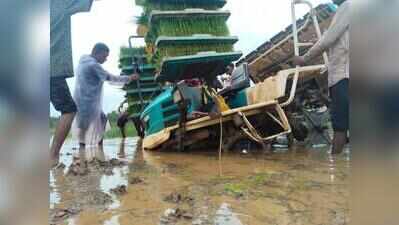
Panaji: Delayed desilting of a rivulet in Sarmanas, Bicholim, has left paddy fields waterlogged for the fourth consecutive year, severely affecting transplanting operations.“Overflowing water from the silted rivulet inundates low-lying fields soon after paddy transplantation, damaging crops and making it difficult for farmers to continue cultivation,” said farmer Meghnath Gaonkar.“After transplanting, the fields get flooded, and the entire crop is affected. Farmers are investing time and money, but if we don’t get a proper yield, all that effort goes to waste,” he said.He further said that the laborious task of ploughing in such conditions has become so tough that even machine-powered equipment in difficult to operate.
CJP Jantar Mantar Protest Updates
As a result, the flooding has also disrupted mechanised farming operations.Agriculture service provider Dinesh Harmalkar, who is among the directorate of agriculture’s authorised service providers offering mechanised transplantation at 50% subsidised rates, said tractors and paddy transplanters frequently get trapped in the waterlogged fields.“These are automatic, sensor-based machines. Once they get stuck, there can be electrical failures and other mechanical damage. It also takes considerable time and effort to recover the machinery,” he told TOI.The delays have a cascading effect on transplantation schedules across villages. Mechanised paddy transplantation is carried out within a fixed window from June 15 to July 30, with each day earmarked for a different village.“If we lose an entire day trying to retrieve machinery from flooded fields, it affects the next day’s schedule and the commitments made to other farmers,” Harmalkar said.“In places such as Siolim and Oxel, some farmers resorted to manual transplantation because the subsidised mechanised service is generally available only once. Opting for a second round means paying the full cost, which many farmers simply cannot afford,” he added.Farmers have urged authorities to expedite desilting of the rivulet before increasing rainfall aggravates the situation further.“We have only managed to transplant 35,000 ha of land so far, from the 70,000 ha of land. Delaying the transplanting process would translate to delay of the harvest,” another farmer said.Prasanna Kumar, assistant director, agriculture, said, “The matter has been brought to the attention of the department, and appropriate action will be taken in this regard.”“The water resources department (WRD) has already initiated the process of desilting the rivulet and is currently in the tendering stage. In some stretches, excess water has accumulated, preventing paddy transplanters from operating. We have also directed our zonal agriculture officer to inspect the site. Farmers now have two options—they can either pursue the desilting work through the WRD or form a community farming group with the agriculture department’s support to undertake the work themselves. Depending on what the farmers prefer, the necessary action will be taken,” said agriculture director Chandrahas Desai.