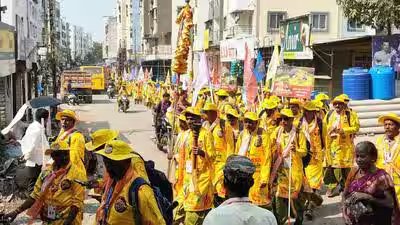









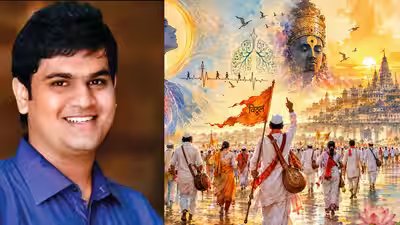
Every year as the monsoon clouds gather over Maharashtra thousands of feet begin moving towards one destination – Pandharpur. They walk for days across villages, fields and highways carrying little more than faith on their shoulders and the name of Vitthal on their lips. To an outsider the Pandharpur Wari may appear to be one of the world’s largest religious pilgrimages. To a warkari it is a journey of surrender. Yet if one pauses long enough to observe the wari through another lens something remarkable begins to emerge. Hidden within centuries of devotion lies an astonishing understanding of the human body. Author and talk-show host Rhythm Wagholikar walked with the warkaris this year and had a profound experience. Sharing his thoughts, he says, “Long before fitness trackers counted steps and neuroscientists studied meditation the warkaris had unknowingly designed a moving laboratory of physical emotional and mental wellbeing.”Rhythm says that the wari is one of the few traditions where spirituality is not experienced sitting still. His experience led him to read up a lot about the connection of the wari with physical and mental well-being.“It is lived through movement. Every step, every clap, every chant, every leap and every breath forms part of a rhythm. Walking itself is among the simplest yet most effective forms of exercise. The average warkari walks between fifteen and twenty five kilometres every day for several days. Such sustained walking strengthens the body and stimulates the release of endorphins that naturally elevate mood while reducing stress hormones,” he adds.Yet the wari is not merely about covering distance. It is about walking in synchrony.“Researchers studying collective rhythmic movement have observed that when people walk together, sing together or move together their breathing patterns gradually begin to align. This shared rhythm fosters emotional bonding, reduces feelings of loneliness and creates an extraordinary sense of belonging. Anyone who has walked even a few kilometres with the Warkaris instinctively recognises this feeling. Strangers begin as fellow travellers and often return home as family,” says Rhythm.The repeated invocation of “Vitthal Vitthal” may sound like a simple devotional expression yet it creates a fascinating physiological response. Rhythm, who has done some reearch in the area, adds, “Repetitive chanting naturally slows the breathing cycle and activates the vagus nerve which plays a central role in regulating the parasympathetic nervous system often referred to as the body’s rest and recovery mechanism.Perhaps one of the most overlooked aspects of the Wari is the joyful clapping that accompanies the abhangs. To the casual observer clapping may appear symbolic. In reality it is a surprisingly dynamic physical activity. Clapping also transforms passive listening into active participation. Every devotee becomes part of the music.Then there are the moments that fill every first time visitor with wonder.Without warning hundreds of Warkaris begin jumping together while singing the names of Vitthal. What appears spontaneous is in fact a full body workout hidden within celebration.“Gentle repetitive jumping engages the calf muscles, thighs, core and lower back while strengthening bones through weight bearing impact. It challenges balance, improves coordination and briefly elevates heart rate providing cardiovascular benefits,” shares Rhythm.The music itself deserves equal attention. Abhangs are rarely hurried. Their tempo encourages steady breathing, measured footsteps and emotional immersion. Neuroscientists have long recognised music’s ability to influence heart rhythm, brain wave activity and emotional processing. Familiar melodies also strengthen memory while group singing reduces perceived exertion making long hours of walking feel surprisingly effortless.Rhythm adds, “The Wari also gently disconnects participants from the overstimulation of modern life. Mobile phones become secondary. Deadlines disappear. Meals become simpler. Sleep follows the natural rhythm of physical exertion. Conversations become unhurried. Sunrise and sunset regain their importance. Many wellness retreats today attempt to recreate precisely these conditions through digital detox programmes, mindful walking retreats and nature immersion experiences. The Wari has offered all of them for centuries without ever marketing itself as wellness.“As I walked towards Pandharpur this year I found myself reflecting not only on Vitthal but also on the remarkable intelligence hidden within our traditions. Every clap awakened the senses. Every chant steadied the breath. Every leap dissolved hesitation. Every shared step reminded me that healing is sometimes less about discovering something new and more about remembering something ancient,” shares Rhythm.Perhaps that is the quiet genius of the Pandharpur Wari. It never asks whether you arrive as a believer, a seeker, a scientist or simply a curious traveller.“It simply asks you to walk. And somewhere between the rhythm of your footsteps and the sound of countless voices calling out “Vitthal Vitthal” you may discover that the journey has been gently transforming your body your mind and your heart all along,” concludes Rhythm about his experience in the wari.