








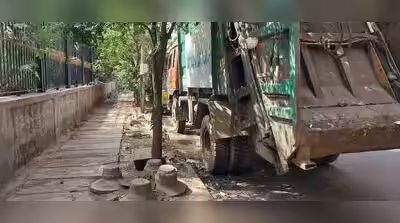
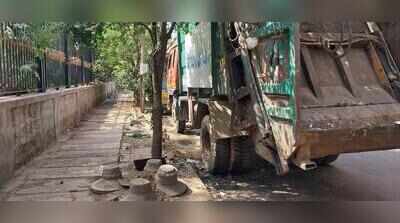
Bengaluru: Even as Greater Bengaluru Authority (GBA) clears encroachments under its ‘Safe Footpaths’ drive, roadside solid waste transfer operations continue to block pavements across the city. Garbage is routinely shifted from auto tippers to larger compactors on footpaths and roadsides, forcing pedestrians onto busy carriageways.One such stretch is on Krishna Rajendra Road near National College Metro station. Auto tippers, compactors parked along the road, and heaps of trash leave little space for pedestrians, pushing them onto the main road.To eliminate roadside waste transfer, Bengaluru Solid Waste Management Ltd (BSWML) plans to set up a network of permanent transfer stations where waste will be moved indoors using specialised machinery. Instead of conventional compactor trucks, the stations will load waste into leak-proof capsule trucks for transport to processing facilities.Three transfer stations, each with a capacity of 150 tonnes per day (TPD), are already operational — in Chamarajpet, BTM Layout, and Sarvagnanagar assembly constituencies. Two larger stations of 200 TPD each are under construction in Vasanth Nagar and Vijayanagar. Another 25 are planned, taking the total to 30 transfer stations across the city within about a year. Each station is expected to cost Rs 11-14 crore, putting the overall project cost between Rs 330 crore and Rs 420 crore.“Most of the funding is from the state govt, while a portion comes from the Centre’s Swachh Bharat Mission,” BSWML CEO Karee Gowda said.A BSWML official said the upcoming stations will have a capacity of 265 TPD each but, unlike the three existing facilities, will not include automatic waste segregators (AWS). Sources cited budget constraints and the technology’s relatively slow processing speed of about 5 tonnes an hour. “The current budget does not permit inclusion of AWS, and the system itself has a segregation capacity of only around 5 tonnes an hour,” the official said.Land challengesBSWML will build the facilities before handing them over to the respective city corporations for operation and maintenance. However, identifying suitable land remains a major challenge.“In some constituencies, residents are opposing the project as they fear land earmarked for parks will be used for transfer stations. In one case, the park was barely being used,” the official said.Residents say existing roadside transfer points continue to hamper walkability. A transfer point on Outer Ring Road in Banashankari, between Kadirenahalli Cross and Devegowda petrol bunk, was recently shifted, but locals say they have been told a permanent transfer station may come up there.Saranyan Rajagopalan, a resident, said the transfer activity stopped about two weeks ago. “We understand there is a shortage of land, but authorities should identify more suitable locations. There is a large vacant parcel in Kadirenahalli. A station along the ORR may not be the best idea,” he said.In HAL Township, resident Deeprekha Rajpoot said footpaths near HAL Market remain clogged with garbage dumped by traders and residents. Although waste is cleared about once a week, she said the site is never fully cleaned, leaving the footpath unusable and contributing to a growing rat menace.Responding to concerns over transfer points occupying footpaths, Karee Gowda said alternative land has been difficult to find. “Please find us land and we will shift the transfer points. Once the new transfer stations are ready in about a year, these roadside spaces will no longer be needed,” he said.