








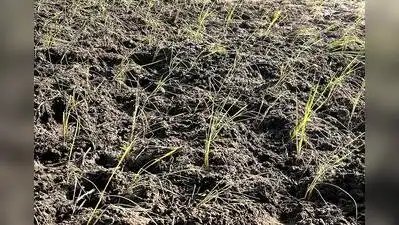
Margao: A prolonged dry spell coupled with scanty rainfall has left farmers across South Goa staring at the prospect of a poor harvest this season, with paddy transplantation stalled in large swathes of the district even as the sowing window narrows.Most paddy fields had already been ploughed in anticipation of the monsoon before sowing began, but the dry spell that has followed has upset farmers’ plans, forcing many to delay transplantation indefinitely while they wait for the rains to pick up.Agriculture officers confirmed that while standing nurseries have not suffered damage so far, the situation could worsen rapidly if the dry spell persists.In Quepem, zonal agriculture officer Siddhi Prabhugaonkar said transplantation had been delayed across the taluka. “There is no situation where the crop has been damaged after transplantation, but if the dry spell continues for another week, the situation could change for the worse. It needs to rain over the next week for transplantation to proceed,” she said.She added that the majority of farmers were yet to transplant their paddy, with only those who had adequate access to water having done so. Farmers who had raised their own nurseries were ready for transplantation but had held off due to the dry conditions, and were currently sustaining their nurseries through alternative irrigation arrangements.In Sanguem, zonal agriculture officer Agresh Shirodkar said transplantation had not been carried out in most parts of the taluka, including in Netravali, which has a significant area under paddy cultivation. Only some areas of Rivona had seen transplantation completed so far. “Wherever water sources such as streams and creeks are available, irrigation has been possible. But if it doesn’t rain over the next few days, these fields too could be affected. If the dry spell continues, the crop may die, as streams and creeks themselves run dry without adequate rainfall upstream,” he said.He added that in Netravali, most farmers depend on mechanised transplantation, which has caused further delays as they wait their turn for machinery.In Canacona, zonal agriculture officer Mahendra Pagi said transplantation had been completed only in a few upland (morod) areas of Cola, which rely entirely on the monsoon and use the broadcast sowing method. “Retention of moisture is doubtful if it doesn’t rain soon,” he said.In Gaondongrim and Cotigao, cultivation remains at the nursery stage, with five to six days still available before transplantation must begin. “If it rains in the next two to three days, there is unlikely to be any problem. In all the fields inspected so far, there has been no damage,” Pagi said, adding that a delayed onset of monsoon had led to farmers delaying nursery preparation, limiting the impact so far.In Salcete, agriculture officers said the rainfall situation was unlikely to significantly affect paddy cultivation, as the scanty rain received so far had been sufficient to maintain water levels in fields where transplantation had already been completed. However, in most areas of the taluka too, transplantation remains pending.Meanwhile, the directorate of agriculture has issued an advisory to paddy farmers, asking them to take precautionary steps to minimise crop stress. Farmers are advised to provide protective irrigation wherever possible, maintain shallow water levels in transplanted fields, and postpone transplantation until adequate rain or irrigation is available.In case of complete crop loss due to adverse weather, farmers may report to their nearest zonal agriculture office under the Shetkari Adhar Nidhi Scheme, director of agriculture Chandrahas Dessai said.