








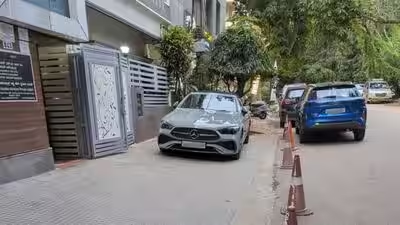
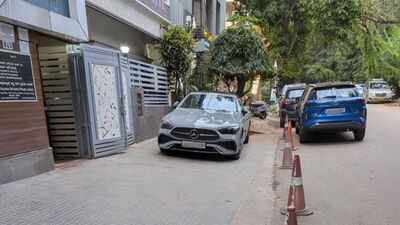
Once again, a problem that exists in almost every Indian city has been brought to the fore with a single picture of a luxury Mercedes parked fully on a Bengaluru footpath. The image was shared on X by Biocon chairperson Kiran Mazumdar-Shaw who called the act ‘shameful behavior! no civic sense’. Thousands of citizens identified with her statement, because what happened was not rare but a daily reality for pedestrians in India. The episode also coincided with a ‘Safe Footpath’ campaign by Bengaluru authorities to rid the pavements of encroachments and illegal parking.But the debate is about more than one luxury car or one city. That raises a larger question: why has illegal and thoughtless parking become one of India’s biggest civic problems?India has become a nation of vehicles but not of parking spacesOver the last two decades, vehicle ownership in India has grown rapidly. Rising incomes, easier financing and expanding road networks have brought millions of new cars and two-wheelers on to the roads. Unfortunately, though, parking infrastructure has not kept up.
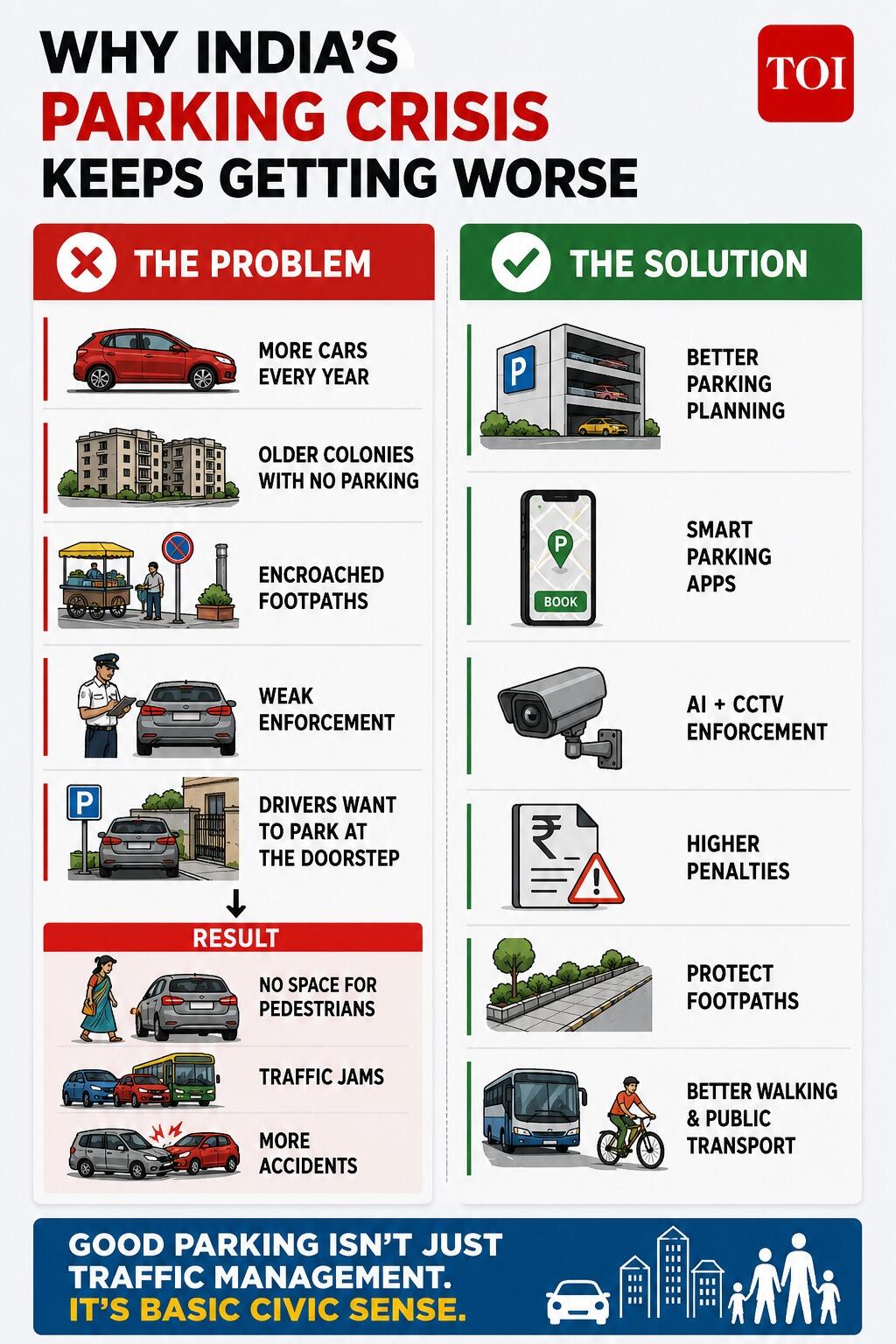
Many residential colonies were planned many decades ago when households had one scooter or one small car. Today, many families have two or three cars and many motorcycles. Older neighbourhoods just don’t have the space for them.The same problem exists in commercial areas. Shops, restaurants, clinics and offices attract many more vehicles than the parking facilities can hold. The inevitable consequence is: vehicles spill onto roads, pavements and even public spaces.
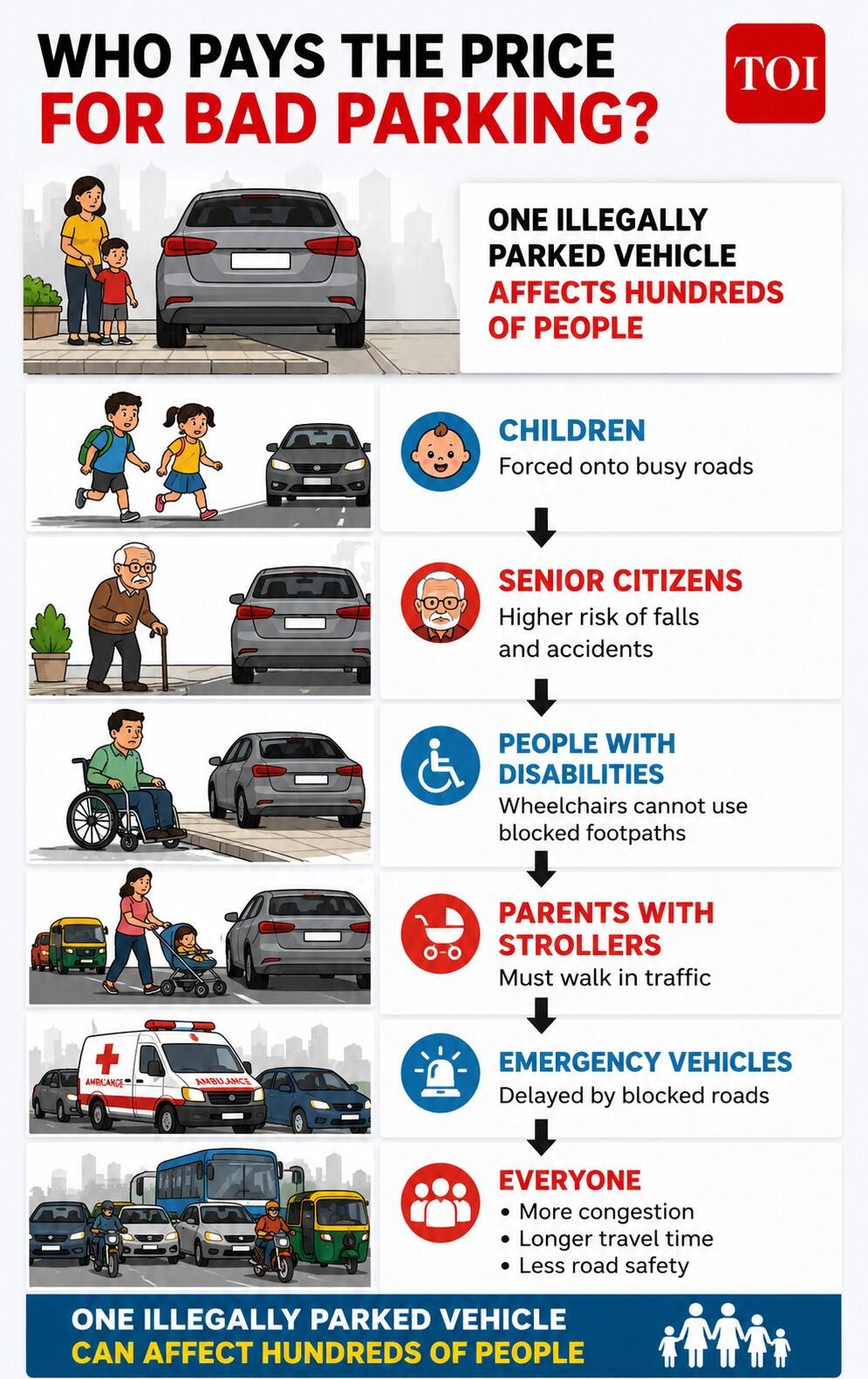
The first casualty is the footpathsTo many drivers, the road is a void. It’s the one safe place for pedestrians. Busy roads are crammed with people and cars are parked on footpaths. The elderly, children, people with disabilities and parents with pushchairs are most at risk of being caught up in it.Ironically, India spends thousands of crores every year on building footpaths under various urban development programmes, only to see many of them get blocked by parked vehicles, vendors or construction material. Mazumdar-Shaw’s critique resonated because the Mercedes in question had completely blocked pedestrian movement, a problem experienced daily in Bengaluru, Delhi, Mumbai, Hyderabad, Chennai and countless other cities.
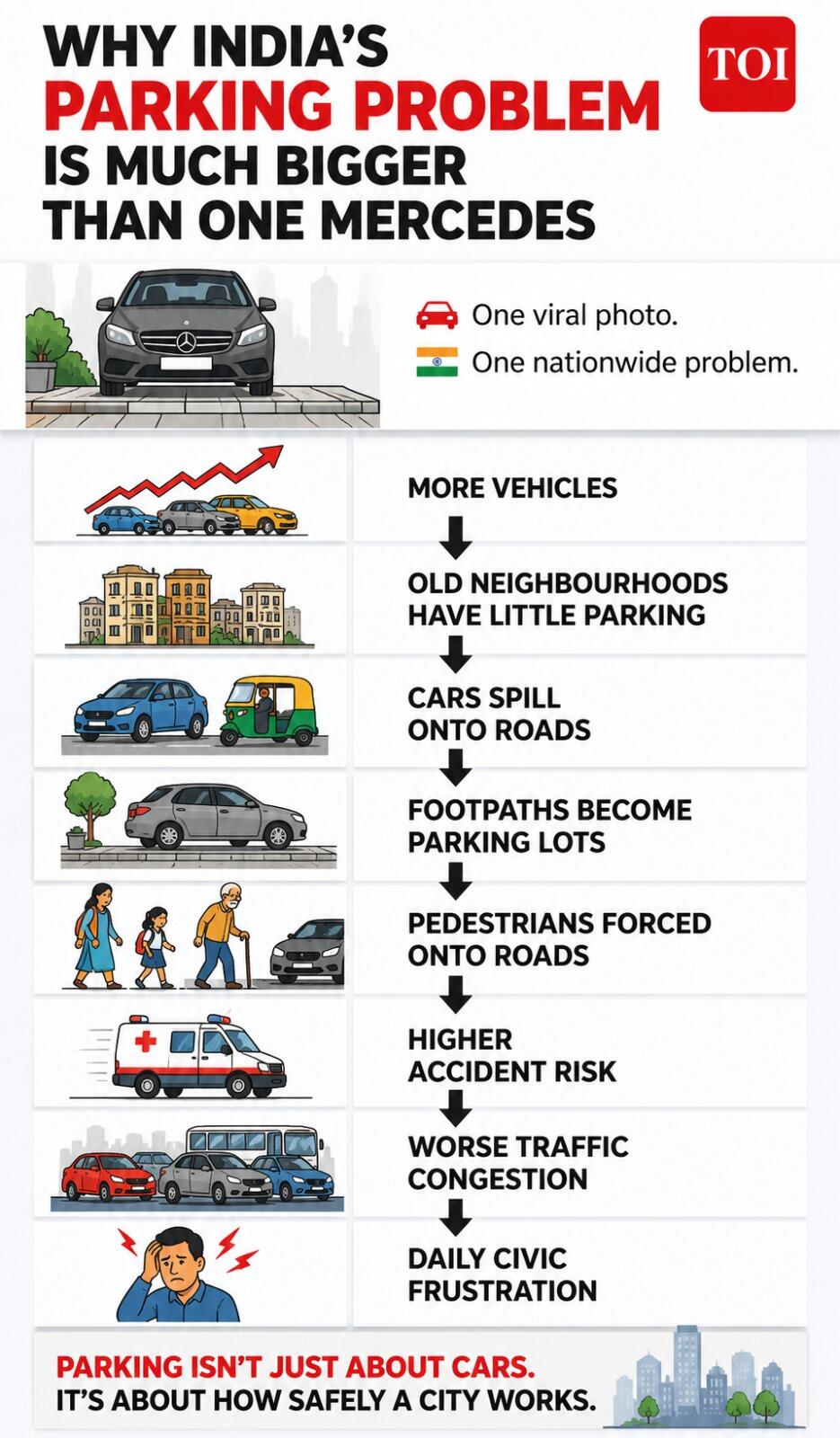
India’s weakest traffic rule still civic senseIllegal parking is not always caused by a lack of space. It’s often just convenience. Many drivers prefer to park right in front of their destination, rather than in a nearby parking garage that requires a short walk. Double parking, blocking driveways, parking on zebra crossings, occupying bus stops and leaving vehicles on narrow streets is now socially accepted in many places.Unlike speeding or drunk driving, for example, poor parking is seen as a minor offence in many cases. But the overall effect is enormous. One vehicle illegally parked can block traffic, block emergency vehicles, reduce road capacity and increase the risk of accidents.Lax enforcement leads to repeat offendersIn most Indian cities, there are rules against illegal parking. The problem is enforcement. Traffic police can’t watch every street all the time. In many cities the fine is still quite small compared to the hassle of having to find legal parking.Even where towing drives are put in place, enforcement is usually temporary. Motorists soon find that the chance of being penalised is slim. The experts often say the size of the fine is less important than certainty of punishment. Illegal parking continues to flourish if violations are not detected consistently.Urban planning didn’t anticipate future demandIndia’s cities have grown faster than its infrastructure. Many neighbourhoods were approved decades ago with little or no parking requirements. Builders frequently turned stilt parking into commercial or additional apartments. Then residents parked on the public streets.Meanwhile, newer commercial developments often create much greater parking demand than planners had first thought. The gap between the number of cars owned and the amount of parking available is growing wider each year.Encroachment is not just for vehiclesParking issues also touch on broader civic concerns. Utility boxes, transformers, construction debris, temporary structures, and street vendors often take up footpaths. The situation is made worse by parked cars when pedestrians are already pushed out of the pavements. The result is cities in which walking is difficult, dangerous, and often impossible.Paradoxically, by making things more walkable, we may reduce the need for private vehicles, and hence parking demand over time. Technology can help, but only if cities embrace it. Many cities around the world are now using smart parking systems. Sensors check for available parking spaces. Apps lead drivers straight to empty spaces. Dynamic pricing discourages long term occupation of premium roadside spaces.Breaches can be detected by automatic number plate recognition cameras without police being on permanent duty. Some Indian cities have incorporated elements of these systems, but the implementation is piecemeal and restricted. The adoption of artificial intelligence, CCTV networks and integrated digital payment systems at scale could considerably improve the management of parking.Why do luxury cars get more hate?There was a little focus on the vehicle involved in the Bengaluru Mercedes incident. Luxury cars often serve as symbols of privilege. When a fancy car blocks a public footpath, many citizens don’t see bad judgment, they see entitlement. Illegal parking cuts across income groups, though.The problem is two-wheelers, autorickshaws, delivery vehicles, SUVs and hatchbacks. The problem is behavioural, not economic. Parking reflects the civic culture of a city. Urban planners have described parking as a “mirror” of civic discipline.Cities where people respect parking rules tend to be more compliant with other regulations as well. Three things need to combine for good parking behaviour to occur: Enough infrastructure. Consistent enforcementPublic cooperation. If any one of these breaks down, illegal parking takes over. All three often confront India simultaneously.The path forwardMazumdar-Shaw’s viral post may have pointed to one incident but it has kicked off an important national debate.India’s urban future cannot be only about building more flyovers and wider roads. Cities should protect footpaths, enforce parking rules uniformly, and re-imagine neighbourhoods around people, not vehicles.Each car that’s parked illegally can feel like a minor inconvenience. But in the millions, these violations add up to less road capacity, more congestion, more risk for pedestrians and less respect for public spaces.You can’t solve India’s parking crisis simply by building more parking spaces. It’s about changing how people look at public space that is shared. Roads are for everybody. But pavements are too. Respecting both is a minimum of civic duty — and one that India’s fast-growing cities can no longer afford to overlook.