








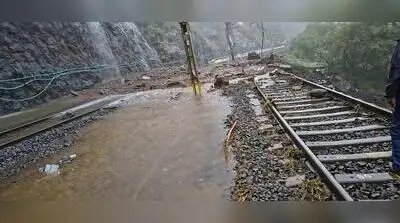
Pune: Recent landslides in the Pune-Mumbai ghat section have once again raised questions over slope stability and long-term mitigation measures. Geologists have stressed that scientific monitoring and year-round maintenance — not just pre-monsoon work — are critical to preventing such disasters.A senior geologist, choosing anonymity, told TOI that preventing landslides in the Western Ghats requires a combination of engineering and geological interventions. “There are several measures that need to be implemented, including subsurface drainage systems, sealing of rock cracks, structural stabilisation and scientific slope modification. Numerous parameters are involved and ignoring even one of them can trigger a landslide,” he said.The latest collapse between Thakurwadi and Monkey Hill on Central Railway’s (CR) Bhor Ghat section (southeast ghat section) caused unprecedented damage, said rail officials. Apart from massive quantities of debris crashing onto the tracks, nearly 50-60m of landmass supporting the railway line between the two locations was washed away, making restoration extremely challenging. The damage has led to the cancellation of around 30 trains, including three Pune-Mumbai intercity services, until July 17.Of the three railway lines in the section, only one is currently operational. Now, Central Railway officials said they expect a second line to be restored before July 17.The incident highlighted the vulnerability of the region’s basaltic rock formations during heavy rainfall. Explaining the region’s geology, the expert said the Pune ghat section consists of basaltic rocks formed by volcanic eruptions millions of years ago. He elaborated, “The lava that flowed during these eruptions cooled and solidified into basalt. Over time, weathering led to the formation of black cotton soil on the surface. This soil absorbs almost twice its volume in water, causing it to swell. During intense rainfall, the saturated soil loses stability and begins to slide, resulting in landslides.”Another geologist, who also requested to stay unnamed, said authorities should adopt a dedicated, year-round approach for vulnerable ghat sections instead of limiting maintenance to the weeks before the rainy season. “Pre-monsoon works generally begin in May. But, we are talking of highly sensitive stretches. A specialised task force should monitor them throughout the year, study global best practices from regions with similar terrain and continuously assess slope stability,” he said.A railway official, refusing to be named, said, “Proper monitoring and maintenance work on the section happen throughout the year.”Meanwhile, Central Railway chief public relations officer (PRO) Swapnil Nila said restoration work remains the immediate priority for now. “The entire focus right now is on operationalising the second line by July 17. During the landslide, not only did debris fall onto the tracks, but the ground supporting the railway line also caved in. Clearing debris is comparatively easier. Rebuilding the washed-away embankment, restoring the ballast and stabilising the track foundation is far more time-consuming. Our teams are working round the clock,” he informed.Nila said the section had remained free of landslides over the past two monsoons but had witnessed several such incidents earlier. “This is among the steepest ghat sections in the country and received nearly 2,400mm of rainfall. At present, our focus is on restoration. Over the years, Railways have undertaken several improvement measures to reduce landslide risks,” he said.The section had previously witnessed a major landslide in Aug 2019, disrupting train services for 13 days and affecting nearly 400 trains. Following this, Central Railway consulted a Swiss engineering firm based in Australia and implemented several slope protection measures, including strengthening tunnels and other vulnerable locations, significantly reducing the frequency of landslides in subsequent years.