








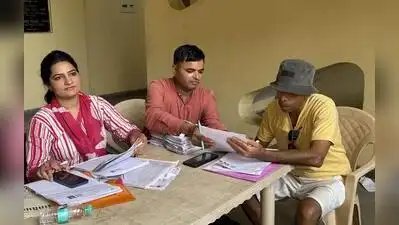
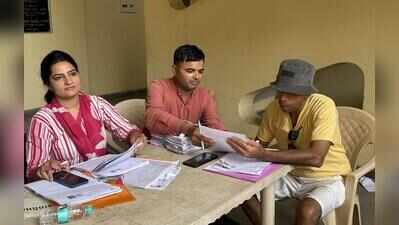
Gurgaon: A combination of inaccessible gated communities, demanding work schedules, complicated documentation requirements and technological limitations has slowed the special intensive revision (SIR) of electoral rolls in one of Haryana’s most urbanised districts.Hoping to complete the SIR, every morning at 9, Shweta begins knocking on doors in DLF-3. Most doors, however, never open. At several homes, domestic helps answer instead of residents. Those who do respond often ask her to return after office hours. “What am I supposed to do the whole day? It reduces our efficiency greatly,” she said, describing a routine that has become emblematic of the challenges facing booth level officers (BLOs) in Gurgaon’s upscale residential societies.With the deadline for the first phase of the SIR exercise looming, the Gurgaon district administration has identified nearly 100 polling booths where enumeration remains critically low. Ground visits by TOI to several societies reveal that the poor response is not merely the result of voter apathy. The difficulties are particularly acute in Gurgaon because a large proportion of voters remain “unmapped”. While mapped voters can complete the process by simply entering their name and EPIC number, only around 35% of voters in Gurgaon district are mapped. In Badshapur assembly constituency, which covers much of the Millennium City, the mapped voter percentage is only 21%, making verification significantly more time-consuming.Besides, repeated visits often test residents’ patience, says Praveen Malik, a BLO assigned to Sector 23, adding, “People get irritated because we visit again and again. Most ask us to come either on weekends or in the evening. But our duty is for the entire day. That reduces our productivity.”For Ajay Kumar, who covers Paras Irene, Tower Grace and Pyramid Homes in Sector 70A, even entering a society is a challenge. “Security clearance itself takes time. Once inside, residents ask us to sit in the clubhouse and allot us a two-hour window. During that period, only a limited number of residents come. It becomes impossible to cover the entire society,” he said.Even after reaching residents, the work often extends beyond distributing and collecting forms. “Most people are unable to fill the forms themselves and become angry with us. We end up filling every form. Officially, our role is to distribute, collect and upload the forms while guiding people. But in reality, we are filling forms for almost everyone. There is only so much we can do in a day,” another BLO said.The job has occasionally turned hostile. In Palam Vihar, a resident allegedly suspected a BLO of attempting theft and called the police. The BLO was taken to a police station before being released after intervention by the sub-divisional magistrate. In another incident in the DLF area, a resident allegedly let loose a pet dog on a BLO, leaving the official injured and requiring medical treatment for a dog bite.Residents, however, argue that they are being unfairly blamed for the slow pace of enumeration. SN Garg, a Gurgaon resident since 1988, said the process itself is proving difficult. “People are struggling to locate their details from the 2002 electoral records. Many BLOs are unable to help. The administration should have organised assistance camps to help residents fill the forms, as was done in Delhi and even Panchkula. Holding residents solely responsible for the slow digitisation is not correct. The administration also has a responsibility to facilitate the process,” he said.Another resident, Siddharth Sharma of Sector 50, questioned the cumbersome process of tracing old electoral records. “To search the 2002 record, one needs the EPIC number, booth number, school where the polling booth was located and even the serial number of the voter. How is anyone expected to remember all these details after 24 years?” he asked.For migrants and professionals, the problems are different. Suman Mishra, originally from Bihar but registered as a voter in Gurgaon, said the form requires details of family members who remain enrolled in Bihar. “When I searched for my parents’ electoral details on the Election Commission website, it simply showed ‘not available’. That makes completing the form difficult,” he said.Election officials privately acknowledge that the system has limitations. “Ideally, voters should be able to retrieve their records by simply entering their name and Assembly constituency. The system should then display matching records. That would make the process far easier,” an official said. He explained that the 2002 electoral database was digitised by a private IT company long before modern AI-based search capabilities were available, making record retrieval cumbersome.Recognising these challenges, the district administration is now planning a community-based intervention. Badshapur SDM Sanjeev Singla said the polling booths with poor enumeration have been identified. “We will share details of voters who have not completed the SIR process with resident welfare associations and estate managers, requesting them to contact residents and organise weekend camps. If residents participate, BLOs will also visit societies during the evening to complete the exercise,” Singla said.With the July 14 deadline approaching, officials believe the success of Haryana’s voter roll revision in Gurgaon may ultimately depend less on door-to-door visits and more on cooperation between residents, RWAs and election authorities to bridge the trust and logistical gaps that continue to hamper the exercise.