









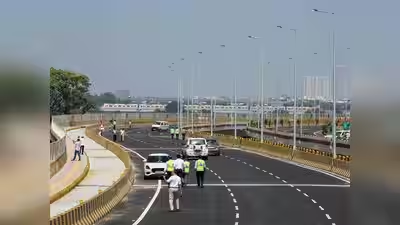
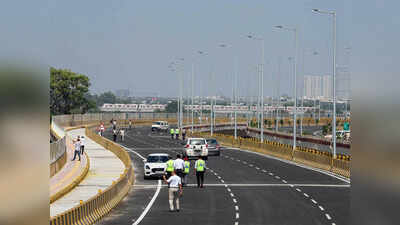
NEW DELHI: The Delhi Traffic Police has identified a structural bottleneck on the Old Barapullah Flyover as the key reason for the severe congestion following the opening of Barapullah Phase-III.In a post on X, Delhi Traffic Police said traffic from around eight to nine lanes is converging into just three lanes at a single point on the older flyover stretch.According to the traffic police, the Old Barapullah Flyover has three lanes, while the newly opened Phase-III flyover on the Mayur Vihar side, the Sarai Kale Khan loop and the DND loop each have around three lanes. The convergence of these roadways creates the bottleneck.The department said Google Maps was also not reflecting the live traffic situation accurately and was continuing to show the stretch as green. Traffic personnel have been deployed at the merging points to regulate vehicle movement.To ease the congestion, traffic coming from Barapullah Phase-III is being diverted towards NH-24/DND, Delhi Traffic Police said.The clarification came after a journalist posted about a 2-km traffic jam from Mayur Vihar towards AIIMS, claiming that even an ambulance had been caught in the congestion.The traffic snarls have emerged soon after the opening of Barapullah Phase-III, which was expected to improve connectivity between Mayur Vihar and Sarai Kale Khan and ease movement towards central Delhi.Meanwhile, the Centre has approved a ₹1,789.52-crore Intelligent Traffic Management System (ITMS) for Delhi Police to improve traffic management through real-time monitoring, adaptive signals and automated enforcement.The project will cover 42 traffic corridors and is scheduled to be implemented in three phases over 24 months, followed by five years of operation and maintenance.The ITMS will include 1,092 Adaptive Traffic Control Systems and 1,029 enforcement locations. Unlike Delhi’s existing fixed-time signals, adaptive systems will adjust signal timings according to real-time traffic conditions.The system is also expected to enable green corridors and priority movement for emergency vehicles, detect congestion and road incidents in real time, and facilitate quicker diversions.Digital message boards and connected platforms will provide information on congestion, diversions, parking availability and traffic conditions, while AI-based systems will assist in detecting violations including speeding, red-light jumping, wrong-way driving, illegal parking and use of mobile phones while driving.Delhi has around 71 lakh active registered vehicles, with vehicular growth outpacing the expansion of road infrastructure. The ITMS is intended to improve the use of the existing road network through real-time traffic intelligence and dynamic traffic management.