



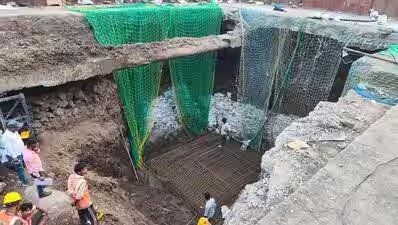
Pune: One piece of the city’s history has been rescued from a corner under a peepal tree in Kothrud. Another—a 150-to-200-year-old well bearing traces of the late Peshwa and British periods—risks being lost under a flyover pier near Bund Garden.The contrasting discoveries have raised fresh questions over the preservation of the city’s historical remains, particularly as the well, exposed during excavation, still holds water. During a site visit by TOI, a pipe was seen draining water from the well into a gutter even as Pune grapples with acute water stress following a drought.“The Lord Hanuman sculpture, estimated to be 700 to 800 years old, was spotted on Nov 23 by history researcher Abhishek Wagh and his friend Jayesh Shinde under a peepal tree in Rahulnagar, near Karve statue in Kothrud. It was lying beside a tea stall,” said Sachin Joshi, an archaeologist at Deccan College.“My attention was drawn to it because I realised it was something unusual. Given my background in history, I went closer to examine it,” said Wagh, who holds a PhD in the subject. The duo took geotagged photographs of the sculpture in situ before handing it over to the Bharat Itihas Sanshodhak Mandal for safekeeping.“Measuring approximately 5 inches by 6 inches and 2.5 inches thick, the stone sculpture depicts Lord Hanuman holding the Dronagiri mountain in his right hand. A round object is visible in the left hand, though its identity remains uncertain. The figure also features anklets, a loincloth, and an elaborate carved frame,” said Joshi, who guided Wagh and Shinde in documenting the artefact before facilitating its transfer to the Mandal’s museum.Joshi noted that the frame, known as a devakoshtha, and its architectural style point to a connection with temples of the Yadava period, dating back to the 12th and 13th centuries. Similar features are seen at temples such as Gondeshwar near Nashik and Bhuleshwar near Pune.“It is unlikely to have been the principal deity in a temple’s sanctum. It was more likely one of the subsidiary images placed on a temple’s exterior walls or pillars,” Joshi said. While its exact origin remains unknown, Pune had several temples from that era, including the historic Punyeshwar temple.The well, meanwhile, faces a far bleaker prospect. Exposed during excavation for a flyover pier near Bindu Madhav Thackeray Chowk (Shahadwal Baba Dargah) in the Yerawada–Vishrantwadi area, it lies directly beneath the proposed pier’s footprint.Joshi estimated the well’s age at 150 to 200 years based on three distinct layers of masonry: a stone foundation, a late Peshwa-period middle section, and an upper layer from the British era.According to him, the well had been filled with soil and stones during earlier roadworks. Recent excavation re-exposed it, though part of its wall was damaged and some stones were removed. Water began accumulating again once the debris was cleared.Warning that the pier’s foundation will cut directly into the well, putting the remaining structure at risk, Joshi suggested renovating the surviving portion and covering it with a protective slab, subject to technical feasibility. He added that no heritage officials had visited the site for an assessment.A Pune Municipal Corporation (PMC) road department official said only around 30% to 40% of the well’s arch remains intact, noting that substantial damage had occurred when a stormwater line was laid there 10 to 20 years ago. He confirmed that the pier would go ahead as planned, though natural water channels would not be blocked and the existing stormwater line would be reconnected.“The natural streams will be maintained; we will not close them,” the official said, without clarifying whether the surviving historic masonry would be conserved.A local resident visiting the site questioned the wastage of water. “There is already such a severe water shortage. Letting it flow into a drain is not an option. It must be saved and put to use,” he said.