









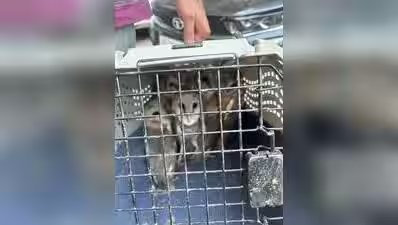
Noida: Seven owls, including two adults and five owlets, have been rescued from a highrise in Greater Noida West, ending a weeklong ordeal for the residents. Over the past 10 days, residents claimed the owls swooped down on anyone passing through parking areas, lobbies and open spaces late at night or early in the morning and attacked them with their sharp talons. As many as seven people were allegedly injured in these attacks.Owls generally do not attack humans and are shy birds that prefer to keep their distance. However, they can become aggressive when they feel threatened, particularly while protecting their nests or chicks. During breeding season, some species may become more territorial and dive-bomb people who approach too closely.The birds were rescued on Monday from a shaft in Tower 5 of La Residentia by a team of the district forest department and would be relocated to Surajpur Bird Sanctuary.Last week, Tower 4’s Bijoy Tripathi reached home one night at 11. As soon as he parked his car, an owl swooped down and struck him twice on the back of his head. He had to get stitches and anti-rabies shots. “My neighbours got very scared and they started staying indoors after sunset,” he said. “Many of them had even started wrapping their heads in blankets or wearing helmets to keep the birds away.”Another resident, Sumil Jalota, then reached out to wildlife conservation experts and filed a complaint with the forest department. Expert volunteer rescuer and wildlife photographer Ashish Tak, along with Dr Vineet Arora, watched the birds for three days to study their behaviour.On Sept 14, a team of Surajpur forest ranger Ram Avatar Choudhary, forest officer Rahul Thakur and a veterinary doctor trapped the seven birds from the shaft. The owls have been kept under observation. “Once cleared, they will be released into the Surajpur Bird Sanctuary, a protected wetland environment in Greater Noida, far away from urban concrete developments,” Choudhary said.The rescue brought relief to the residents but environmentalists are ringing a warning bell.Environmentalist Pradeep Dahalyia said the owls did not invade human space; rather, humans built over theirs. “Birds like owls rely on specific natural food chains and nesting sites. When we flatten forests, these creatures cannot simply disappear overnight. True, sustainable development must preserve old trees and respect the natural habitats of native wildlife,” he said.He added that in the past, a sprawling, contiguous ecosystem of dense forests stretched from Surajpur wetland, from the police lines to Bisrakh (near Hindon) and Parthala. This was a rich green cover that served as native nesting grounds for diverse wildlife. Over time, rapid construction, highrises and concretisation led to severe loss of tree canopies, which forced the birds and other species in the area out of their natural habitat, just like the owls were forced into the building shaft to survive.