







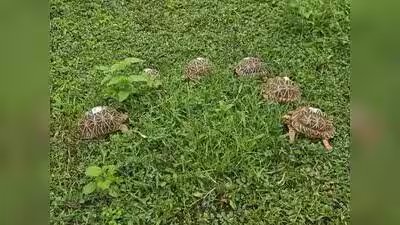
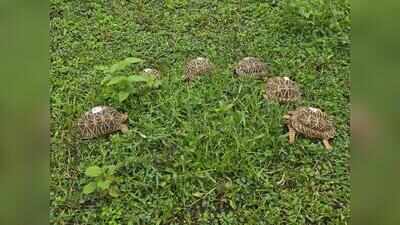
Mumbai: In a significant move for wildlife conservation, 216 rescued Indian Star Tortoises were successfully rehabilitated in Tadoba Andhari Tiger Reserve (TATR) from Mumbai and Thane. This massive rehabilitation marks the official launch of Project STRIPES (Star Tortoise Repatriation Initiative Protecting Endangered Species), a dedicated initiative of Forest Department and RAWW aimed at restoring trafficked reptiles back into their natural habitats.“This initiative aims catering to a recurring issue of Star Tortoises which are regularly recovered and seized in Mumbai and MMR that can be reintroduced to their natural habitat in a structured and scientifically managed framework for periodic rehabilitation exercise,” said the founder of Resqink Association for Wildlife Welfare (RAWW), Pawan Sharma, who is also the honorary wildlife warden of state forest department.The successful operation was executed by a collaborative 10-member team comprising wildlife experts and personnel from Maharashtra Forest Department’s Mumbai Range and RAWW. The entire mission was conducted under the guidance of Principal Chief Conservator of Forests (PCCF) & Chief Wildlife Warden of Maharashtra State, and closely supervised by Deputy Conservator of Forests Thane, Assistant Conservator of Forests Thane and the Range Forest Officer (Mumbai) of Territorial Wing of Forest Department.The 216 tortoises were previously seized during various law enforcement crackdowns on illegal wildlife trafficking, as well as separate rescue operations across Mumbai and Thane regions. 150 Star Tortoises were under rehabilitation and care of RAWW and the remaining were with Thane TTC (Transit Treatment Center) of Forest Department, TCPCA, PAWS and WWA.To ensure maximum safety, the reptiles were transported over 800 kilometres in a specialised wildlife ambulance of RAWW.They were carried in ventilated carriers with cushions, with the transit team taking planned, regular halts to monitor health and hydration parameters.Upon arriving at Tadoba, the tortoises underwent a comprehensive medical re-examination and an overnight resting period. Following strict conservation guidelines, they were released batchwise into designated forest ranges with a scientifically calculated male-to-female ratio to support long-term population sustainability.This successful rehabilitation underscores State Forest Department’s rigorous commitment to combating wildlife crime and ensuring that victims of the illegal pet trade are successfully rehabilitated into the wild, added Sharma.