









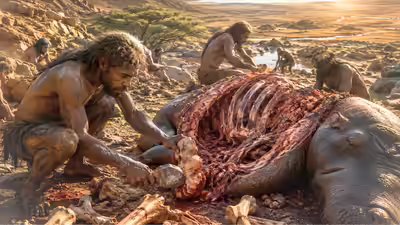
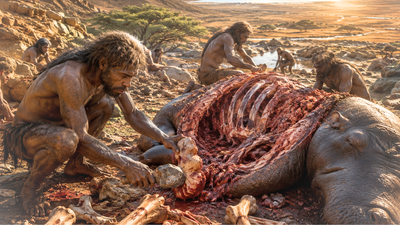
For decades, scientists have debated whether the earliest humans survived mainly by hunting animals or scavenging carcasses left behind by predators. Now, a new study of 1.6 million-year-old fossils from Kenya suggests the answer may be far more complex. Researchers analysing ancient animal bones, stone tool marks and hominin remains from the Koobi Fora Formation found evidence that early humans likely used a flexible mix of hunting, scavenging and carcass processing to secure meat. The findings, published in Proceedings of the National Academy of Sciences, provide a clearer picture of how the earliest members of the genus Homo adapted to dangerous environments and steadily improved their survival strategies.
Ancient bones reveal how early humans secured meat
The research focused on fossil assemblages discovered in the Koobi Fora Formation in northern Kenya, a site famous for preserving evidence of early human evolution. Scientists examined animal bones, hominin teeth and stone tools dating back around 1.6 million years.Many of the bones carried cut marks made by stone tools, along with percussion marks left behind when bones were smashed open to extract marrow. Researchers also found carnivore tooth marks, helping them reconstruct the sequence of events surrounding carcass use.By studying these traces together, the team could determine whether humans reached carcasses before or after predators and how thoroughly the remains were processed.The analysis suggested that early humans often accessed animal carcasses while substantial amounts of flesh, fat, and nutritious tissue were still attached to the bones. This indicates they were not merely scavenging leftovers abandoned by predators long after feeding. Instead, the findings point to a more active and strategic role in obtaining meat, either by reaching carcasses shortly after a kill or by competing directly with other carnivores for fresh remains. Researchers say this behaviour would have provided early humans with access to calorie-rich food sources that likely played an important role in supporting brain growth, survival, and social cooperation.Researchers also found evidence that hominins transported the meatiest parts of animals to other locations for further processing and consumption. Bones were frequently broken apart to reach nutrient-rich marrow, which would have provided valuable calories and fat.At the same time, some fossils showed only limited human modification, suggesting that scavenging still played a role in their survival strategy.
A mix of hunting and scavenging
According to the study’s lead author, biological anthropologist Francis Forrest, the findings point to a balanced and adaptable approach rather than a strict dependence on either hunting or scavenging.Instead of relying on one method, early humans likely adjusted their behaviour depending on the availability of animals, competition from predators and changing environmental conditions. This flexibility may have been one of the key traits that allowed humans to survive across different habitats.The study also highlights the importance of cooperation, tool use and learning in early human communities.
The significance of the discovery
Scientists have long considered meat consumption an important turning point in human evolution because it provided concentrated nutrients that may have supported brain development and increased energy demands.The new findings help researchers move beyond the simple debate over whether early humans were hunters or scavengers. Instead, the evidence paints a more realistic picture of adaptable foragers capable of responding to changing circumstances.Researchers say future studies will continue exploring how animal size, habitat and behaviour influenced the feeding patterns of early humans.