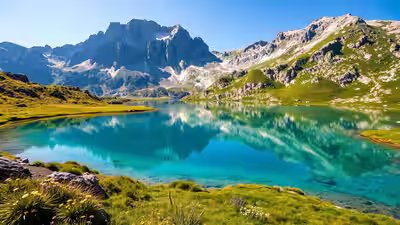









Researchers tracked 724 Northern Hemisphere lakes from 2000 to 2022; above critical winter temperatures, ice-loss sensitivity rose up to 22-fold and could shorten seasons by 40 days

Study says Northern Hemisphere lakes may lose 40 days of winter ice by 2100 (National Geographic photo) Winter ice on lakes plays an important role in keeping lakes healthy by controlling water temperature, supporting aquatic life and helping maintain the natural balance of freshwater ecosystems. However, scientists say this seasonal ice cover is disappearing faster…

Read More

Meet Roy Kim, the 13-year-old Oregon student who designed a chamber that turns moisture in the air into water for drought-hit farms

“Do what you can do tomorrow, today,” says Roy Kim, a 13-year-old Oregon student who has solved the water crisis for numerous farmers in the region. The teenager developed a device that turns moisture in the air into water, helping farmers access a sustainable and reliable source of water in drought-prone areas, as per a…

Read More

A Massachusetts farmer has put 832 tracking solar panels over his crops. The land now grows food, electricity and extra farm income all at once

The Massachusetts project is an example of agrivoltaics, a nascent farming practice that combines agriculture with solar energy generation on the same land. Farmers have relied on sunshine to grow healthy crops for generations. But as they say, excess of anything is bad and with climate change causing hotter summers, longer droughts and erratic weather,…

Read More

Ghana’s capital discards 300 tons of plastic per day, now they mix it with sand and use it as street paving that is cheaper than concrete

Ghana is transforming its plastic problems into paving blocks for its roads, sold below the price of concrete blocks. Behind this operation is Nelson Boateng, who graduated in computer network engineering, and was already manufacturing plastic bags and began transforming the same material into flooring. The plastic Ghana cannot contain Accra, the capital of Ghana…

Read More

In 1869, the Suez Canal connected the Red Sea to the Mediterranean; over 150 years later, 120 fish species have crossed and scientists predict the next three

More than 120 fish species have migrated from the Red Sea into the Mediterranean Since the Suez Canal opened more than 150 years ago, more than 120 fish species have migrated from the Red Sea into the Mediterranean. Researchers at Tel Aviv University have now created a statistical model that predicts which species are likely…

Read More

Minnesota’s largest coal plant once burned 30,000 tonnes daily; its existing wires now carry 710MW from 1.7 million solar panels powering about 150,000 homes

America is retiring coal plants slowly and steadily. The boilers are cut up for scrap, the smokestacks get dropped on camera and the land tends to sit in permitting limbo for a decade. But in Becker, Minnesota, the state’s biggest coal plant is being used, not for all this hardware but for a plug.On July…

Read More

Around 150 BCE, Aksum rose along Red Sea trade routes; researchers say surviving Tigray grapevines may preserve part of that ancient agricultural legacy

A lost chapter in the history of Ethiopia agriculture Picture yourself wandering through a tranquil village in the northern Ethiopian highlands, a gnarled grapevine sheltering from the afternoon sun over a stone courtyard. It is a familiar part of daily life for local families, a source of sweet fruit, a place to gather, and a…

Read More

In 1966, scientists wiped out nearly every insect on tiny Florida islands to see how nature would rebuild itself |

Image(s): Florida Key Isaland/Canva Imagine erasing almost every insect and small animal from an island, then watching nature rebuild itself from scratch. That was exactly what a team of ecologists did in the Florida Keys during one of the most influential ecological experiments ever conducted. In 1966, researchers enclosed tiny mangrove islands in enormous plastic…

Read More

South Africa released 11 formerly captive elephants onto wild reserves; five years later, their behaviour closely matched elephants that had never lived in captivity

Rewilded elephants on Khamab Kalahari Reserve, who were observed during this research project (from left to right: Ngwedi, Mana, Michael, and Chikwenya) South Africa released 11 elephants that had spent years in captivity into protected reserves. Five years later, researchers found that their behavior was very similar to elephants that had always lived in the…

Read More