








Scientists sent a robot two miles below California and found a bigfin squid; it was the first live Northeast Pacific sighting

Photo credit: Monterey Bay Aquarium Research Institute Two miles below the surface of the Pacific Ocean, off the coast of California, in a world of near total darkness and crushing pressure, a remotely operated vehicle glided silently through the water. Its cameras were scanning the deep for the strange and the seldom-seen when something extraordinary…

Read More

In 2019, conservationists brought red-billed choughs back to Kent after 200 years; 35 birds are now living there |

Red-billed choughs are re-establishing themselves in Kent, with the county’s population now standing at 35 birds following a summer in which eight wild-born chicks successfully fledged. Kent Wildlife Trust confirmed the figure this week, noting that the latest additions take the total number of wild-born choughs to nine since the species returned to the county….

Read More

All known life uses 4 DNA letters; UC San Diego showed an existing bacterial enzyme can accurately read and transcribe 8, doubling the genetic alphabet with synthetic letters

Representative image of DNA All life on Earth, from bacteria to blue whales, writes its genetic instructions using the same four-letter alphabet. These four DNA bases, usually referred to as A, T, C and G, pair up in predictable ways to store and pass on the information needed for life. Now, researchers at UC San…

Read More

In 2018, scientists moved wolves to an isolated island to rebuild its ecosystem; five years later, researchers found out if it worked |

A new study reveals that wolves brought back to Isle Royale National Park are building a self-sustaining population. Researchers observed the wolves from September 2018 to September 2023 after the National Park Service released 19 animals captured in Minnesota, Michigan and Ontario. The population grew steadily during this period, reaching a minimum of 27 wolves…

Read More

Scientists tagged 14,000 endangered Australian moths with paint and eyelash glue to trace their migration; not one was found, and researchers say that may be good news

Representative Image (AI-generated) More than 14,000 Bogong moths were tagged in an unusual attempt to uncover the secrets of one of Australia’s most remarkable insect migrations. Researchers marked the endangered moths in the Snowy Mountains and hoped to track where they travelled after leaving their summer shelters. Some were marked with non-toxic paint, while others…

Read More

In 1952, Mary Tsingou programmed a Los Alamos experiment that helped change modern physics; her role was reduced to a footnote and took more than 50 years to receive proper credit

Mathematician and programmer Mary Tsingou Menzel When mathematician and programmer Mary Tsingou Menzel sat down in 1952 at Los Alamos National Laboratory to code a complex physics problem on one of the world’s earliest digital computers, she was breaking new ground. Her work helped make possible a landmark experiment that went on to influence chaos…

Read More

In 2024, Nevada built a 1.8-million-panel solar farm in the Mojave; its panels helped a rare plant hold water longer and produce 10 times more fruit |

On the edge of the Mojave Desert, rows of solar panels now cover ground that once looked much like the surrounding landscape: pale sand, scattered vegetation and long stretches of exposed soil. The Gemini solar project, northeast of Las Vegas, was built across about 20 square kilometres and contains roughly 1.8 million panels. Before construction,…

Read More

China tested nanobubbles across a 3,300-square-metre section of Taihu Lake; within 20 days a key measure of cyanobacteria fell nearly 90% and ammonia nitrogen dropped sharply

China’s Taihu Lake sees improved water quality over past 10 years A field trial using a two-stage nanobubble treatment system across a 3,300-square-metre section of Taihu Lake in eastern China reduced a key measure of toxic cyanobacteria by nearly 90 per cent within 20 days. Published in the journal Environmental Research and indexed on PubMed,…

Read More

In 2023, Australia put a 330-square-metre floating wetland on a wastewater lagoon; two years later researchers found methane emissions had fallen by up to 66%

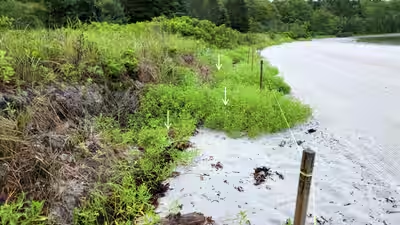
Floating wetlands slash wastewater greenhouse gas emissions Installing a floating wetland planted with native vegetation on an Australian municipal wastewater lagoon cut methane emissions by up to 66 per cent, according to the results of a two-year field trial. Published on 25 August 2026 in the Journal of Environmental Management, the peer-reviewed study looked at…

Read More