










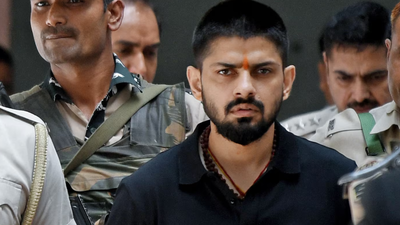
NEW DELHI: A Delhi court on Tuesday framed charges against gangster Lawrence Bishnoi under Maharashtra Control of Organised Crime Act (MCOCA) in a 2021 case concerning an alleged crime syndicate involved in extortion and kidnapping. The case will now proceed to trial.Justice Prashant Sharma noted that the “organised crime syndicate” was run by Sandeep, also known as Kala Jathedi, and his associates. “He, along with his associates are singly or jointly involved in the commission of several crimes,” the judge added. They also “accumulated wealth by means of extorting from different people by the use of violence or threat or intimidation or coercion,” the court noted.Charges under MCOCA and the Arms Act have been framed against 19 others also. — Sampat Nehra, Jagedeep, Rajkumar Basodi, Ravider Singh, Naresh Sethi, Priyavrat, Anil Rohila, Rahul, Sachin, Akshay Antil, Virender Pratap, Sandeep Jhanjhariya, Deepak, Bintu, Keshav, Kashish, Prityavrat Fauzi, Omprakash Dagar, and Naresh Kumar.The case goes back to March 16, 2021, when a proposal to invoke MCOCA was initiated, followed by the registration of an FIR on March 30, 2021. A main chargesheet was filed on Sept 18, 2021., and supplementary chargesheets submitted on Oct 14, 2022, and May 13, 2024.The prosecution, led by Akhand Pratap Singh, said Jathedi ran the syndicate with associates including Lawrence and Sampat Nehra, and was continuously involved in crimes such as murder, extortion and kidnapping for financial gain.“From the statements of witnesses, it is clearly revealed that members of this crime syndicate are receiving hefty amount of extortion and protection money on behalf of this gang from local businessman, liquor shop owner, local shop owners,” the court noted. It further observed that the syndicate operated across Delhi, Haryana, Punjab and Rajasthan, fulfilling the requirement of “continuing unlawful activity” under MCOCA, with more than one charge sheet filed over the past decade.Detailing the modus operandi, the court observed that extortion money was used to procure arms and ammunition. It also took note of confessional statements of seven accused under Section 18 of MCOCA and recoveries that included pistols, live cartridges, eight grenades and an AK-series assault rifle from Priyavrat , also known as Fauji.Investigators pointed to an international network, with associates operating from Thailand, Canada and the United States after fleeing India on fake passports.Judge Sharma noted that the syndicate continued to operate from inside jail, using mobile phones to coordinate criminal activities.The defence argued that invoking MCOCA would amount to double jeopardy as some had already been chargesheeted in earlier cases. The court rejected this argument., clarifying that prior offences are in fact necessary to establish “continuing unlawful activity” and don’t bar prosecution under MCOCA.It was also contended that earlier FIRs weren’t jointly registered against all accused, but court dismissed this, holding that MCOCA assesses the syndicate “as a whole and not individual roles”, thus a single charge sheet against the syndicate is sufficient.The court eventually concluded that sufficient material was placed on record, including witness accounts and recoveries, to show that extortion proceeds were used to fund pecuniary gains. It held that these findings were adequate at this stage to proceed with trial under MCOCA.