









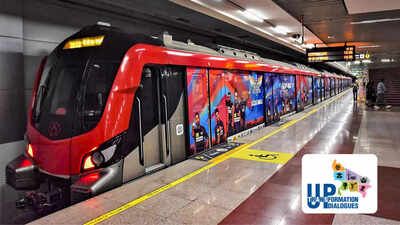
Lucknow has emerged as one of India’s fastest-growing state capitals and a major economic hub of northern India. Traditionally known for its rich cultural heritage and administrative importance, the city has transformed into a centre of investment, infrastructre and large-scale public investments. The ease of living in the city has significantly improved.Lucknow today contributes one of the largest shares to Uttar Pradesh‘s Gross State Domestic Product (GSDP), with its economy estimated at well over Rs 3 lakh crore, driven primarily by the services sector, real estate, finance, IT/ITES, healthcare, tourism, and trade. The city has consistently attracted substantial investment proposals through the Uttar Pradesh Global Investors Summit, while its start-up ecosystem and industrial clusters continue to expand. With world-class infrastructure, rapid urbanisation, and rising per capita income, Lucknow is increasingly positioning itself as a modern economic powerhouse and an important driver of Uttar Pradesh’s aspiration to become a one- trillion-dollar economy. It all happened under the leadership of Chief Minister Yogi Adityanath since March 2017.Lucknow has undergone a significant transformation in infrastructure, particularly in urban mobility. The Lucknow Metro’s initial North-South corridor sections were inaugurated in 2017, marking the beginning of modern mass rapid transit in the city. Further progress includes government approval for the East- West corridor (Charbagh to Vasant Kunj) at an estimated cost of around Rs5,800–5,881 crore, with additional extension proposals (such as towards Barabanki).Complementing the metro is the major redevelopment of Chaudhary Charan Singh International Airport. A new Terminal 3 was inaugurated inMarch 2024, featuring modern amenities and cultural design elements. Runway extensions (to approximately 3,500 metres), parallel taxiways, and substantial private investments (around Rs10,000–10,700 crore by Adani Airports) have significantly boosted capacity and enabled wider-body aircraft operations, turning Lucknow into a stronger aviation hub.Road connectivity has also improved dramatically. The Lucknow-Kanpur Expressway and integration with the state’s expanding expressway network have reduced travel times, enhanced logistics, and strengthened Lucknow’s position as a central node linking western and eastern Uttar Pradesh. These projects form part of Uttar Pradesh’s emergence with one of India’s largest expressway networks, directly benefiting the capital’s economic linkages and daily commuting.Economically, Lucknow has strengthened as a key node in the Uttar Pradesh Defence Industrial Corridor. The Lucknow node has attracted investments exceeding Rs1,400 crore, including major projects by BrahMos Aerospace for missile systems and other aerospace manufacturing units. Combined with state-level policies for investment in IT, manufacturing, and related sectors, along with improved law and order, these developments have generated employment and positioned Lucknow as an emerging industrial and defence hub. The latest Green Corridor road project within the city is another landmark of the modern connectivity.Urban renewal and smart initiatives have enhanced the city’s livability and aesthetics. The Gomti Riverfront has evolved into a vibrant public space with promenades, parks, and recreational facilities, offering residents improved access to green and leisure areas.As part of the Smart City Mission, Lucknow has implemented an Integrated Command and Control Centre, smart traffic systems, and other digital initiatives, contributing to better civic services and higher rankings in cleanliness and urban governance parameters. Overall, these changes reflect a broader shift toward better governance, safety, and citizen-centric development. Improved law and order, digital governance, and welfare delivery have made Lucknow a safer and more efficient city, supporting its transition from a traditional administrative centre to a modern, connected, and investment-friendly capital.Education and skill development have seen notable advancements in Lucknow. The city has benefited from expanded higher education infrastructure, including upgrades to medical colleges and technical institutions as part of the state’s broader push in medical education and polytechnics. Initiatives like Operation Kayakalp improved basic facilities in government schools, while new skill development centres and IT-related training programmes have aligned with Lucknow’s emerging role in technology and defence sectors, preparing the youth for better employment opportunities in a growing economy.Healthcare infrastructure has strengthened considerably. Lucknow has witnessed the addition and modernisation of medical facilities, emergency complexes, and specialised centres. As the state capital, it has gained from Uttar Pradesh’s focus on increasing medical seats, establishing new super- specialty units, and improving primary healthcare delivery. These efforts have enhanced access to quality medical services for residents and positioned Lucknow as a regional healthcare hub. Cultural heritage preservation and tourism promotion have transformed Lucknow’s identity.The government has emphasised restoring and promoting historical sites, Nawabi-era monuments, and cultural landmarkswhile integrating them with modern amenities. Events, improved connectivity, and riverfront developments have boosted tourism, making the city more attractive to visitors and contributing to local economic growth through hospitality.Lucknow’s tourism sector has significantly boosted due to focused heritage preservation and infrastructure integration. Iconic sites such as the Bara Imambara, Chota Imambara, Rumi Darwaza, and Kaiserbagh complex have seen restoration efforts, improved lighting, visitor amenities,and digital interpretation to enhance the visitor experience while preserving Nawabi-era grandeur. The development of the Gomti Riverfront as a recreational and cultural promenade, coupled with better air and road connectivity via the expanded airport and expressways, has made the city more accessible.Promotion of Lucknow’s unique cuisine, handicrafts (like chikankari), and cultural festivals has attracted both domestic and international tourists, contributing to local livelihoods and reinforcing the city’s identity as a vibrant heritage destination.Housing, environment, and smart governance initiatives have improved overall livability. Under schemes like Pradhan Mantri Awas Yojana, significant progress has been made in providing affordable housing and slum redevelopment. Environmental efforts include green spaces, wastemanagement under Smart City projects, and river rejuvenation. Digital platforms for e- governance, grievance redressal, and municipal services have reduced corruption and enhanced transparency, with Lucknow Municipal Corporation achieving high rankings in cleanliness and urbanmanagement.These additional developments, building on infrastructure and economic gains, reflect a comprehensive approach to turning Lucknow into a more liveable, sustainable, and progressive capital over the past nine years.Prior to 2017, Lucknow, like much of Uttar Pradesh, grappled with a notorious reputation for high crime rates, political patronage to criminal elements, and a general sense of insecurity often described as “goonda raj.” Organised crime syndicates, frequent instances of extortion, land mafias, and sporadic communal tensions created an environment where daily life for ordinary citizens was marked by fear, especially for women and business owners.Safety and law and order in Lucknow have undergone a transformative improvement, making it markedly safer for residents and visitors alike. Strict enforcement against organised crime, mafia networks, and encroachments, combined with transparent police recruitment, increased patrolling, and widespread deployment of CCTV cameras through Smart City initiatives, has led to a noticeable decline in criminal incidents. Women now report feeling more secure to move freely, including during night hours, while swift action on complaints and digital grievance systems have restored public trust. This enhanced sense of security has been pivotal in attracting investments, boosting tourism,and elevating the overall quality of urban life in the capital.