






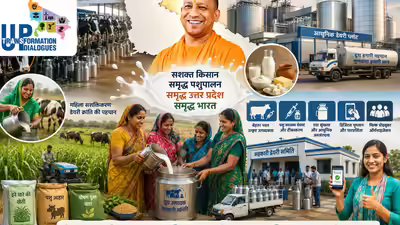
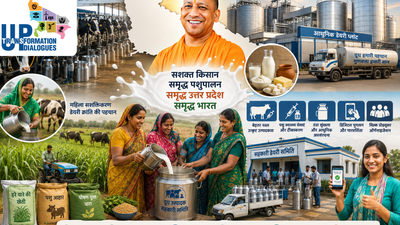
The milk production of 277 lakh tonnes in 2016–17 to around 388 lakh tonnes in 2024–25, continued leadership with roughly 16 percent of India’s milk output, the Rs 1,000-crore Nand Baba Dugdh Mission, and NDDB-backed women-led milk producer companies across Bundelkhand, Purvanchal, Awadh, Gorakhpur and the Terai – these are some of the achievements which may be listed as part of the White Revolution in Uttar Pradesh during the last nine years.Uttar Pradesh has made significant progress towards building a modern, technology-driven and farmer-centric dairy economy. Through policy reforms, infrastructure expansion, investment promotion, breed improvement, animal healthcare, cooperative strengthening and women’s participation, the state has laid the foundation for a new phase of the White Revolution. The well meaning policy formulation and steely political will negated the challenges such as low productivity of indigenous cattle, fodder shortages and climate-related stresses remain. The broad direction of policy has shifted from merely increasing milk production to building an integrated dairy value chain that benefits producers, processors and consumers alike.As India’s largest milk-producing state, Uttar Pradesh is well positioned to lead the next generation of the country’s dairy revolution. If current reforms continue with sustained investment in technology, processing, quality improvement and market access, dairy farming will remain one of the strongest engines of rural prosperity, women’s empowerment and agricultural growth in the state.Uttar Pradesh has long been India’s largest milk-producing state, contributing nearly 16 percent of the country’s total milk production. However, until a decade ago, the state’s immense dairy potential remained largely underutilised due to fragmented procurement systems, inadequate processing capacity, poor cold-chain infrastructure, low productivity of cattle, and limited market access for small dairy farmers.Over the last nine years, the Yogi Adityyanath government has sought to transform this landscape through a multi-pronged strategy that combines infrastructure development, policy reforms, investment promotion, breed improvement, animal healthcare, women’s empowerment, cooperative strengthening and private sector participation. The objective has been not merely to increase milk production but to create a sustainable dairy economy capable of enhancing rural incomes, generating employment, improving nutrition and contributing significantly to the state’s economy.Today, dairy farming has emerged as one of the most reliable supplementary sources of income for millions of rural households in Uttar Pradesh. With most dairy farmers owning two to five cattle, milk production has become a daily source of cash flow unlike seasonal crop income.Dairy: The backbone of rural livelihoodAnimal husbandry contributes significantly to Uttar Pradesh’s agricultural economy. Dairy farming provides year-round employment, particularly to women, landless labourers and marginal farmers.Recognising this potential, the government has integrated dairy development with its broader agenda of doubling farmers’ income, women’s economic empowerment and rural prosperity.The strategy rests on five major pillars:
- Increasing milk production through scientific animal husbandry.
- Expanding organised milk procurement.
- Building modern dairy infrastructure.
- Encouraging private investment.
- Improving value addition through processing and milk products.
Uttar Pradesh Dairy Development and Milk Products Promotion Policy, 2022One of the biggest initiatives during the last nine years has been the launch of the Uttar Pradesh Dairy Development and Milk Products Promotion Policy, 2022, which seeks to make the state a major dairy processing hub. The policy aims to attract investments of around ₹5,000 crore, expand milk processing capacity, ensure remunerative prices for milk producers and raise milk processing levels substantially.The policy offers an attractive package of incentives including:
- Capital subsidies for establishment and expansion of dairy processing units.
- Interest subsidies on loans.
- Stamp duty concessions.
- Incentives for cold-chain infrastructure.
- Support for cattle-feed manufacturing units.
- Assistance for quality certification such as ISO, HACCP and food safety standards.
- Patent and design registration support.
- Skill development and manpower training.
These incentives are intended to encourage investment in milk processing plants, cheese, butter, ghee, paneer, yoghurt, ice cream and other value-added dairy products.Strengthening cooperative dairy networkThe Pradeshik Cooperative Dairy Federation (PCDF) has undergone significant strengthening during the past nine years.Parag Milk has expanded its procurement network, connecting thousands of village dairy cooperative societies with organised markets. Farmers now receive transparent payments directly into their bank accounts, reducing dependence on middlemen.Modern milk collection centres equipped with electronic milk analysers have improved transparency by accurately measuring both quantity and quality.The cooperative system has also expanded chilling centres, bulk milk coolers and transportation facilities, reducing spoilage and improving milk quality.Expansion of milk processing infrastructureOne of the major achievements has been rapid expansion of milk processing infrastructure.Several dairy plants have been modernised while new plants have been established with greater processing capacities.Modernisation includes:
- Automatic milk processing lines.
- High-capacity chilling facilities.
- Packaging plants.
- Quality testing laboratories.
- Refrigerated transportation.
Expansion of processing capacity enables farmers to sell larger quantities while ensuring better quality products for consumers.Promotion of private investmentAlongside cooperatives, the government has encouraged private investment in dairy processing.Large dairy companies have expanded procurement operations in Uttar Pradesh.The state’s dairy policy provides a favourable investment climate by offering fiscal incentives, easier approvals and infrastructure support.Private participation has increased competition for milk procurement, resulting in better prices for farmers while improving processing and marketing efficiency.Scientific breed improvementImproving productivity of cattle has remained a key focus area.The government has promoted artificial insemination,high genetic merit semen,indigenous breed conservation,cross-breeding programmes and embryo transfer technology in selected projects.Breed improvement aims to increase average milk yield per animal rather than merely increasing cattle numbers.Higher productivity translates directly into higher farmer incomes.National programmes supporting dairy growthThe state has effectively implemented several Central Government programmes, including Rashtriya Gokul Mission, National Livestock Mission,National Programme for Dairy Development,Livestock Health and Disease Control Programme and Dairy Infrastructure Development initiatives.These programmes have strengthened breeding services, disease control, fodder development and dairy infrastructure.Animal healthcare revolutionHealthy animals produce more milk.Accordingly, the government has substantially expanded veterinary healthcare services through:
- Mobile veterinary units.
- Vaccination drives.
- De-worming campaigns.
- Artificial insemination centres.
- Disease surveillance.
- Infertility camps.
- Emergency veterinary services.
Mass vaccination against major diseases such as Foot and Mouth Disease and Brucellosis has reduced livestock losses and improved productivity.Strengthening fodder availabilityRecognising that nutrition accounts for a major share of milk productivity, the government has encouraged:
- Green fodder cultivation.
- High-yield fodder varieties.
- Silage preparation.
- Balanced cattle feed.
- Mineral mixture distribution.
Awareness campaigns have promoted scientific feeding practices among dairy farmers.Women at the centre of the white revolutionPerhaps the most remarkable aspect of Uttar Pradesh’s dairy transformation has been women’s participation.Self-Help Groups under the rural livelihood mission have increasingly entered dairy farming.Women now manage milk collection centres, producer organisations, dairy cooperatives and household dairy enterprises.The success of women-led milk producer organisations in eastern Uttar Pradesh illustrates this transformation. Thousands of women now supply milk daily, earning regular monthly incomes while several have become “Lakhpati Didis” through dairy entrepreneurship.Milk producer organisationsThe government has promoted Milk Producer Organisations (MPOs) on the pattern of successful dairy cooperatives.These organisations aggregate milk from thousands of small producers, improving bargaining power and ensuring better market access.They also provide:
- Veterinary services.
- Feed supply.
- Extension support.
- Financial literacy.
- Capacity building.
The collective model significantly reduces marketing costs for farmers.Dairy entrepreneurshipYouth are increasingly viewing dairy farming as a profitable enterprise.Government support has encouraged:
- Commercial dairy farms.
- Dairy-based start-ups.
- Value-added milk products.
- Organic dairy.
- Cattle-feed manufacturing.
- Dairy logistics.
Banks have also extended credit under various livestock financing schemes.Integration with rural developmentThe dairy sector has been integrated with multiple government programmes.Beneficiaries of rural livelihood missions, self-help groups, housing schemes and rural development initiatives are increasingly linked with dairy-based livelihoods.This convergence has helped poor families diversify income sources.Digital payments and transparencyTechnology has improved transparency across the dairy sector.Electronic milk testing ensures quality-based pricing.Digital procurement records reduce disputes.Direct Benefit Transfer (DBT) ensures timely payment directly into farmers’ bank accounts.Digital monitoring has strengthened accountability across procurement operations.Cold chain developmentMilk is a highly perishable commodity.The government has therefore invested in:
- Bulk milk coolers.
- Village chilling centres.
- Refrigerated transportation.
- Cold storage infrastructure.
Improved cold-chain facilities reduce wastage while enabling farmers in remote areas to participate in organised dairy markets.Value additionRather than selling only liquid milk, Uttar Pradesh is increasingly promoting value-added dairy products such as:
- Paneer.
- Cheese.
- Butter.
- Ghee.
- Yoghurt.
- Flavoured milk.
- Ice cream.
- Milk powder.
Value addition increases profitability for processors while generating employment.Support for dairy industriesThe Dairy Development and Milk Products Promotion Policy also provides incentives for:
- Cattle-feed industries.
- Milk packaging.
- Food safety certification.
- Export-oriented processing.
- Quality laboratories.
These measures strengthen the entire dairy value chain.Employment generationThe White Revolution has generated employment across:
- Dairy farming.
- Milk collection.
- Transportation.
- Veterinary services.
- Feed manufacturing.
- Processing industries.
- Marketing.
- Cold-chain logistics.
Every expansion in milk production creates opportunities across multiple sectors.Nutrition securityThe growth of dairy production has also strengthened nutritional security.Greater availability of milk contributes to better intake of protein, calcium and essential nutrients.This has important implications for child nutrition and public health.Contribution to rural economyUnlike crop agriculture, dairy provides daily income throughout the year.Regular cash flow enables farmers to:
- Meet household expenses.
- Finance children’s education.
- Access healthcare.
- Invest in better livestock.
- Reduce dependence on informal borrowing.
For millions of small farmers, dairy has become an effective hedge against crop failures and market fluctuations.Future roadmapThe next phase of Uttar Pradesh’s dairy revolution is expected to focus on:
- Expanding organised milk procurement.
- Increasing milk processing capacity.
- Promoting export-quality dairy products.
- Improving indigenous breeds.
- Climate-resilient livestock management.
- Digital livestock services.
- Expansion of women-led dairy enterprises.
- Integration with the national ‘White Revolution 2.0’ initiative, which seeks to expand dairy cooperatives and increase organised milk procurement across the country.