









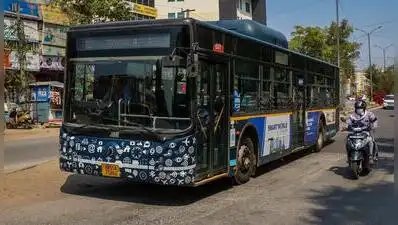
Gurgaon: The city bus service has lost more than 83 lakh passenger trips over the last three financial years, with annual ridership falling from 3 crore in 2022-23 to 2.2 crore in 2025-26.The decline has also impacted fare collections: annual ticket revenue dropped by nearly Rs 12 crore over the same period, an RTI reply from Gurgaon Metropolitan City Bus Ltd (GMCBL) shows. The decline in ridership assumes significance as GMCBL is currently undertaking a citywide route rationalisation exercise ahead of the rollout of 200 electric buses. Gurgaon resident Aseem Takyar had filed the RTI query.While the RTI reply does not specify the reasons behind the decline, a GMCBL official told TOI, “Ridership was affected as services on some routes had to be temporarily suspended due to poor road conditions. The disruption reduced connectivity for commuters travelling to several peripheral areas, impacting overall passenger numbers. With services being restored, we expect ridership to improve in the coming months.”The RTI shows that the city’s bus network carried 3,09,78,091 passengers in 2022-23. Ridership remained almost unchanged at 3,09,51,397 in 2023-24 before declining to 2,82,83,549 in 2024-25 and further to 2,26,25,432 in 2025-26, marking a decline of 83.5 lakh passenger trips, or about 27%, over three years.The fall in commuters has been mirrored in fare collections. Revenue from ticket sales stood at Rs 49.1 crore in 2022-23 and Rs 49.6 crore in 2023-24 before dropping to Rs 45.3 crore in 2024-25 and Rs 37.4 crore in 2025-26. Overall, the city bus service recorded a decline of nearly Rs 11.7 crore in annual ticket revenue during the period.The RTI also provides route-wise details of the city bus network, showing the deployment of buses across 32 routes connecting key residential, commercial and industrial areas of Gurgaon as well as adjoining towns such as Manesar, Sohna, Farrukhnagar and Ballabhgarh. GMCBL currently operates 150 city buses, while another 200 electric buses are proposed to be inducted in phases.Among the busiest corridors in terms of fleet deployment in the RTI data is the IFFCO Chowk Metro Station-Dhana More route, which was allocated 26 buses. The Basai Chowk-HUDA City Centre circular route had 20 buses, while the Millennium City Centre Metro Station-Maruti Kunj route operated 14 buses. Several routes, however, were served by only one or two buses, including services to Gurgaon University, Dhorka, Business Zone Sector 50 and Behlpa village.The RTI also provides a snapshot of the service’s growth since its launch in Sept 2018. After carrying 26.7 lakh passengers during its first seven months of operation in 2018-19, annual ridership rose to 1.9 crore in 2019-20 before falling to 1.2 crore during the Covid-19 pandemic in 2020-21. The service recovered to 2.1 crore passengers in 2021-22 and crossed the three-crore mark over the next two financial years before witnessing the recent decline.For the current financial year, GMCBL buses carried 31.4 lakh passengers during April and May 2026, generating Rs 5.4 crore in fare revenue, according to the RTI. “The objective is to optimise the existing network using ridership data, improve last-mile connectivity and create a more accessible and commuter-centric public transport system,” the GMCBL official had earlier told TOI while announcing the expansion exercise. The initiative aims to analyse commuter demand, redesign routes and optimise bus deployment to better match passenger needs.