








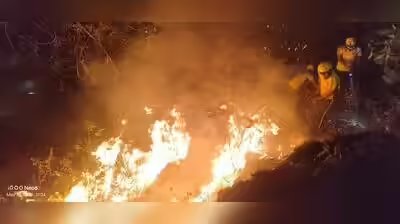
Gurgaon: An unusually high number of satellite-detected fire alerts in Haryana over the past six months has renewed concerns over the state’s green cover.Global Forest Watch (GFW), a platform that monitors forest change and active fires using satellite imagery, recorded 177 high-confidence visible infrared imaging radiometer suite (VIIRS) fire alerts in Haryana’s forest areas between June 2025 and June 2026 — nearly double the historical average of 91 for the same period since 2012. However, what is alarming is that of the 177 fires, 157 were reported from Jan-June this year.Notably, this count excludes crop fires, which typically spike in winter months and are tracked separately.The alerts do not necessarily indicate forest fires. Nasa’s VIIRS system detects all active heat sources — across forests, scrublands, grasslands and agricultural land — and ground verification is required to confirm the cause and location of each alert. That said, repeated fires regardless of origin can degrade soil quality, fragment wildlife habitats, damage regenerating vegetation and increase carbon emissions, even without extensive tree cover loss.Haryana’s peak fire season typically begins in mid-Sept, driven by post-harvest crop residue burning. A late-June spike of this scale points to fire sources beyond agricultural activity — likely scrublands, grasslands or degraded forest patches that are more vulnerable during dry summer months.Long-term data shows fires have accounted for 39 of the 459 hectares of tree cover lost in Haryana between 2001 and 2025 — roughly 8.5% — with the remaining 420 hectares lost to other drivers. The worst single year for fire-related loss was 2012, when seven hectares were destroyed, accounting for 14% of that year’s total tree cover loss in the state.Haryana has limited natural forest cover and a landscape characterised by fragmented green patches, making what remains disproportionately vulnerable to repeated burning.“These alerts should be treated as an early warning rather than dismissed because they occur outside the traditional fire season. Repeated burning, whether in forests, scrublands or adjoining areas, weakens ecosystem resilience, affects biodiversity and hampers natural regeneration. The unusual June spike warrants field verification to identify the source of the fires and prevent further damage,” said Sunil Harsana, ecologist and wildlife conservationist.