







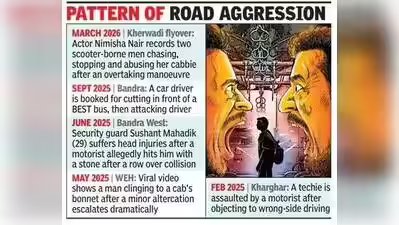
* Naresh Waghela (63) was beaten to death this April under the Dadar TT bridge after he requested the driver of a car not to park at the location. The driver summoned the vehicle owner and they rained kicks and blows on him.* Motorcyclist Shariq Ansari (25) was killed in a clash with a cab driver on Malad Link Road after the duo had a spat over driving in March.* In Feb, junior college teacher Alok Kumar Singh was stabbed to death in a train coach by a co-traveller over an argument on alighting.Mumbaikars, whether on roads or in railways, seem angry all the time, with trivial arguments having the potential to snowball into violence. Experts said extremely crowded transportation systems, infrastructure bottlenecks and daily stress at work or home are transforming minor friction into violent clashes.“There is so much frustration around travel alone. The bus fleet has gone down. So, there are longer queues at bus stops. Trains are impossibly crowded most of the time. And Metros do not seem to be solving the issue. Newer and swankier office buildings come up with no thought given to how employees will commute,” said former IPS officer-turned-lawyer Y P Singh.When commuters are already burdened by work-related or financial anxieties, irritants such as a fellow commuter playing social media reels can erode tolerance in confined spaces. On the railways, high density loads force close body contact where an accidental push can be perceived as deliberate, sparking arguments that can escalate.In June 2025, a viral video captured an incident inside the women’s compartment of a Central Railway train where an argument over being “elbowed” while boarding escalated into a full-blown fight. The video showed women exchanging blows, pulling each other’s hair and hurling expletives.Psychologists and public health researchers have long warned that crowded, unpredictable commuting environments can trigger intense stress responses that affect a person’s behaviour and decision-making.According to a Harvard University publication, stress activates the body’s ‘fight or flight’ response, releasing hormones that increase heart rate, heighten alertness and prepare a person to react to perceived threats. While this mechanism evolved to deal with danger, modern stressors such as traffic congestion, overcrowded trains, delays and uncertainty could trigger the same physiological response.A research paper published in ‘Frontiers in Sociology’ last year found that overcrowding, invasion of personal space, noise, heat, unpleasant surroundings and service disruptions contribute to frustration, emotional tension and anxiety among commuters. Long commutes are also linked to “time poverty”, poor sleep, psychological exhaustion and lower life satisfaction. Researchers have identified anger as a common response in transport settings, particularly when people encounter congestion, perceived unfairness or conflicts over limited space.Prof Dr Bhaskar Shah of Somaiya Medical College and Hospital said Mumbai’s rising road rage may also reflect broader pressures. “There is too much rage on Mumbai’s roads, perhaps brought on by financial, job-related and personal stress. People live in small houses and often don’t have space to relax or recharge,” he said.He said repeated exposure to aggressive social media content may leave some psychologically vulnerable individuals overstimulated, making them more prone to impulsive and rage-filled reactions when confronted by minor triggers.Prevention may be key, according to former DGP Pravin Dixit. “Railways must have access control and turnstile gates with mandatory frisking and baggage checks at least at major stations. This will ensure lethal weapons, such as the knife used in the train murder, can get detected,” he said.On the roads, he said inclusive street design, better signage and strict enforcement on violations like wrong-side driving can reduce collisions.