









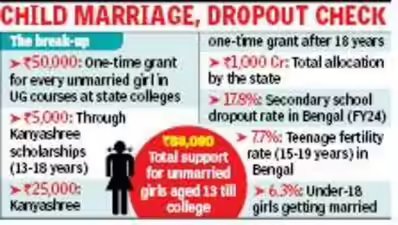
Kolkata: In a fresh drive to discourage child marriage and improve female participation in higher education, the Bengal govt on Monday announced a one-time financial assistance of Rs 50,000 for every unmarried girl student enrolling in undergraduate courses at govt and govt-aided colleges across the state.“To reduce the dropout rate of girls from higher education, a scheme will be implemented for girl students at the time of admission to UG courses at govt and govt-aided colleges. Under this scheme, one-time support of Rs 50,000 will be provided to unmarried girls,” Dasgupta said in his budget speech.Dasgupta said the govt would earmark Rs 1,000 crore for the initiative.The announcement comes amid concerns over educational discontinuation among young women and the persistence of child marriage in parts of Bengal. While official figures on college dropouts are not available, data from the ministry of education showed that Bengal recorded a secondary school dropout rate of 17.8% in FY24.The scheme also seeks to address social indicators linked to early marriage and adolescent motherhood. According to recent demographic data, Bengal continues to face significant challenges on both fronts. Bengal tops the chart in teenage pregnancy with 7.7% fertility rate in the 15-19-year age bracket. At 6.3%, it has the highest number of women marrying before turning 18.Age-specific fertility rate in the age group 15-19 years, which is also known as adolescent birth rate (ABR), is 10.9 at the national level for the year 2024. Bengal had the highest ASFR for 15-19 years or ABR of 22.9, followed by Assam (18.1) and Jharkhand (17.2), while NCT of Delhi (2.6) and Jammu & Kashmir (3.3) had the lowest ABR followed by Keralam (4.5) and Uttarakhand (4.6).An official said the new assistance programme expanded the state’s existing efforts to support girls’ education. Bengal’s flagship Kanyashree Prakalpa, introduced by the previous Trinamool govt, which had received international recognition, was also introduced to prevent child marriage and encourage girls to remain in school. Under that scheme, unmarried girls aged between 13 and 18 years received an annual scholarship of Rs 1,000, while those who continued their education after turning 18 were eligible for a one-time grant of Rs 25,000. Officials said the new Rs 50,000 grant is intended to complement Kanyashree, which means from the age of 13 till college, an unmarried girl will receive a grant of Rs 80,000.Education experts have long argued that direct financial support can play a crucial role in improving college enrolment among girls, particularly those from economically weaker households. Saswata Ghosh, associate professor at Institute of Development Studies, Kolkata, said, “Incentive can be a part to arrest the rising number of child marriage cases but to curb child marriages, community awareness and movements are essential. MP’s ‘Lado Abhiyan’ can be a model here.”