









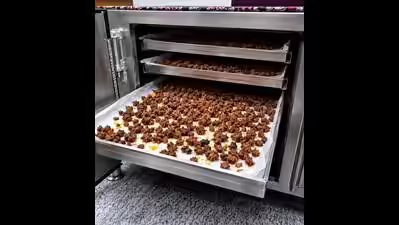
The curious business of food dehydration and freeze-drying has gone up in direct proportion to the number of Indian students filling college campuses across the world – 14 lakh and rising, according to government reports. Concerned that their offspring might abandon their eggless upbringing, anxious mothers now routinely send food to these little factories – that have sprung up in Mumbai, Ahmedabad, Sonipat, Delhi — many of which even organise the courier service. Playing surrogate to actual home food, companies like Avarya and DryM Foods, started by a mother-daughter team, package their own branded ‘home-style’ and ‘mummy wala khana’.Mumbai’s Shreya Shah explains: “Moisture is what leads to the microbial growth which causes food spoilage, so when we take out the moisture, the food can last for a year or more without preservatives.” She needs a minimum of 12 hours to dehydrate food, depending on the water content. “One customer was so concerned about ‘fresh fresh’, she insisted I do the entire batch before sunset.”Navi Mumbai resident Parul Patel says that she regularly sends food to her son who is doing his medical residency in a rural Republican town in South Carolina, US, where most residents have never sampled Thai curry, let alone an Indian dish. “He comes home late, and so tired, where he’ll manage to cook? I know how much he loves my home food,” she says.Some vegetables don’t dehydrate well. For example, potatoes have got mixed reviews as many find that the texture is not the same when rehydrated. Paneer cubes come out chewy or coarse, but shredded paneer goes down well. Pav bhaji is a staple as are all the lentils and sambhar. Recently, Patel did some research and found out that freeze-drying is better than dehydration — for taste, texture as well as nutritional content. “So, this year, I managed to send him aamras,” she adds, beaming widely. Because mango pulp contains water, sugar and volatile compounds, dehydration tends to turn it into a leathery fruit sheet, whereas freeze-drying retains the magical Alphonso aroma and allows it to be reconstituted into something closer to fresh aamras.Indeed, the ‘lyophilization’ or freeze-drying technology which NASA once developed to feed astronauts in space, is now increasingly being deployed by Indian mothers who are eternally suspicious of the foreign cafetaria. Freeze-drying is more expensive than dehydrating, but it does preserve flavour and retains more nutrients. Both methods remove water from the food, but while dehydration uses heat, freeze-dried food is frozen solid, placed in a vacuum chamber, and the ice turns directly into water vapour, bypassing the liquid stage.This is what prompted Mumbai resident Amit Chheda, proprietor of My Taste My Meal, to get into this business. Chheda had been running a basic courier business. One day, a group of doctors with children studying abroad suggested that he courier dehydrated food. The success of the business, especially during Covid, led him to create his own brand of packaged dehydrated foods. A few years ago, he invested in a freeze-drying machine. Today, the machine can do 200 kg of food per day during peak season, which is April-May (summer vacation) as well as August-September. Business has been growing at 20% annually, he says. The US, Canada and the UK are the primary destinations, but of late parents are sending food packages – and even Thums Up — to colleges in the Netherlands and Germany, which are becoming popular options. “Recently there was a family going for Hajj. They said their aged parents were vegetarian so they asked us to dehydrate some daal-rice for them.” Besides non-veg food, the only thing they don’t take on is sugary items because the sugar gets stuck.“Frankly, I find all this absurdly amusing,” says acclaimed food writer Pushpesh Pant. “Dehydrated daal-dhokli? Avial? Amti? Alu vadiyan? The thought is revolting. I draw the line at some special heirloom pickles and sweets with a long shelf life.”