








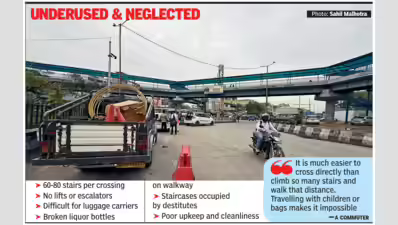
Gurgaon: Nearly a year after the elevated skywalk at Mahavir Chowk was made operational, the structure remains largely deserted. Hundreds of commuters continue to weave through moving traffic at road level, risking their lives and disrupting vehicular flow at one of Gurgaon’s busiest intersections.A TOI visit found pedestrians routinely crossing the carriageway despite the 230-metre skywalk overhead. The structure showed signs of neglect — broken liquor bottles scattered across the pavement, uncleaned stretches of the walkway and destitute people occupying parts of the staircases.The design itself discourages use. To cross via the skywalk, pedestrians must climb 30-40 steps, walk over 200 metres along the elevated corridor, then descend another 30-40 steps on the other side. For commuters carrying luggage from the nearby Haryana Roadways bus stand, or travelling with children, the route is simply too cumbersome. Planned lifts could not be installed due to non-availability of land, leaving staircases as the only means of access.Mahavir Chowk is a critical traffic node where roads leading to NH-8, Old Delhi-Gurgaon Road and Mehrauli-Gurgaon Road converge, with heavy pedestrian movement generated by the bus stand, auto-rickshaw stands, markets and vending zones. Yet commuters overwhelmingly choose the shortest route.“It is much easier to cross directly than climb so many stairs and walk that distance. Travelling with children or bags makes it impossible,” said Mohd Tasleem, a commuter near the auto stand.Urban transport experts say the behaviour is predictable. Sewa Ram, dean (research) and professor of transport planning at School of Planning and Architecture, Delhi, says skywalks succeed only when they align with how people actually move.“Skywalks work best when they provide direct connections between destinations that naturally generate pedestrian movement — transport terminals, railway stations, airports. In such cases, people use them because they facilitate seamless transfers,” he said. “In Mahavir Chowk’s case, there is a mismatch between the infrastructure and actual pedestrian behaviour. People prefer crossing at surface level unless compelled otherwise. If traffic speeds allow them to find gaps, or autos and e-rickshaws drop them close to their destination, they will not take the longer elevated route.”Ram also flagged poor maintenance as a deterrent. “When such facilities are poorly maintained or see low footfall, people perceive them as insecure. Internationally, pedestrian infrastructure is increasingly designed around human behaviour — not the other way around.”Safety concerns compound the problem. “The skywalk has become a place where anti-social activities happen. People consume alcohol there. Women may not feel comfortable using a poorly maintained, unsurveilled space,” said Rajiv Agrawal, a Sadar Bazaar shop owner.Traffic police feel equally helpless. “Most pedestrians prefer crossing directly. We cannot force people to use a particular facility — our job is to regulate traffic. If the skywalk isn’t being used, the concerned agencies need to find out why,” a traffic police officer said.The Rs 25.9-crore Mahavir Chowk redevelopment project — comprising the skywalk, a 318-metre underpass and service roads — was approved in 2018 and executed by PWD with GMDA funding. Work began in 2020 after bureaucratic delays, and the project missed multiple deadlines due to underground utilities requiring relocation and a contractor halt in Oct 2023 over pending funds. The underpass opened in Nov 2022, and the skywalk followed last year.GMDA has acknowledged the concerns. “The structure was built as per IRC norms, but its utility has been limited. To increase usage, we may need to restrict at-grade crossings or improve accessibility. We will re-evaluate and examine how utility can be enhanced,” a senior official said.