









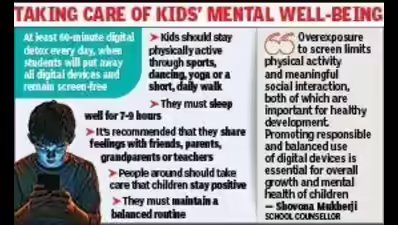
Kolkata: A new health and hygiene handbook introduced by the Council for the Indian School Certificate Examinations (CISCE) has underlined the importance of regulating screen time to protect students’ mental well-being.The handbook recommends a “digital detox hour” — a 60-minute period each day when students put away all digital devices and remain screen-free. “Use this time to read, draw, talk to family or spend time in nature,” the handbook advises, noting the practice can offer much-needed rest to the eyes, mind and emotions.Screen time among students rose sharply during the Covid-19 pandemic, when digital platforms became the primary mode of academic instruction in 2020 and 2021. In the post-pandemic period, however, reducing dependence on screens has emerged as a major challenge. Experts have repeatedly linked excessive screen use with concerns related to mental health and overall well-being.The handbook is prepared to guide affiliated schools in promoting healthy habits among students. It also asks school heads to sensitise students, teachers, and parents about physical and mental wellness. A 24×7 toll-free mental health helpline number has also been included to support individuals experiencing stress, anxiety, depression or suicidal thoughts.Highlighting how overexposure to screen affects youngsters’ emotional health, the handbook points out that emotional distress may arise from social media comparisons, friendship-related issues, bullying, body-shaming, or excessive screen exposure. These can lead to loneliness, anxiety, sadness, reduced confidence, disturbed sleep, poor concentration and strained relationships, and may also point to deeper concerns, such as anxiety or depression.Several schools have already begun monitoring students’ screen habits more closely and encouraging them to take part in offline activities and spend more time with their families.“Our counsellors conduct life skill classes for children. It is a double-period class held once a week, where they guide students on how to utilise their time for better activities,” said The Heritage School principal Seema Sapru. “We teach them how to use the internet for meaningful and purposeful work instead of just for social media or watching reels. We give them project work every two to three days that they must complete at school. We always encourage them to build a reading habit and spend time with family, especially with parents and grandparents. We also remind parents from time to time not to give mobiles to their wards for personal use before a certain age.”National English School principal Mousumi Saha said, “Aligned with the CISCE ‘Health and Hygiene’ initiative, we have introduced the council’s module on responsible digital habits in our moral science classes to address mobile addiction and protect students’ well-being. This module has been shared across official parent WhatsApp groups to reinforce healthy digital boundaries at home.”School counsellor Shovona Mukherji said excessive screen time affected students’ concentration, sleep patterns, emotional well-being and academic performance. “It limits physical activity and meaningful social interaction, both of which are important for healthy development. Promoting responsible and balanced use of digital devices is essential for overall growth and mental health,” she said.Many countries have taken strong steps toward banning social media for children. Australia became the first country to ban social media for youngsters under 16, blocking access to several online platforms. China has already put a restriction on screen time for children and introduced app-specific rules, while Denmark, France, Germany, Greece and Britain plan to introduce similar measures shortly. Graphic—