







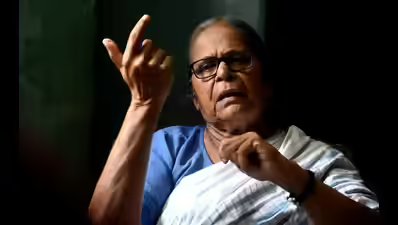
Chennai: Social activist Geetha V stands at the entrance of a crumbling old building at Pursaiwalkam in Chennai. Before the 74-year-old begins her day’s work, fighting for the cause of unorganised workers, she must first face her own uphill battle: two flights of steep, narrow stairs. Her ailing knees do little to help. Leaning on the railings, Geetha slowly makes her way up to the office of the Unorganised Workers Federation (UWF), which she founded more than two decades ago.“This used to be easier when I was younger. I would run up and down these stairs, catch buses, meet workers and govt officials to unionise them,” says Geetha, as she opens the door to a space that feels swallowed by files and petitions. The paint is peeling off the dark green walls; there is hardly any light or ventilation; the room is hot and sticky; the air smells of bleach, but neither Geetha nor her colleagues, all aged 70 or more, seem to notice.“We have been working out of this office for more than 26 years for unorganised workers, including sanitation workers, construction labourers, weavers, salt pan workers, agricultural workers and street vendors,” says Geetha. A former physics lecturer at Queen Mary’s College, Geetha began researching women in the construction industry, then turned to grassroots activism in 1979, when construction workers across Tamil Nadu began protesting unemployment, poor working conditions and a lack of social security. “I realised writing about their issues was not enough and joined the movement,” says Geetha. “Every member in this office sought solace here from the system that had been hard on them and came from underprivileged backgrounds themselves. We brought all our unions under one umbrella, UWF, in 2006.Leelavathi R is one of them. After years of toiling, Leelavathi and her husband, a construction worker, managed to build a home for themselves. But in 1994, their dreams were shattered. “We built a hut in a slum settlement in Bharathi Nagar, Koyambedu, but the govt decided to evict 400 families from there. We were among them. We had an idea of what to do. I had given up, and that’s when I met Geetha,” says the 73-year-old.Geetha and a group of people protested against the govt’s decision and fought for months. Seeing Geetha’s persistence, Leelavathi decided she was not going to be a silent spectator and joined the fight. “I participated in all the protests and helped write petitions to the govt. I eventually even got arrested. Though it was my first time, I wasn’t scared because I had a strong group of women and my husband supporting my decision to protest. After three months, we got our pattas,” says Leelavathi, who decided to help other women facing domestic issues, housing crises and workers’ rights, eventually joining the Penn Urimai Iyakkam wing of the federation. Every Friday, she would sort out domestic issues among families and counsel them. Over the years, she has helped Geetha draft several demands for workers, and later took on the role of UWF state secretary.During one such counselling session in 1996, Leelavathi met Kamala B from Pulianthope. “My husband was an alcoholic and used to fight with me over money. A grocer brought me to UWF to sort it out. They spoke to us and made sure my husband gave me Rs 500 every month. Soon, I realised the organisation would help a lot of women in my locality and could represent our issues; that’s what made me join,” says the 63-year-old.None of the women at UWF draws a salary. “We get an allowance of Rs 5,000 for transport, and since we all take autos, there is hardly anything left. If we need help with medicines, Geetha ma’am provides it for us and during festivals gives us clothes. Our office functions on donations; everything from the current bill we pay to the tea and coffee we drink is through donations,” says Kamala.However, all the work comes with its own challenges. Geetha says every administration she has seen over the years has always viewed the federation as a ‘political outfit’. “Whoever is in power thinks we’re paid by the opposition. We’re not anti-govt, we’re pro-workers, but the bureaucracy never understands that.”Over the years, says Geetha, UWF has helped slum residents resist evictions and access housing rights through protests, legal interventions, and mobilisation; worked with migrant workers, bonded labour survivors, and Irula and Narikuravar communities to provide access to welfare schemes; campaigned nationally for a central law protecting construction workers; and supported domestic workers’ unions in getting included under welfare frameworks.Today, the office is run by seniors who continue to advocate for workers. “We’re getting old and don’t know how much longer we can keep going,” says Kamala. “A few college students volunteer with us occasionally, but we need more young people to take this movement forward.”Got monsoon relief thanks to UWF, says salt pan workerFor decades, the Salt Pan Workers’ Union fought for better working conditions, a welfare board and monsoon relief assistance, until they began working with UWF in 2007. UWF helped them organise protests and demonstrations, leading to a breakthrough in 2022, when salt pan workers began receiving an annual monsoon relief payment of Rs 5,000, along with eye and medical check-ups, educational assistance, social security benefits and access to govt subsidies. For workers such as Kanimozhi Arumugam from Marakanam, the assistance brought some relief but addressed only part of their struggles. Earning about Rs 9,000 a month, the 48-year-old spends more than seven hours a day in the salt pans, exposed to heat, saline dust and UV radiation. “The heat burns our eyes. Most of us have vision problems,” she says.It gets more difficult during the monsoon when salt production comes to a halt. “We take up odd jobs to put food on the table,” says Kanimozhi. “The Rs 5,000 assistance helps us manage for a while.”